Which regions are the main production areas of matsutake mushrooms?
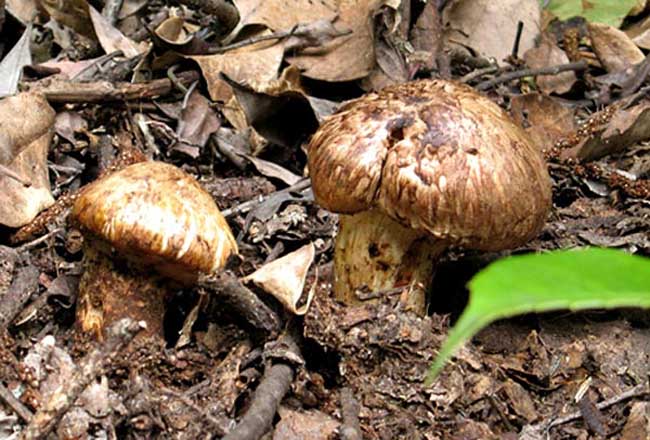
Matsutake mushrooms have extremely demanding requirements for their growing environment, and their growth process is also extremely slow, generally requiring 5-6 years. At present, there is no successful precedent for artificial cultivation anywhere in the world. Japan is at the forefront of research on artificial cultivation of matsutake mushrooms, and since research began in the early last century, artificial cultivation still cannot be achieved. Let's take a look at the distribution of matsutake production areas below!
Distribution of matsutake production areas
Matsutake is a species endemic to Asia, mainly distributed in Japan, the Korean Peninsula, and China's Shangri-La, Chuxiong, Yanbian, Taiwan, China, and other regions. It is reported that there are variants of matsutake in the United States and Europe, but the yield is low and the quality is poor. Among the global matsutake production areas, China's Shangri-La matsutake production area has the highest matsutake yield, accounting for about 70% of China's total matsutake output and 33% of the global total output annually.
1. Domestic production areas of matsutake: The main production areas of matsutake are the Yanbian region of Jilin Province, the Mudanjiang region of Heilongjiang, and Yunnan and Tibet, among other places.
2. International production areas of matsutake: The main international production areas of matsutake include Japan, North Korea, South Korea, Myanmar, the United States, Mexico, and other countries. The shape of matsutake is not completely the same in every country.
The production environment of matsutake
Matsutake has very demanding requirements for its production environment. It can only grow in virgin forests without any pollution or human intervention. Its spores must form a symbiotic relationship with the root systems of pine trees, and the age of the symbiotic tree species must be more than 50 years before mycelium and fungal beds can form. At the same time, it depends on broadleaf forests such as cypress and oak trees to provide nutritional support in order to form healthy fruiting bodies.
Before matsutake emerges from the soil, it must receive sufficient rain, and immediately after emerging it must receive sufficient light. In addition, factors such as temperature, insect damage, and damage to the mycelium caused by violent human harvesting also have a direct impact on the growth of matsutake. It can be said that the birth of every matsutake is a miracle of creation.
In recent years, global matsutake production has been declining year by year. China's average annual output of fresh matsutake is currently only 2,000 tons. Excluding old matsutake, young matsutake, damaged matsutake, and single-leaf forest matsutake from poor production areas, high-quality matsutake is less than 1,000 tons, which when fully processed into dried product is about 60 tons, much less than the output of cordyceps sinensis. Among them, matsutake longer than 16 cm is less than 1 ton. Some experts call for rapidly strengthening the protection of matsutake resources, because otherwise in the near future we will permanently lose this rare species, the matsutake.