Detailed Explanation of Agaricus blazei Cultivation Techniques and Management Key Points
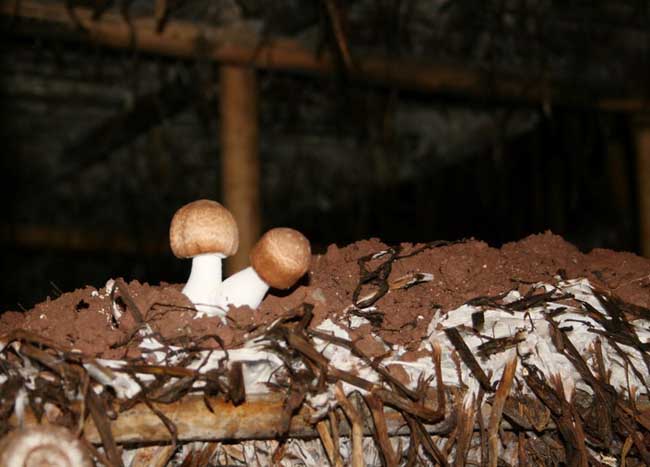
Agaricus blazei has been cultivated on a large scale in countries such as Japan, the United States, and Brazil. In Japan, cultivation uses the "mushroom house bed cultivation method," adding casing soil on top of compost made mainly from rice straw and sugarcane bagasse to form raised beds, sowing at the bottom of the beds, with mushrooms emerging after about 35-40 days. The fruiting period lasts 3-4 months, with each flush cycle lasting 10 days, producing about 10 kg of fresh mushrooms per sq m. China introduced Agaricus blazei from Japan in 1992. Currently, domestic production of Agaricus blazei is mainly concentrated in Fujian, where 1 sq m can yield more than 5 kg of fresh mushrooms.
Because Agaricus blazei has good export prospects and a high exchange rate, it is a new variety with development value. In the coastal plains of North China, planting can be chosen from early April to mid-May. Three-dimensional cultivation of Agaricus blazei in outdoor greenhouses saves labor and materials, requires low investment, gives high yields, is easy to manage, is convenient to operate, has strong heat preservation and moisture retention capacity, good light regulation and ventilation, simple technology, and a simple cultivation model. The cultivation methods and techniques of Agaricus blazei are basically similar to those of the button mushroom (Agaricus bisporus) and can be carried out by reference. Its cultivation techniques are introduced as follows:
Cultivation Materials
The most suitable cultivation material for Agaricus blazei is sugarcane bagasse. Rice straw, wheat straw, cottonseed hulls, corn stalks, thatch grass, sawdust, etc. can also be used as raw materials for cultivation. To one or a mixture of the above raw materials, appropriately add some cow manure (horse manure), poultry manure, and a small amount of chemical fertilizer.
For the cultivation materials of Agaricus blazei, refer to the button mushroom cultivation process; after stacking, fermentation, and turning, a compost suitable for the growth of Agaricus blazei is made.
Cultivation Season
According to the biological characteristics of Agaricus blazei, the cultivation season is generally arranged in late spring and early summer and in autumn. Spring cultivation is around Qingming (March-May), and autumn cultivation is after Liqiu (September-November). In low-altitude areas, sowing can be extended to April-May, with mushroom harvesting in June-July.
In short, it is best to ensure that after sowing, when mushrooms begin to emerge after 40-50 days, the temperature can reach 20-28°C. Climate conditions vary from place to place, so the sowing period should be flexibly determined.
Cultivation Techniques
Agaricus blazei spawn is also divided into three grades: mother spawn, stock spawn, and cultivation spawn, and can be produced according to the spawn-making method for the button mushroom. Mother spawn uses PDA medium; stock spawn and cultivation spawn generally use wheat grain medium.
1. Building the Stack
Soak rice straw and other straw materials or cottonseed hulls thoroughly in water. After pre-wetting, mix them fully with raw and auxiliary materials such as rice bran, sawdust, and livestock and poultry manure to build a stack. The top width of the material stack is 80-90 cm.
2. Turning the Stack
The pre-stacking time is about 7 days. When the material temperature rises to about 70-75°C, the first turning should be carried out. During turning, add ammonium sulfate or urea to the compost; with the help of microorganisms, it becomes a nitrogen source usable by Agaricus blazei through fermentation. During the pre-stacking period, the middle layer of the stack ferments better and has a higher material temperature, but the compost around the sides is not fully fermented. When turning, mix thoroughly, turning the middle-layer compost to the outer periphery and stacking the outer compost into the center of the stack.
After 5 days, carry out the second turning, then turn again at intervals of 4 days, 4 days, and 3 days (5 turnings in total, fermentation time 23-25 days). In order to make the inside and outside of the stack ferment evenly, when turning, the middle compost should be turned to the outside, and the outer compost should be stacked in the middle. After fermentation, the compost becomes brown; when the fibers break easily when pulled by hand, fermentation is complete. After composting and fermentation, the moisture content of the compost is about 60-75%. If the pH value is too high or too low, it can be adjusted with superphosphate or slaked lime. In order to make uniform, fully mature, high-quality compost, turning is a very important process and must not be careless.
3. Filling and Bedding
Agaricus blazei can be cultivated both indoors and outdoors. For indoor cultivation, 4-6 layers of shelf beds can be set up, or spacious mushroom houses and shelf beds can be used, spreading the fully mature compost evenly and neither too loose nor too tight on the mushroom bed, with a thickness of 20 cm being suitable. After the compost is put on the bed, carry out "secondary fermentation," that is, close the entrances, exits, and ventilation openings of the mushroom house, raise the temperature of the mushroom house to 55-60°C, maintain for about 2 days, and sow again when the material temperature drops to 25°C. Outdoor cultivation is carried out under a shade shed. The bed width is 1.3 m, and the length is arbitrary. The shade shed height is 2-2.3 m, and the top and surroundings are shaded with straw curtains and shade nets (requiring alternating light and shade). The raised bed is shaped into a turtle-back form, slightly higher in the middle than around the sides, and drainage ditches should be opened well. If cultivated in mountainous areas, flood-control ditches must also be opened. Spray the surface of the raised bed with chemical pesticides to kill pests. Then spread the fully mature compost onto the raised bed, generally 20-25 cm thick (calculated by dry material, about 16-20 kg of compost per sq m).
4. Sowing and Management
Gently break apart the wheat grain spawn, evenly scatter 2/3 on the surface of the compost, use a fork to shake appropriately so that the spawn falls into the material, scatter 1/3 on the bed surface, and finally cover with about 1 cm of compost to cover the spawn. The sowing rate per sq m is 1-2 bottles.
For outdoor cultivation, after sowing, cover the raised bed with plastic film to preserve heat and moisture. Generally, within 5 days after sowing, there is no need to uncover the film, nor to spray water; on the 6th day, uncover the film for ventilation. The relative air humidity should suitably be 85-90%; if the material surface is dry, spray water to preserve moisture. Under normal conditions, ventilate once every 2 days.
For indoor cultivation, also pay attention to changes in temperature and humidity in the mushroom house. Do a good job of heat preservation and moisture retention, and let more fresh air enter the mushroom house; do not let it feel stuffy and hot in the mushroom house every day.
5. Casing Soil
The time for casing soil is after seeing that the Agaricus blazei mycelium has survived in the compost. Generally about 20 days after sowing, when the mycelium has grown to 2/3 of the entire compost, begin casing soil. The quality of the soil particles covering the compost and the quality of the casing method have a very large impact on the yield of Agaricus blazei. Therefore, casing soil is a very important task in cultivation. The soil particles used for casing soil should not be too hard; large soil particles that contain no fertilizer, are fresh, retain water, and have good air permeability are best. In China, field subsoil is generally used, with a moisture content of 70-75%.
Casing soil can use a flat-spreading method or a "gear" method. That is, first cover the material surface with a layer of soil particles about 1 cm thick, and at intervals of 10-15 cm make a soil ridge 10 cm wide and 5 cm high, about 3-4 cm thick. For outdoor cultivation, insert bamboo or wooden strips on both sides of the raised bed into an arched shape, then cover with plastic film so that it grows in a microclimate. The temperature inside the covered film should suitably not exceed 30°C; if too high, the film should be uncovered to lower the temperature, and the relative humidity should not be lower than 85%.
6. Fruiting Management
Whether management during the fruiting period is appropriate or not can cause large increases or decreases in yield. Therefore, careful management is necessary. Agaricus blazei mycelium begins to fruit only after spreading through the compost. Generally about 40 days after sowing, the mycelium develops thick and strong, and a small amount climbs onto the upper layer. At this time, water should be sprayed on the raised bed surface; the relative humidity inside the covered film is required to be 90-95%, and after keeping the film covered for 2 days, white rice-grain-like mushroom buds will appear on the soil surface, then grow to soybean size. After 3 days, when the mushroom buds grow to 2-3 cm in diameter, stop spraying water to avoid deforming the mushroom (bud) bodies; this is the key to water management. During fruiting, a large amount of oxygen is consumed and carbon dioxide is released, so during the fruiting period, great attention must be paid to ventilation and air exchange. Uncover the film for ventilation 1-2 times daily, with each ventilation period not less than 30 minutes. After ventilation, continue covering the film to preserve moisture and promote normal growth of the mushroom buds. In rainy weather, the surroundings of the covered film can be lifted for ventilation and air exchange to prevent the mushroom buds from rotting.
The best temperature for the fruiting period is 20-25°C. If sown in early spring, the temperature during fruiting is relatively low, so the film can be tightly covered to preserve heat and moisture, and the ventilation time and frequency should be shortened. When the temperature in early summer exceeds 28°C, thicker shading materials can be added on the shade shed, and the film can be opened all day for ventilation and air permeability to create a cooler climate. For indoor cultivation, also pay attention to shading doors and windows, and ventilate in the morning and evening. The fruiting cycle is generally about 10 days. After fruiting ends, the shape of the bed can be modified, and then water can be sprayed to replenish the moisture of the raised bed, preparing for the next fruiting. Fruiting can continue for 3-4 months, and mushrooms can be harvested batch by batch (generally 4-5 batches). Water for spraying should preferably be well water or spring water.
Pest and Disease Control
Agaricus blazei has the ability to resist miscellaneous bacteria and is almost not attacked by harmful bacteria. However, great attention must be paid to ventilation and air exchange; do not let the mushroom house and bed surface become too wet. Harmful bacteria are often found before and after casing soil; when harmful bacteria occur, it is best to burn them off with a blowtorch.
The pests of Agaricus blazei include mushroom flies, mushroom moths, nematodes, etc. If post-fermentation is very complete, almost all pest occurrence can be prevented. If pests occur, they can be burned off with a blowtorch or driven out by fumigation with aluminum phosphide when Agaricus blazei is not fruiting or has stopped fruiting.
Harvesting and Processing
The suitable harvest time for Agaricus blazei is the mushroom bud stage before the cap has just left the stipe, that is, when the cap is still in the bud and has not yet opened, the surface is light brown with fibrous scales, and the inner membrane of the gills has not yet ruptured. If the membrane ruptures, the spores on the gills gradually mature, and after drying the gills will turn black, reducing commercial value.
Fresh mushrooms after harvest can be processed by fresh-keeping or salting. If dried, it should be according to customer requirements: some are placed whole in a dryer to dry; some are cut in half from cap to stipe and dried as finished products. The dried product has a fragrant aroma and white gills; it is packaged in transparent plastic bags, with outer packaging in cardboard boxes or according to customer requirements.