How profitable is greenhouse vegetable growing, and how much can you earn per mu of land?
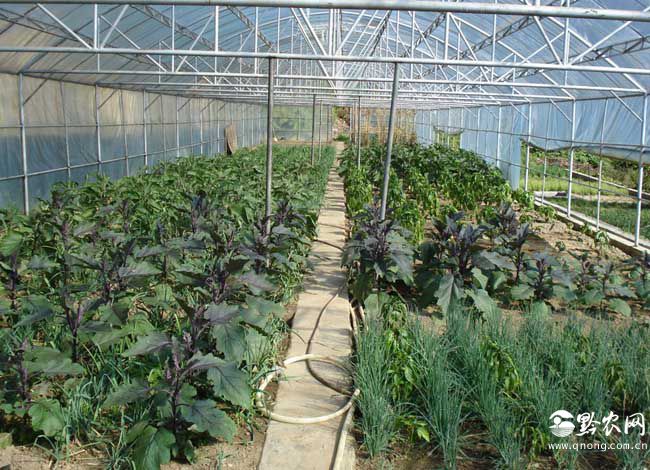
The cost and profit of greenhouse vegetable growing are mainly determined by greenhouse construction and maintenance, as well as the agricultural inputs needed for vegetable planting and management, and conditions vary from place to place. Below, the editor of Qiannong Network will analyze the profit of greenhouse vegetable growing under conventional conditions.
Profit from greenhouse vegetable growing
A general vegetable greenhouse frame costs about 5500 yuan per mu. To save on construction costs and extend the service life of the greenhouse, a relatively economical way to build a greenhouse is to use a magnesite greenhouse frame together with plastic film, which both lowers the construction cost and makes daily use and maintenance easier. Such a greenhouse can be used for 5 years, and only the plastic film needs to be replaced each year. The annual cost of vegetable seedlings, pesticides, fertilizers and so on is about 700 yuan per mu, and the land rent is about 800 yuan per year.
Combining the above calculations, the cost of greenhouse vegetable growing is about 7000 yuan per mu for the initial investment, and based on a 5-year service life for the vegetable greenhouse, the average amortized cost is about 2500 yuan per mu per year.
The profit from greenhouse vegetable growing can reach 150%-250%, and 2-3 seasons of vegetables can be produced each year. If common vegetables are grown, 1-2 seasons of vegetables are basically enough to recover the initial construction and greenhouse vegetable management costs, so profit can be achieved in the first year, with an average profit of 100%-150%. In subsequent years, the only annual cost is replacing some plastic film.
Types of vegetable growing greenhouses
1. 6-meter-wide assembled steel-frame greenhouse: This greenhouse type has been promoted and applied for many years. It is a steel greenhouse type that mainly uses galvanized thin-wall steel pipes with a diameter of 22 mm and a thickness of 1.2 mm as the greenhouse frame material. The greenhouse is 6 m wide, with a top height of 2.2-2.5 m and a shoulder height of 1.2 m, a land utilization rate of 80%, a service life of more than 10 years, a cost of 10-30 yuan per sq m, and a construction cost of 7000-20000 yuan per mu. It is suitable for growing vegetables, flowers and so on. The disadvantages are that the greenhouse width is relatively small, operation and management efficiency is relatively low, and winter insulation is relatively weak.
2. Simple bamboo-frame greenhouse: This is a widely used type. The greenhouse is generally 5-6 m wide, with a top height of 2-3.2 m and a side height of 1-1.2 m, and arch rod spacing of 1-1.1 m. The advantages are low cost, easy availability of materials, and easy construction, with a cost of about 3000 yuan per mu (including film). The disadvantages are that there are many posts inside the greenhouse, a high shading rate, inconvenient operation, a short service life, and poor wind and snow resistance. Among them is a type commonly known as the “ground-rolling dragon” style, with a span width of 4-6 m, low top height and shoulder height, and a covering method using a single film all the way to the ground. It saves more cost than ordinary moso bamboo vegetable greenhouses and is suitable for cultivating creeping crops. Greenhouse watermelon cultivation commonly uses it.
3. Steel-bamboo hybrid greenhouse: The structure of the greenhouse is the same as that of a simple bamboo-frame greenhouse, with steel pipes and bamboo poles used alternately as arch rods. It has the advantages of saving steel, lowering construction cost, and convenient operation, and has a certain application area; its performance and cost fall between those of a steel-frame greenhouse and a bamboo-frame greenhouse.
4. 8-meter-wide enhanced steel-frame greenhouse: The height and width of the greenhouse body are increased, the height and width of the ventilation windows on the sides of the greenhouse are increased, the space inside the greenhouse is enlarged, management efficiency and winter insulation are improved, and the land utilization rate is raised. This greenhouse is built with galvanized pipes with a diameter of 28-32 mm and a thickness of 1.5 mm; the top height is 3.2-3.5 m and the shoulder height is 1.8 m. The greenhouse body has a large space and is suitable for growing tall-climbing vegetables and so on. However, the construction cost of this vegetable greenhouse increases substantially, at about 20-45 yuan per sq m, or 15000-30000 yuan per mu, and it is mainly suitable for agricultural demonstration parks and vegetable growers with a certain economic strength.
5. Ordinary multi-span greenhouses and simple bamboo-frame multi-span greenhouses: The structure of an ordinary multi-span greenhouse is similar to that of a steel-frame multi-span greenhouse. It has the advantages of large space and a high land utilization rate, but the cost is much lower, at 50-100 yuan per sq m.
Covering materials for vegetable growing greenhouses
Vegetable growers should choose suitable covering materials for vegetable greenhouses according to their own production needs.
1. Ordinary film: Made from polyethylene or polyvinyl chloride as raw material. The greenhouse film is 0.1 mm thick and colorless and transparent; its service life is about half a year.
2. Multifunctional long-life film: Made by adding an appropriate amount of anti-aging material and surfactant during the polyethylene blow molding process. It is 7.5 m wide and 0.06 mm thick, has a service life 1 times longer than ordinary film, and keeps the greenhouse temperature at night 1-2°C higher than other materials; the film is not prone to water droplets, has a good covering effect, low cost and high benefit.
3. Straw covering and straw fans: Woven from rice straw, with good insulation performance. They are nighttime insulation materials.
4. Polyethylene high-foaming flexible sheet: A white plastic flexible sheet with many air bubbles, 1 m wide and 0.4-0.5 cm thick, lightweight and rollable, with insulation performance close to that of straw covering.
5. Non-woven fabric: A kind of polyester filament, a cloth-like material that has not been woven. It is divided into black and white types and comes in different densities and thicknesses. In addition to insulation, it can also be used as a shade net.
6. Shade net: A kind of plastic woven silk net. Commonly used types are black and silver-gray, and there are several density specifications, with different shading rates. It is mainly used for shading and rain protection in summer, and can also be used as winter insulation covering.
Orientation of vegetable growing greenhouses
They should be built on plots with a low groundwater level, sufficient water sources, convenient drainage and irrigation, and loose, fertile, pollution-free soil; generally, the orientation is required to run north-south, with ventilation openings set on the east and west sides. The advantages of doing this are as follows.
1. It helps reduce humidity inside the greenhouse.
2. It reduces mutual shading among trellised crops and tall-stalk crops in the greenhouse, making their light exposure uniform.
3. It avoids overly rapid cooling and the intrusion of north winds when the greenhouse is being ventilated (cooled) and aired in winter, while also increasing the air exchange volume.
Alright, that is where the editor's analysis of greenhouse vegetable growing profit comes to an end. The development of greenhouse vegetable growing technology can be said to be a trend. As people's living standards improve, the demand for a greater variety of vegetables will further increase. Vegetable greenhouses can make up for the seasonal shortage of some vegetables and will undoubtedly play an important role in future vegetable production.