What are the main methods for controlling the major insect pests of green leafy vegetables (bok choy)?
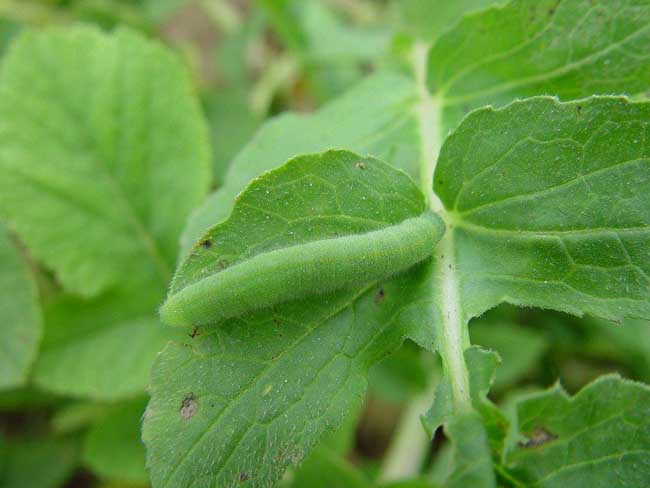
The main insect pests of green leafy vegetables (bok choy) are aphids, diamondback moths, imported cabbageworms, cabbage webworms and striped flea beetles. Effective control of these pests is essential for ensuring a high yield of green leafy vegetables. How should we control these pests? Below, the editors of Qiannong Network will introduce the control methods for these pests of green leafy vegetables!
Aphids
1. Damage: The aphids that harm green leafy vegetables (bok choy) include the turnip aphid (Lipaphis erysimi) and the green peach aphid (Myzus persicae), and they are the main pests of green leafy vegetables. Both the adult and nymph stages of these two cabbage aphids suck plant sap, causing leaves to curl and turn yellow and plants to become stunted, and they can also transmit viral diseases. The turnip aphid produces 10—20 generations a year and overwinters as wingless aphids in the heart leaves or on the undersides of leaves of the host. In March—April of the following year, it reproduces and produces winged and wingless aphids, and throughout the year it alternates among cruciferous vegetables to cause damage. However, the damage is most severe in autumn. The green peach aphid produces 20—30 generations a year and overwinters as wingless aphids in the heart leaves or on the undersides of leaves of the host, or as eggs. The eggs hatch in March—April of the following year, and by May large numbers of winged aphids are produced and migrate to cause damage. This continues until winter. Male aphids can reproduce parthenogenetically and give birth to 10—100 or more offspring, and when the climate is suitable, they can lay eggs once every 4—5 days. In dry years the damage is even more severe.
2. Control methods: Spray with 40% dimethoate emulsifiable concentrate at 1500 times dilution, or 4.5% beta-cypermethrin at 3000 times dilution, or Ke Ya Bao produced by Shenzhen Ruidefeng at 1500 times dilution.
Diamondback moth
1. Damage: The larvae of the diamondback moth (Plutella xylostella), commonly known as "two-pointed ends," are another major pest harming green leafy vegetables (bok choy). First-instar larvae bore into the tissue and mine the leaf mesophyll, second-instar larvae begin to chew the mesophyll on the undersides of leaves, and after the third instar they eat the leaves into holes or a net-like pattern. The diamondback moth produces 9—10 generations a year, and adults, pupae and larvae can all overwinter. When the weather warms, the adults begin to be active, and eggs are mostly laid on the undersides of leaves near the veins. A single female moth can lay an average of up to 300 eggs. Generally, diamondback moth damage occurs from April to October, with more frequent and severe damage in April—May and August—September.
2. Control methods: Spray with 90% trichlorfon crystals at 800 times dilution or 25% Zhongke Meiling at 1500—2000 times dilution.
Imported cabbageworm
1. Damage: The imported cabbageworm (Pieris rapae), also called the green worm, has an adult form known as the cabbage white butterfly, also called the cabbage butterfly. Its larvae damage leaves, eating them into holes or notches, and in severe cases eating the entire leaf so that only the petiole and veins remain. The imported cabbageworm produces 8—9 generations a year and begins to overwinter as pupae in November. The first generation of adults begins to appear in mid-March. The adults are active during the day, feeding on nectar, and prefer to lay eggs on cabbage and cauliflower. Each female moth can lay 100—200 eggs, and the egg stage lasts 3—8 days. The larvae have five instars in total, and before the third instar they eat relatively little and have poor resistance to pesticides.
2. Control methods: Chemical control is the same as for the diamondback moth.
Cabbage webworm
1. Damage: The larvae of the cabbage webworm (Hellula undalis), commonly known as the heart-boring worm, spin silk and form webs inside the heart of young seedlings, feeding on the heart leaves. After the third instar, they can also bore downward from the heart leaves through the stem pith to the roots, causing the roots to rot. Seedlings are most severely damaged when they have 3—4 leaves. The cabbage webworm produces 6—7 generations a year and overwinters as larvae in the soil, spinning silk to bind soil and dead leaves into a nest and overwintering inside the cocoon. In the spring of the following year, it forms a cocoon and pupates in the soil or on fallen leaves and plant debris on the ground. After the adults emerge, they are active at night, and eggs are laid singly on leaves, mostly on the heart leaves. The larvae have the habit of alternating hosts to cause damage, and mature larvae form cocoons and pupate on the soil surface near the vegetable roots or in the soil.
2. Control methods: Remove weeds and dead plant residue from the field and eliminate pupae and cocoons. At the seedling stage of the vegetables, that is, before the larvae spin silk and form clusters, spray with 90% trichlorfon crystals at 800 times dilution or 25% Zhongke Meiling at 1500—2000 times dilution.
Striped flea beetle
1. Damage: The striped flea beetle (Phyllotreta striolata), commonly known as the flea, has larvae commonly known as white maggots, and it is also one of the main pests harming vegetables. Both the adults and larvae of the striped flea beetle can cause damage. The adults mainly eat leaves, and can also damage tender stems, flower buds and pods. The larvae scrape and eat the root epidermis or bore into the root epidermis or into the roots to form tunnels, causing the plants to wilt. The striped flea beetle produces 5—6 generations a year and overwinters as adults in soil crevices, on the undersides of vegetable leaves on the ground, and in plant debris and weeds. When the temperature is warmer, it continues to be active and feed. Each overwintering female adult can lay about 600 eggs. After hatching, the larvae feed on the vegetable roots, and mature larvae pupate at a depth of 3—7 cm below the soil surface.
2. Control methods: After autumn, remove weeds and dead leaves and plant debris from the field to eliminate overwintering adults. In early spring, after the weeds grow, they should also be removed promptly so that the overwintering adults have no suitable food. When adults are found, immediately spray with 90% trichlorfon crystals at 800 times dilution or 25% Zhongke Meiling at 1500—2000 times dilution. For larvae, the above pesticides can be sprayed on the soil surface to eliminate them.