A Complete Analysis of the Key Technical Points for Vegetable Greenhouse Construction
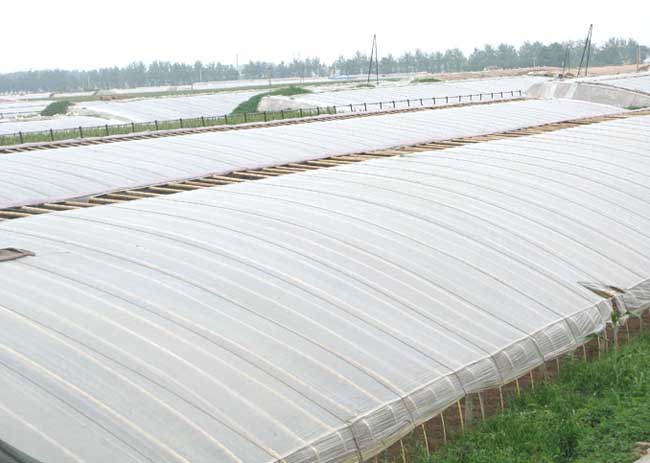
Currently, protected agriculture produces large outputs and good returns, and is a major direction for developing modern agriculture. At the same time, it involves a high level of technology, high technical requirements, and large capital investment, so for ordinary farmer friends who want to get involved, both the risk and the difficulty are very great. Below, the editor will share with you the relevant techniques for vegetable greenhouse construction.
1. Bamboo-wood arched-frame plastic greenhouse: span 8-14 m, center height 2.2-2.5 m, length about 50 m, using bamboo poles 3-6 cm in diameter as arch bars, each row of arch bars supported by 4-6 posts, arch bar spacing 1.0-1.2 m, uprights made of cement posts or wooden poles, upright spacing 3.0-3.6 m. Assembled galvanized steel pipe plastic film greenhouse: span 6-8 m, center height 2.5-3 m, length 30-50 m, using φ22×1.2-1.5 mm thin-walled steel pipes to make arch bars, tie bars, and uprights.
2. Span 4-6 m, center height 1.5-2 m, with one row of posts set in the middle, arch bar spacing 1 m, one post for every 3 arch bars, at 20 cm from the post to the greenhouse surface use bamboo poles for longitudinal connection, tighten with No. 10 iron wire, fix each upright to form a whole.
3. Small sheds mainly use thin bamboo poles or bamboo strips, twigs of chaste tree, 6-8 cm steel bars, etc. as support materials, bent into arched frames, center height 1-1.5 m, span 2-3 m, insert frame materials in sequence every 60 m, depth about 20-30 cm, length depending on the terrain, cover the frame with plastic film.
4. Shed type and height-to-span ratio: the shed type and height-to-span ratio mainly relate to the stability of the greenhouse. Under a certain wind speed, a streamlined shed surface with a large curvature weakens the wind speed, so wind resistance is better. A shed with shoulders has a small height-to-span ratio and small curvature, so wind resistance is poorer. For greenhouses in the south, a height-to-span ratio of 0.3-0.4 is preferable.
5. Specifications and orientation of the greenhouse: greenhouses in the south are generally 30-50 m long and 6-12 m wide, which is suitable. If too long, the temperature difference between the two ends is large, and transport and management are also inconvenient. If too wide, ventilation and air exchange are poor, and it also increases the difficulty of design and construction. A center height of 2.2-2.8 m is suitable. The taller the greenhouse, the greater the wind load it bears, but if the greenhouse is too low, the shed surface curvature is small, making it susceptible to wind damage, and when the rain is heavy it can also form water pockets, causing the shed to collapse.
6. Site selection and planning: the greenhouse site should be chosen facing the sun, sheltered from wind, with flat terrain, fertile soil, good soil quality, sufficient water sources, convenient drainage and irrigation, and no tall trees or buildings around for shade. When building a group of greenhouses, the distance between sheds should preferably be kept at 2-2.5 m, and the distance between shed ends at 5-6 m, which is conducive to ventilation, air exchange, and transport.
7. It is mainly composed of uprights, arch bars, film, pressure bars, or No. 8 iron wire. The cross-section of this kind of greenhouse is tunnel-shaped, oriented longitudinally north-south, with a shed length of 50-150 m and a shed width of about 13 m, which is suitable.
8. Film covering: the film is best an anti-drip film, with the width selected according to the shed-type span. Start from both sides first, then cover upward in sequence. The connecting seams of two sheets of film overlap each other by 20 cm. Between two arch bars on the shed film, set one film-pressing bar to press the film tightly, making the shed surface into a corrugated shape.
9. Install the arch bars and tie bars: choose duck-egg bamboo for the tie bars, fix them at 0.3 m below the top of the uprights, so that each row of longitudinal uprights forms a whole. Fix the arch bars on top of the uprights with duck-egg bamboo, and tighten with iron wire.
10. Bury the uprights: choose 6×8 cm cement posts or 5×8 cm wooden posts or bamboo poles for the uprights. Bury one row of uprights every 3.2 m, and each row is generally composed of 4-6 uprights. The center post is 2 m above the ground, the two waist posts are 1.5 m above the ground, and the two side posts are about 0.7 m above the ground. The uprights are buried 0.3-0.4 m underground. Each upright must be accurately positioned, firmly buried, and straight, and form rows from east to west and north to south, with each row of uprights at a consistent height.
Note: The orientation for building a plastic vegetable medium greenhouse is very important. A greenhouse extended north-south receives uniform light and is suitable for spring and autumn production. A greenhouse extended east-west has good lighting conditions in winter.