Fava Bean Cultivation Techniques and Management Methods
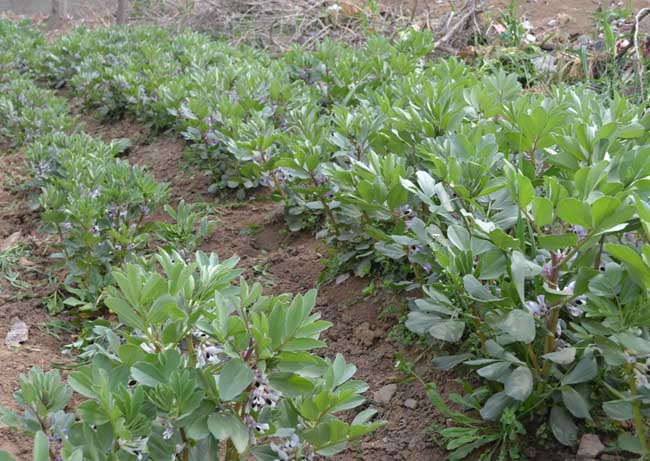
The fava bean (Vicia faba) is one of the earliest legume crops cultivated by humans. More than 50 countries around the world grow fava beans, concentrated along the Black Sea and the Mediterranean coast. China has more than 40 cultivated varieties, and in the 1950s its output ranked first in the world, with an annual production of over 3 billion kg. As a food, it is ground into flour to make pastries and snacks. When young, it is used as a fresh vegetable or feed. The seeds contain 22.35% protein and 43% starch. In folk medicine it is used to treat high blood pressure and edema. There are reports from abroad of using fava beans to extract anti-cancer substances.
Fava Bean Cultivation Techniques
1. Ditching and bed division: To ensure uniform and strong seedlings and to prevent rotten beans and dead seedlings, generally fields are divided into beds 2-2.5 m wide; fields with higher ridges are divided into beds 2.5-3.5 m wide, with ditches 18-20 cm deep and 30 cm wide. In fields with a high groundwater table such as the Haixi area of Dali City, ridge cultivation is implemented, with a ridge surface 50-55 cm wide, ditches 30-40 cm deep and 40 cm wide.
2. Sowing period: The sowing period for fava beans should be based on the timing that allows the full-bloom and pod-setting stage to avoid the occurrence of heavy frost, so as to determine the optimal sowing season for fava beans in different ecological regions. That is: in bean-growing areas at an altitude of 1550-1700 m, sow from October 5 to 15; in bean-growing areas at an altitude of 1750-1900 m, sow from October 10 to 20; in areas at an altitude of 1950-2200 m and above, sow from October 15 to 25.
3. Reasonable close planting and standardized drilling or spot sowing: In bean-growing areas at an altitude of 1550-1700 m, sow a basic stand of 12,000-15,000 plants/667 sq m, with a plant-row spacing of 15-18 × 750px; in bean-growing areas at an altitude of 1750-1900 m, sow a basic stand of 18,000-22,000 plants/667 sq m, with a plant-row spacing of 13 × 650px or 16 × 500px; in bean-growing areas at an altitude of 1950-2200 m and above, sow a basic stand of 23,000-28,000 plants/667 sq m, with a plant-row spacing of 13-15 × 450px. The sowing method uses open-seed drilling or spot sowing.
4. Reasonable fertilization: After sowing, cover each mu with 1500-2000 kg/667 sq m of high-quality barnyard manure or an appropriate amount of rice straw; at the 2.5-3 leaf stage of the bean seedlings, apply 30 kg/667 sq m of ordinary calcium superphosphate and 10-15 kg/667 sq m of potassium sulfate; in the lakeside areas of Erhai in Dali City and Eryuan County, in order to reduce pollution to Erhai and other lakes, the amount of phosphate fertilizer is reduced, and at sowing time 0.5-1 kg/667 sq m of soil phosphorus activator (Anglisu) is used to dress the seed, and at the 2.5-3 leaf stage of the bean seedlings, 15-18 kg/667 sq m of ordinary calcium superphosphate is applied.
5. Irrigation: Throughout the entire growth period, irrigation should be carried out in a timely manner for the bud-emergence flowering water, full-bloom pod-setting water, and grain-filling and pod-plumping water, 3-4 times in total.
Field Management of Fava Beans
1. Seedling stage management measures: At the seedling stage, according to the condition of the seedlings, control water or irrigate to achieve sturdy and strong seedlings, ensuring uniform, even and strong seedlings. In sticky muddy bean fields, cover with straw promptly after sowing to retain heat and moisture.
2. Mid-term management measures: Do a good job in forecasting and forecasting of diseases and insect pests, promptly control the harm of diseases, insects, weeds and rodents, and manage water well. Carry out pruning and thinning in the field, pull out weak and diseased plants, and ensure the healthy growth of the population.
3. Late-stage management measures: Ensure the water demand during the grain-filling period, keeping the soil moisture content at 20-25%; if it falls below 18-20%, irrigation must be carried out immediately; for high-yield fields and late-maturing fields, at the final flowering and tip-spreading stage, top and pinch the growing points to facilitate ventilation and light penetration, increase grain weight, and promote early maturity.
4. Precautions
Fava beans should not be grown continuously; continuous cropping makes the plants sterile, with few root nodules and low activity, fewer pods, and more disease. When growing fava beans, carry out crop rotation of at least 3 years. Fava beans adapt to slightly heavy and moist soil, but cultivation on deep, fertile clay loam or sandy loam is best.
Harvest the tender pods of fava beans at the right time; they can be harvested in several pickings, from bottom to top, each about 7-10 days apart. For the later harvest of mature seeds, harvest when the fava bean leaves have fallen and the middle and lower pods are fully mature, then dry and thresh for storage.
Pest and Disease Control of Fava Beans
For pest and disease control of fava beans, in addition to selecting disease-resistant varieties, reasonable close planting and pruning, doing a good job in drought prevention and drainage, and increasing the application of phosphorus and potassium fertilizers to enhance plant resistance, chemical control is also very necessary.
1. Fava bean damping-off
The disease can occur at all growth stages of fava beans, but is more severe at the tender pod stage. It mainly infects the stem base or underground parts of fava beans, and also infects seeds. When the stem base is infected, black lesions mostly appear on one side of the stem or around the stem, causing the stem to turn black.
[Chemical control] At the early stage of the disease, begin spraying 58% metalaxyl-mancozeb wettable powder 500 solution, or 75% chlorothalonil wettable powder 600-700 solution, or 21% iminoctadine-carbendazim wettable powder 800-1000 times liquid, or 20% tolclofos-methyl emulsifiable concentrate 1100-1200 solution, etc.
2. Red leaf spot
Small red spots first appear on the leaves, and the small spots gradually expand into round or oval lesions; in severe cases, all parts turn black and wither. Black sclerotia are found on the inner wall of the stems.
[Chemical control] At the early stage of the disease, spray 1:2:100 Bordeaux mixture. After that, spray 50% carbendazim 500 times liquid once every 10 days, for 2-3 consecutive sprays.
[Tip] Spraying Bordeaux mixture at the early stage is better than spraying carbendazim.
3. Rust
Rust spots appear on the leaves until the leaves dry up. In severe cases, the entire plant dies.
[Chemical control] 50 g of 15% triadimefon can be mixed with 50-60 kg of water and sprayed. Use 40-60 kg of spray liquid per mu. About 20 days after application, spray once more.
4. Fusarium wilt
The main symptom is that the roots become diseased and black, the main root is short and small, there are few lateral roots, the leaf color turns yellow, the plant appears wilted, and the top stems and leaves droop.
[Chemical control] At the early stage of the disease, 50% thiophanate-methyl 500 times liquid can be poured on the roots, using the medicine 2-3 times, with good control effect.
5. Fava bean brown spot
It can infect the stems, leaves, pods and seeds of fava beans. When leaves are infected, small reddish-brown freckles first appear, then expand into round or oval lesions; the center of the lesion is light gray, and the edges are dark brown and red, with a diameter of 3-8 mm, densely covered with small black dots arranged in concentric rings. When the disease is severe, they merge with each other into irregular large patches.
[Chemical control] At the early stage of the disease, spray 70% thiophanate-methyl wettable powder 600-800 times liquid, or 50% copper bis(dodecylbenzenesulfonate) wettable powder 500-600 solution, etc., once every 7-10 days, for 1-2 consecutive sprays.
7. Fava bean Verticillium wilt
At first, yellowing occurs only in one section of the plant, while the other side remains normal in color. The leaves on the upper part of the stem gradually yellow from the lower part upward. The yellowed leaves are at first pale green or greenish-yellow, then completely turn yellow.
[Agricultural control] Select disease-resistant varieties and practice crop rotation.
[Chemical control] At the early stage of the disease, irrigate with 50% mixed sulfur suspension concentrate 500-600 times liquid, or 50% carbendazim wettable powder 500 times liquid, or 50% copper bis(dodecylbenzenesulfonate) wettable powder 350 times liquid, pouring 500 mL of the prepared liquid per plant. Stop using the medicine 3 days before harvest.
8. Fava bean anthracnose
It mainly harms leaves, stems and pods. In the early stage of leaf damage, small dark reddish-brown spots are scattered on the surface, then expand into lesions 1-3 mm in size with a light brown center and reddish-brown edges. After the lesions merge, they form large patches, 10 mm in size; the lesions are round to irregular, mostly restricted by leaf veins, and diseased leaves rarely dry up. Later, black dots are produced on the lesions.
[Chemical control] Before the disease occurs or at the early stage of the disease, spray 80% anthracnose thiram wettable powder 800-1000 times liquid, or 58% metalaxyl-mancozeb wettable powder 800-1200 times liquid, etc. Spray once every 7-10 days, for 2-3 consecutive sprays, and stop using the medicine 3 days before harvest.
9. Fava bean mosaic virus disease
[Agricultural control] Select disease-resistant varieties and pay attention to strengthening field management.
[Chemical control] Spray medicine promptly to control aphids; 50% pirimicarb wettable powder 2500-3000 times liquid can be used. Stop applying the medicine three days before harvest.
10. Fava bean root rot and stem base rot
[Chemical control] Before planting, mix 1 part of 50% carbendazim wettable powder with 50 parts of fine dry soil, spread it at the base of the seedlings, with a dosage of 1.5 kg per mu.