Detailed Explanation of Kidney Bean Cultivation Techniques and Management Methods
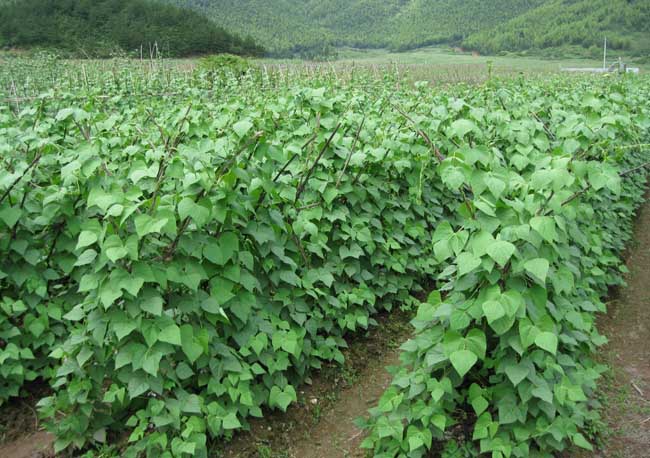
The scientific name of the kidney bean is Phaseolus vulgaris (commonly known as the second-season bean or four-season bean), belonging to the Fabaceae family, genus Phaseolus. It originated in Mexico and the Americas and began spreading throughout the world from the 17th century. It is also known as the multiflora bean and large-flowered kidney bean. It has a long history of cultivation, and due to large export volumes, its planting area has expanded year by year. Kidney beans are nutrient-rich with high protein content, serving as both a vegetable and a grain, and are an important agricultural by-product for export earnings. Gezan belongs to the high-cold mountainous area, with a good natural and ecological environment, where air, water, and soil are pollution-free, pesticide and chemical fertilizer application is minimal, ecological diversity is high, and natural factors provide strong pest control capacity. This is highly suitable for the development of a pollution-free kidney bean industry and is also a pillar industry for farmers in high-cold mountainous areas to escape poverty and achieve prosperity.
Morphological Characteristics of Kidney Beans
The large white kidney bean is an annual herbaceous plant belonging to the Fabaceae family, genus Phaseolus. It has a well-developed root system that penetrates deep into the soil and is relatively drought-tolerant. The stem is vining, vigorous in growth, with strong branching ability, and stem length of over 4 m. The leaves are green, alternately arranged trifoliate compound leaves, heart-shaped, with cotyledons that do not emerge from the soil. The flowers are papilionaceous, in racemes. The seeds are kidney-shaped, with a 1000-grain weight of 800—1500 grams.
Types of Kidney Beans
There are two types of kidney beans: the large white kidney bean and the large black kidney bean. Those with white flowers produce white seeds, called large white kidney beans; those with red flowers mostly produce seeds with purple backgrounds and large black patches or stripes, called large black kidney beans or large flowered kidney beans.
Growing Conditions for Kidney Beans
1. Temperature: Kidney beans are relatively cold-tolerant and averse to high temperatures. They are only damaged by frost when temperatures drop below 5°C, and the above-ground parts die when exposed to frost. Growth and development require a frost-free period of more than 120 days. The optimal germination temperature is 20-25°C, the suitable growing temperature is 18-20°C, and pollination and seed setting become difficult above 30°C or below 15°C.
2. Light: They are cross-pollinated, short-day crops and prefer ample sunlight. The shorter the daylight hours and the more abundant the sunlight, the earlier the kidney beans flower, set pods, and mature. Conversely, with extended daylight and insufficient sunlight, flowering, pod setting, and maturation are delayed, branches and leaves grow excessively, and they may even fail to flower and set pods.
3. Water: Throughout the entire growth period, kidney beans require relatively abundant and uniform moisture. The flowering and pod-setting stage is the period of greatest water demand, which is the critical water requirement period. If water is lacking at this time, it has a significant impact on yield.
Cultivation Techniques for Kidney Beans
1. Selecting good seed: Good seed is the key to improving kidney bean yield, quality, and commercial value. In areas above 2000 m in altitude, large white kidney beans and large flowered kidney beans are the main types. Before sowing, seed selection by grain should be carried out, choosing seeds that are large, plump, uniform in size, consistent in luster, and free from pests, diseases, and damage. Before sowing, sun-dry the seeds for one to two days to promote uniform germination and prevent seed rot from low-temperature sowing in early spring.
2. Fine land preparation: The field for planting kidney beans should be plowed in advance and the soil clods sun-dried to improve soil fertility. First, select acidic or slightly acidic soil with deep soil layers, medium fertility, low groundwater level, good drainage, ventilation and sunlight exposure, and relatively high organic matter content. Apply sufficient basal fertilizer; before land preparation, broadcast 1500-2000 kg of farmyard manure per mu. Before sowing, apply 25 kg of compound fertilizer per mu as seed fertilizer, but strictly avoid phosphorus and potassium coming into contact with the seeds. The planting field should maintain deep plowing and broken clods; trenching, hole digging, and sowing should be done the same day to reduce water evaporation and loss.
3. Timely sowing: Large white kidney beans should not be planted in continuous cropping; instead, alternate planting with corn or potatoes on a yearly rotation. The optimal sowing period for kidney beans is April 20 to May 5, which is from Grain Rain to the Beginning of Summer. Liquid-moisture soil should be used for planting, with deep holes and deep sowing to maintain soil moisture and ensure full emergence in one planting. The sowing depth is 10-15 cm, and the soil cover is about 6 cm.
4. Reasonable close planting: Kidney beans are cultivated in ridge planting. Kidney beans like moisture but fear waterlogging; ridge cultivation can raise soil temperature, facilitate drainage and moisture removal, and maintain soil permeability. For pure kidney bean planting, form ridges with a row spacing of 2.0-2.5 chi, with 2000-2500 holes per mu, using 5-6 kg of seed per mu, sowing 3-4 seeds per hole. For top-grade fields, 1500 holes per mu, with a planting specification of 90 cm × 50 cm. For medium and lower-grade fields, 1600-1800 holes per mu, with a planting specification of 90 cm × 40 cm. The seeding rate per mu is generally 8-10 kg, and pure planting generally uses single-row hole sowing. Reasonable close planting should follow the principle of sparse planting in fertile land and dense planting in poor land. Fertile land utilizes soil fertility to achieve high yield through plant vigor, while poor land utilizes population advantage to increase yield.
5. Field management
① Thinning and final singling of seedlings: This is done when seedlings have 2-3 true leaves. According to requirements, retain enough strong seedlings and remove weak and deformed seedlings. Leave 2-3 seedlings per hole.
② Management before vine trailing: Timely weed control, earthing up, ridge maintenance, and insertion of stakes help with ventilation and light penetration, full pod setting, and improved product quality.
③ Timely trellising and plant adjustment: When seedlings reach 30 cm in height, insert support stakes and guide vines onto the poles. Insert one bamboo or wooden stake per hole, with a length of about 2 m or more, to prevent wind damage. If one insertion is not stable, insert again after a soaking rain.
④ Topping and pinching: Kidney beans have many lateral branches, and stems and leaves are luxuriant and crowd each other, affecting ventilation and light penetration and often causing flower and pod drop. Therefore, excess lateral branches should be appropriately removed. Kidney beans produce many flowers but set few pods. In order to concentrate nutrients for supplying the lower flowers, remove part of the peduncles at the tips of the flower stalks early, so that the seeds become plump. Pods set after August by large white kidney beans mostly cannot mature. At this time, the tips of the main and lateral vines should be removed so that the plant forms a short bushy growth habit, reducing height, increasing the number of flowers and pods, concentrating nutrients in the pods, and promoting early maturity.
⑤ Disease control: The main diseases are powdery mildew, anthracnose, and mosaic virus disease, controlled with Bordeaux mixture, lime-sulfur mixture, and similar treatments.
⑥ Pest control: The main pests are cutworms, flea beetles, leaf roller borers, and pod borers. Cutworms can be manually captured during farming operations such as plowing and sowing. Other pests can be controlled with plant-derived pesticides such as pyrethrum.
6. Timely harvesting: Harvest as each batch matures. The pod maturation period of kidney beans lasts more than a month, and early and late maturity are inconsistent. In addition, since it is during the rainy season, if pods are not harvested promptly after maturing, they are prone to mildew and deterioration, or the seed coats turn black, affecting their commercial price. Therefore, harvest in batches, place them with pods in a cool place to air-dry, and do not expose them to the sun. Thresh once before selling. In this way, the seeds have good color and high plumpness, effectively improving their commercial grade.
7. Seed selection and retention: As the saying goes, “Select seeds year after year, and yields rise higher and higher.” The individual yield of kidney bean plants varies greatly, so select early-maturing, high-yielding individual plants in the field, tag them, and harvest and store them separately. Selection criteria: First, many pods, especially many and concentrated pods on the lower part; second, more plump seeds per pod on average. On the basis of plant selection, further carry out seed selection by grain for even better quality.