Detailed Explanation of Cowpea Planting Techniques and Management Points
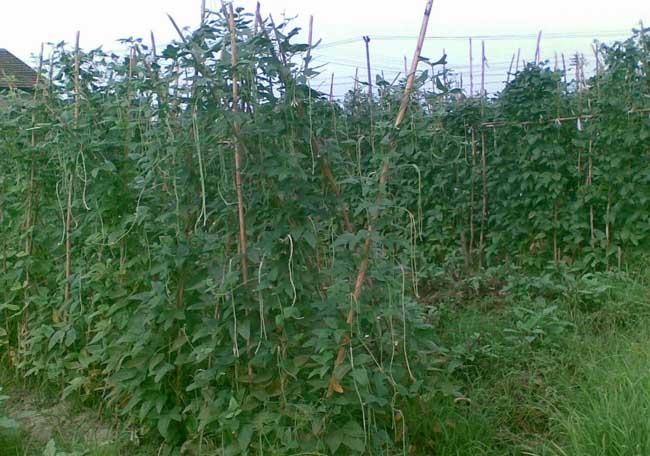
Cowpea, also known as long bean, long podded cowpea, yardlong bean, asparagus bean, rice bean, kidney bean, banded bean, ribbon bean, and chopstick bean, is an annual herbaceous plant of the genus Vigna in the Fabaceae family. Cowpea is eaten for its tender pods; it is fairly nutritious and can be stir-fried, served cold with dressing, salted, processed into pickles, or sun-dried into dried cowpea. Because cowpea has good heat tolerance, it is a heat-resistant variety that fills the summer gap. Below, the editor will introduce cowpea planting techniques for everyone.
Growth and Development Characteristics of Cowpea
For the individual development of cowpea, taking the vining type as an example, from sowing to pod maturity or seed maturity, it can be divided into four stages: seed germination stage, seedling stage, vine elongation stage, and flowering and pod-setting stage.
1. Seed germination stage. The process from seed sprouting to the unfolding of the first pair of true leaves is the seed germination stage. The cotyledons emerge from the soil and do not carry out photosynthesis; they rely on stored nutrients being decomposed and used during germination. When the first pair of true leaves unfolds, photosynthesis can begin and the plant can live independently.
2. Seedling stage. From the unfolding of the first pair of true leaves to having 7-8 compound leaves is the seedling stage. During the seedling stage, internodes are short, the stem is upright, and the root system gradually develops. Afterward, the internodes elongate, and the plant can no longer stand upright and instead grows by twining; at the same time, the axillary buds at the base begin to become active, and the plant enters the vine elongation stage.
3. Vine elongation stage. From having 7-8 compound leaves to the plant showing flower buds is the vine elongation stage. During this period, the main vine elongates rapidly, the base usually begins to send out lateral vines from the axillary buds of the first pair of true leaves and the 2nd-3rd nodes, and root nodules also begin to form.
4. Flowering and pod-setting stage. From the plant showing flower buds to the end of pod harvest or seed maturity, generally 50-60 days. For a single flower, from the beginning of differentiation to the formation of the floral organs takes about 25 days, from flower bud appearance to flowering takes about 5-7 days, from flowering to the pod reaching commercial maturity takes about 9-13 days, and to physiological maturity of the pod requires another 4-10 days, varying with variety and cultivation season.
Growing Environment for Cowpea
1. Temperature. Cowpea tolerates high temperatures and does not tolerate frost. The suitable temperature for germination is 25-35°C, and the suitable temperature for growth and development is 20-25°C. Above 35°C or below 15°C, growth and pod setting are affected. When close to 0°C, the plants will suffer freeze damage.
2. Light. Cowpea is not sensitive to day length, and only a few varieties have strict requirements for day length and are suitable for growing in short-day seasons. Generally speaking, short days can accelerate growth and development and promote earlier maturity. Cowpea likes sunlight; during flowering and pod setting, insufficient light can cause flower and pod drop.
3. Water. Cowpea is a vegetable with moderate water consumption and has relatively strong drought resistance. Too much soil moisture can easily lead to reduced germination rate, root rot and dead seedlings, and flower and pod drop, and is also unfavorable to the activity of rhizobia. Insufficient soil moisture will inhibit growth and development and affect yield.
4. Soil. For planting cowpea, well-drained, loose, and fertile soil is most ideal. The most suitable soil pH is 6.2-7. Cowpea requires complete fertilizer with nitrogen, phosphorus, and potassium. Because cowpea's rhizobia are far less effective than those of other leguminous plants, nitrogen fertilizer should be appropriately increased. At the same time, applying an appropriate amount of phosphate fertilizer can promote rhizobial activity and increase yield.
Cowpea Planting Techniques
1. Selection of good varieties: In the Wuxi area, cowpea can be cultivated in spring, summer, and autumn, and the growing season is long. Appropriate varieties must be selected according to the climatic conditions of each season. Generally, the varieties I commonly use are the Zhijiang series, Yangjiang series, Nanjing Xingguang series, Yandai cowpea, Qicun cowpea, Bacun cowpea, soil cowpea, and so on.
2. Cultivation season and sowing period: For early spring cowpea, sowing and seedling raising can be done in facilities such as greenhouses from late March to early April; after mid-April, direct sowing under plastic film can be done; after late April to early May, direct sowing in the open field can be done. The sowing period for spring-summer cowpea can generally continue to early to mid-July. Autumn cowpea is sown from July to early August, mainly Qicun cowpea and Bacun cowpea.
3. Land preparation, bed making, and application of base fertilizer: Cowpea should not be continuously cropped and requires crop rotation for more than two years; otherwise, diseases are likely to occur. After the previous crop is harvested, deep plow 20-30 cm, apply 3000 kg of base fertilizer per mu, 25-30 kg of superphosphate, 50-75 kg of plant ash or rice husk ash, or 10-20 kg of potassium sulfate. For acidic soil, appropriately increase the application of lime by 75-100 kg, then break up the soil and rake it level, making high beds with a bed width including ditches of 1.3 m.
4. Reasonable close planting: For early spring cowpea, because temperatures are low and there is more rain, seedling raising and transplanting are advocated. After the seedlings emerge, they should be planted when the first pair of true leaves has not yet unfolded. Transplanting should follow the principle of planting small and planting early. When planting, plant two plants per hole. Summer and autumn cowpea mostly use direct sowing, with 3-4 seeds per hole at the least and 4-5 seeds at the most; after emergence, thin to leave two plants per hole. The sowing density is 0.8-1 m between rows and 0.26-0.33 m between plants.
Field Management of Cowpea Planting
1. Fertilizer and water management: In the early stage, properly control water and carry out seedling hardening to promote reproductive growth and form more inflorescences. For spring cultivation, properly control fertilizer and water in the early stage; after the first inflorescence sets pods, gradually increase fertilizer and water to promote growth, more flowering, and more pod setting. When pods begin to be harvested in abundance, continuously apply heavy topdressing. Apply topdressing once every 4-5 days for 3-4 consecutive times, applying 40-50 kg of ordinary compound fertilizer per mu in holes or 1000 kg of human manure and urine, then water after fertilizing. For autumn cultivation, fertilizer and water should be supplied continuously from start to finish. For spring cowpea covered with plastic film, because the root system is well developed and nutrient uptake is strong, fewer topdressings are needed, so base fertilizer should be increased.
2. Plant adjustment: When the vines grow to 17-30 cm, a trellis in the shape of the Chinese character "" should be set up to guide the vines. When the plant grows to a certain size, pruning is needed, that is, remove all lateral buds below the first inflorescence on the main vine. For lateral branches above the first inflorescence on the main vine, leave one leaf and pinch the tip to promote flowering and pod setting. When the main vine grows to 1.3-1.7 m, pinch the top so that nutrients are concentrated and more pods are set.
3. Setting up supports: Supports should be set up when there are 5-6 true leaves. In the early stage, guide the vines onto the trellis counterclockwise and fix them with string, generally done at noon or in the afternoon on sunny days; in the later stage, the twining ability is very strong and no manual assistance is needed.
4. Temperature and water management: It likes warmth, with a suitable growth temperature of 20-30°C. Below 15°C growth is slow, and below 5°C freeze damage occurs. It tolerates high temperatures and can still flower and set pods at 35°C, but the quality is poor. It is relatively drought-tolerant but not waterlogging-tolerant. In the early stage, water should be properly controlled. When about half of the inflorescences on the main vine begin to set pods, water thoroughly to ensure the soil is moist.
5. Pruning and pinch topping: When the main vine produces the first inflorescence, all lateral branches below the inflorescence should be removed, and lateral branches above the inflorescence should be pinched, leaving 2 leaves at the base; when the main vine has climbed over the entire trellis, pinch the top to encourage flower buds to sprout from the lower lateral branches.
Harvesting and Seed Saving of Cowpea
When harvesting cowpea, be careful not to damage the remaining flower buds, and even more, do not remove the inflorescence together with the pod. Cowpea is a crop harvested successively, so it should be harvested in time before the seeds swell. For seed-saving cowpea, carry out plant selection and pod selection when the pods mature. For seed plants, pinch the top early, and select well-developed fruits from the 3rd-4th inflorescences in the middle and lower parts of the main vine to keep for seed. Harvest when the seed pods turn yellow and become soft.
Pest and Disease Control of Cowpea
Aphids mainly damage plants at the seedling stage and can transmit cowpea mosaic virus disease. Spray with 40% dimethoate once every 7-10 days. The legume pod borer generally occurs in large numbers between July and August (summer and autumn cowpea) and damages pods. During the flowering period, spray with 800 times diluted dichlorvos once every 6-10 days. In the south, when there is a lot of rain in summer and autumn, it often causes cowpea black mold disease damage. In the early stage of occurrence, spraying 2-3 times with 50% carbendazim 1000 times solution or 50% thiophanate-methyl 1000 times solution can control it, while cowpea rust can be controlled with 70% thiophanate-methyl wettable powder 1000 times solution or 65% zineb 500 times solution. Spray once every 7-10 days, for a total of 2-3 times.