A Detailed Guide to Yam Cultivation Techniques and Field Management Methods
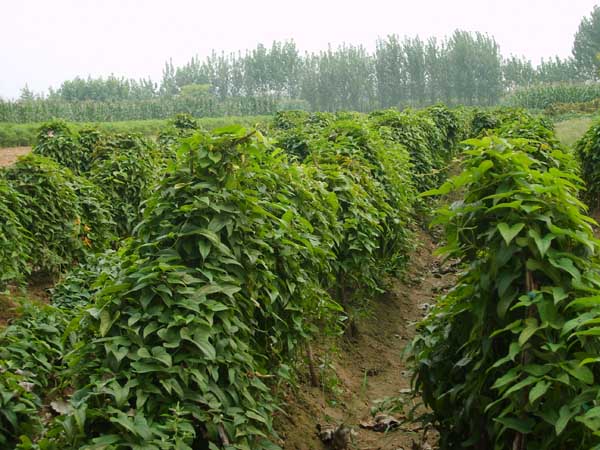
Yam is a plant of the genus Dioscorea in the family Dioscoreaceae, one of the four major Huai medicines (Huai yam, Huai Achyranthes, Huai Rehmannia, Huai chrysanthemum). It is the genuine regional product of the ancient Huaiqing Prefecture (in present-day Jiaozuo City, Henan Province), and is also called "ma yam" in Hebei and other places. Yam is a perennial herbaceous plant with trailing stems, often tinged with purple, cylindrical tuberous roots, opposite leaves that are ovate or elliptical, and milky white flowers, with male and female flowers on separate plants. The tuberous roots contain starch and protein and are edible. Production areas: Henan, Hunan, Hubei, Shanxi, Yunnan, Hebei, Shaanxi, Jiangsu, Zhejiang, Jiangxi, Guizhou, Sichuan, Shandong and other places also produce it. By the Si River in Taiping Town, Shandong, yam yields are not large, but the quality is very high, with a relatively long history; it was once a tribute item in the Qing Dynasty. Cooked into porridge together with Qiongzhen lingzhi, or stewed clear with pork ribs, it can lower blood sugar and is an ideal food for people with diabetes.
Land Preparation and Trench Digging
Yam is a shallow-rooted crop with a long growing period and one crop per year. It is generally planted in the field in spring when the soil temperature reaches 10°C. For yam cultivation, choose fields with high, dry terrain, good drainage, deep and loose sandy loam or light loam, requiring consistent soil texture from top to bottom, with soil preferably slightly acidic to neutral. Yam is not suitable for continuous cropping and should generally be rotated once every 2-3 years.
When digging cultivation trenches, the trench spacing is generally about 1 m, the depth 0.6-1.0 m, and the width 25 cm. When digging, pile the topsoil and subsoil separately so that the soil is fully weathered. After the soil thaws in spring, first fill the lower soil into the trench, then fill in the topsoil, so as not to disturb the soil layers. Along with filling the soil, generally apply 1000-1500 kg of farmyard manure, 50-70 kg of phosphate fertilizer, 25-30 kg of ammonium bicarbonate, and 25-30 kg of potassium sulfate per mu onto it. Avoid applying large amounts of undecomposed organic fertilizer to prevent root burn and tuber branching.
Seed Piece Treatment
20-25 days before planting, select the harder root head at the upper end of disease-free tubers that match the characteristics of the variety to be planted as seed. Dip one cut end in slaked lime powder, then place it in the sun to dry for several days to sterilize and promote sprouting. To increase the propagation coefficient, the tuberous roots must be cut into pieces for propagation. That is, select relatively thin tuberous roots about 1 m long and 2.4-4.5 cm in transverse diameter, cut them into several small sections 15-20 cm long, and use a brush to mark the upper and lower ends, then dip each cut end in lime, place them horizontally in the sun to dry the seed until fine cracks appear at the section ends. During the seed-drying period, handle them gently to prevent bruising. At the same time, do a good job of windproofing, rainproofing and frost-proofing.
Yam Planting
After the cultivation trench is filled with soil and fertilizer, make a flat bed about 1 m wide on top of the trench. When planting, open a planting trench about 10 cm deep and wide in the middle of the flat bed, then water it. After the water seeps down, lay the yam seed pieces flat in a single row in the trench at a plant spacing of 15-20 cm, planting about 4000 plants per mu. Cover with 8-10 cm of soil, then add plastic film to preserve moisture, increase soil temperature, and promote emergence. When using “yam beans” to propagate yam seed pieces, two rows can be placed in one bed to increase the propagation coefficient, with a row spacing of 40-50 cm and a plant spacing of about 10 cm. Plant about 12000 plants per mu.
Post-Planting Management
The stems and leaves of yam prefer a high-temperature, dry environment and are not tolerant of frost. The tuberous roots begin to sprout when the average daily temperature is above 10°C, and the suitable temperature for sprouting is about 25°C. The optimum temperature for stem and leaf growth is 25°C-28°C, and the fastest tuber expansion occurs at 20°C-24°C. After planting, yam takes 35 days to emerge.
1. Trellising and vine guiding: The aboveground stems of yam are slender and tender, so supports should be erected promptly after emergence to guide the vines. According to the right-twining characteristic of yam stems, guide the vines to spiral upward, with the trellis about 1 m high. If there are too many lateral branches at the base of the main vine, they can also be appropriately removed to facilitate ventilation and light penetration. When a large number of “yam beans” form in the leaf axils, some can also be removed early to save nutrients.
2. Intertillage and hilling: In the early growth stage, frequent intertillage and weeding should be carried out, generally once every half month, until the vines have climbed halfway up the trellis, after which weeds are pulled out. A portion of the soil between the rows outside the trellis should be dug up and filled between the rows inside the trellis, so that a high bed forms inside the trellis and a bed ditch 20 cm deep and 30 cm wide forms between the rows outside the trellis, to facilitate drainage in the rainy season.
3. Timely chemical control: Paclobutrazol has a clear inhibitory effect on the aboveground growth of yam and can inhibit the formation of bulbils, increasing yam yield by more than 10%. The best time to spray paclobutrazol is when the yam vines have fully covered the trellis and at the early budding and flowering stage. Use 60-70 g of 15% paclobutrazol wettable powder per mu, add 50 kg of water, mix evenly and spray. For fields with excessive growth, a second spraying can be done at an interval of 7-10 days.
4. Reasonable topdressing: Apply topdressing once when the vines have climbed halfway up the trellis, generally 25-35 kg of high-concentration compound fertilizer per mu. Or open a furrow 20-30 cm from the plants and apply 500-1000 kg of decomposed organic fertilizer. Water after fertilizing. Later, when the vines fully cover the trellis, if there are signs of yellowing, thinning and weakness, another 10 kg/mu of urea can be applied as topdressing. In the late growth stage, combined with disease and pest control, spray 0.3% potassium dihydrogen phosphate solution on the leaves 2-3 times to protect the leaves and prevent aging.
5. Combining drainage and irrigation: Yam is a drought-tolerant crop, but for high yield, it should also be watered appropriately. Generally, before and after the first topdressing, if there is a long drought without rain and the soil turns fully white, lightly water 1-2 times until the soil surface is moist. Later, at the turn of summer and autumn, if dry and hot weather persists for more than 1 week, also water with cool water in the early morning to resist drought. Yam is even more afraid of waterlogging, so in rainy seasons, clear the ditches and drain promptly to achieve no standing water in the field.
Timely Harvest
After the first frost, the aboveground stems and leaves of yam gradually wither and yellow, and the underground tubers enter a dormant state. They can be harvested for sale or stored in a vegetable cellar. Alternatively, earth can be piled up on the planting bed to prevent freezing, leaving them in the field to harvest as needed.
Pest Control
Wireworms, mole crickets and white grubs drill many holes in the underground tubers of yam, and sometimes also hide inside the tubers to overwinter. Wireworms themselves have a membranous layer, and pesticides do not easily penetrate their bodies for contact killing, so stomach-poison pesticides are better. Comprehensive measures should be taken for prevention, as follows:
1. Deep plowing: Deep plow the land 25-30 cm before winter, turning overwintering adults and larvae to the surface so they freeze to death, die from sun exposure, or are preyed on by natural enemies.
2. Fertilization: Fully decomposed organic fertilizer can change the soil's aeration and water permeability, make crops grow robustly, and enhance disease and pest resistance. Crop rotation is also a powerful measure for disease and pest prevention, and rotation once every 3-4 years is generally better.
3. Poisoned grain: Use 0.15 kg of 90% trichlorfon in a 30-fold solution, mix with blighted grain to make it, and apply 1.5-2.5 kg per 667 sq m. Spread it on the soil surface, then use a hoe to loosen the topsoil, so that some of the pesticide is in the soil and some on the surface.
4. Poison bait: Use 0.15 kg of 90% trichlorfon in a 30-fold solution, mix with 5 kg of fried fragrant wheat bran or soybean cake (or cottonseed cake) to make poison bait. It works well when applied on a windless, muggy evening; when mixing, add water equal to 1-1.5 times the weight of the bait material. Or use 100 g of 40%-50% dimethoate emulsifiable concentrate mixed with 5 kg of water and 50 kg of bait material fried until fragrant (wheat bran, soybean cake, crushed corn kernels, etc.), dig a row every 2 m or so, dig a bowl-sized pit every 3-4 m, put in a pinch of poison bait and then cover with soil, using 1.5-2.0 kg of poison bait per 667 sq m. This method controls mole crickets and white grubs very well.
5. Root irrigation: Use 1500-fold solution of 40% isofenphos-methyl emulsifiable concentrate, and irrigate 0.15-0.2 kg of solution per plant. Or use 2% isofenphos-methyl powder, 3-4 kg per 667 cubic m, spread on the topsoil near the plants, then use a hoe to mix the soil and powder evenly. This method has a special effect on controlling white grubs and wireworms. Or use 800-fold solution of 90% trichlorfon, and irrigate 0.15-0.2 kg of solution per plant.