What are the main producing areas of Chinese yam? Introduction to the distribution of main producing areas
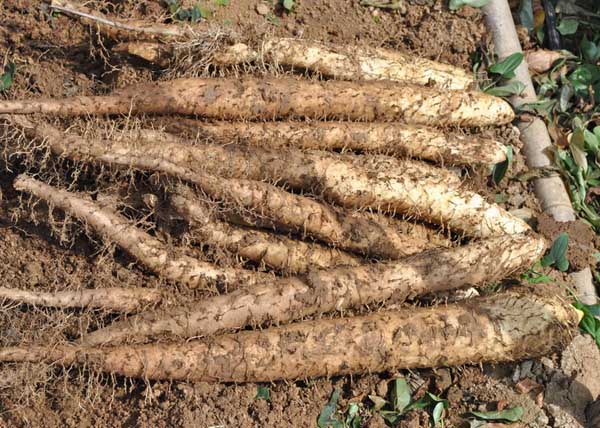
The original producing area of Chinese yam was Jiaozuo, Henan. It is now also produced in Hunan, Hubei, Shanxi, Yunnan, Hebei, Shaanxi, Jiangsu, Zhejiang, Jiangxi, Guizhou, Sichuan, Shandong and other places. On the bank of the Si River in Taiping Town, Shandong, the output of Chinese yam is not large, but its quality is very high, and it has a relatively long history. It was once a tribute item in the Qing Dynasty.
In the Song Dynasty, the great poet Chen Dasou wrote in his work "Yuting Zan": "In the mountains there is a miraculous medicine, green as a immortal prescription; cut several slices of jade, pure white with a floral fragrance." This refers to the winter delicacy——Chinese yam. Going 20 li west from Ruichang City, Jiangxi Province, crossing the rolling mountain paths, bypassing the picturesque Longyuan Reservoir, and going up the mountain along the newly built cement country road, you reach Luocheng Mountain, one of the Chinese yam bases of Nanyang Township. The parent soil formed here by the weathering of limestone over thousands of years of wind and rain provides a special growing soil for Nanyang Chinese yam. The area around Luocheng Mountain in Nanyang has a long history of cultivating Chinese yam. According to the "Ruichang County Annals" from the Longqing period of the Ming Dynasty, Ruichang Chinese yam has a cultivation history of more than 500 years. At that time, Luocheng Mountain in Nanyang was one of the important production areas of products and medicinal materials in Ruichang, Jiangxi.
Authentic Chinese yam
① The surface of authentic Chinese yam is yellow-white or pale yellow, with longitudinal grooves, longitudinal wrinkles and fibrous root marks, and occasionally residual light brown outer skin. It is heavy, solid and hard, not easy to break; the broken surface is white and starchy, with fine dot-like protrusions. The odor is slight, the taste is bland and slightly sour, and it becomes sticky when chewed.
② The starch grains of authentic Chinese yam are simple grains that are flat oval, nearly round, triangular-ovate or rectangular-round, 8-35μm in diameter; the hilum is dot-like, herringbone-like, cross-like or short-slit-like, and striations may be visible; compound grains are rare and composed of 2-3 component grains.
③ The calcium oxalate raphide bundles of authentic Chinese yam exist in mucilage cells, about up to 240μm long, with raphides 2-5μm thick.
④ The bordered-pitted, reticulate, spiral and annular vessels of authentic Chinese yam are 12-48μm in diameter.
Adulterants of Chinese yam
① Cassava: often in sliced form, with most of the outer skin removed; residual outer skin is brown or brownish-brown; the cut surface is white and starchy; near the skin, obvious vein-like ring lines can be seen; in the center there is a small woody core, and some show cracks; it feels like talcum powder when touched. The odor is slight and the taste is bland.
② Greater yam: irregular cylindrical or conical, with relatively thick residual cork layer, yellow-brown or red-brown; the woody patches are bright earthy yellow (these are stone cells) and fall off relatively easily. It is solid, and the broken surface is pale yellow-white, starchy, with a few pale brown dot-like substances. Odorless, sweet taste, slightly sour, and sticky when chewed.
③ Sweet potato: nearly round or irregular thick slices, with relatively thick residual outer skin that is pale red or gray-brown. The cut surface is white or pale yellow-white, slightly elastic, and pale yellow-brown "vein" dots or line markings can be seen; near the skin, a ring of pale yellow-brown ring lines can be seen. It is brittle, starchy, and sweet in taste.