Detailed Explanation of Key Pumpkin Cultivation Techniques and Field Management Methods
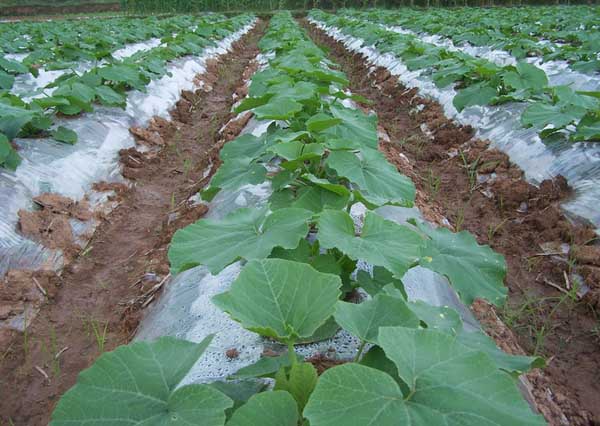
Pumpkin, also known as wogua, fangua, fangua, and fanpumpkin, is a plant of the Cucurbitaceae family and Cucurbita genus. It is an annual trailing herb; the stems often root at the nodes and extend 2-5 m, densely covered with short white bristles. The petioles are stout. It originated in the region from Mexico to Central America and is widely cultivated around the world. It was introduced to China during the Ming Dynasty and is now widely grown in both the north and south. The young fruit is sweet and palatable and is one of the melon vegetables of summer and autumn.
Pumpkin Plantation Site Construction
A plot with higher terrain, good drainage, loose soil, and good aeration should be selected, preferably sandy loam and light loam. Low-lying, easily waterlogged plots are not suitable for growing pumpkins. The soil should be slightly acidic, with a pH between 5.5 and 6.8. Continuous cropping or alternating cropping with Cucurbitaceae and Solanaceae crops should be avoided to prevent severe soil-borne diseases. Land preparation should be careful. Before land preparation, apply 3000 to 5000 kg of high-quality farmyard manure and 20 kg of diammonium phosphate per 667 sq m; if conditions permit, biological bacterial fertilizer can also be applied.
Sowing Time for Pumpkin
The sowing period depends on the specific conditions of the year and locality. The basic principle is to let the seedlings emerge after the last frost, and sprouted seeds should be sown. In the Yangtze River basin, it is generally from February to April. For early sowing, use a hotbed or cold frame to raise seedlings; after mid-to-late March, direct sowing after sprouting can be done. In South China, sowing can be done from February to September. It is mainly divided into spring sowing in February-March and autumn sowing in August-September. The specific method is: soak the seeds in hot water at 55 to 60°C for 15 minutes to kill bacteria on the seed coat surface, then pour in cool water to cool to 30°C, and soak for another 4 to 6 hours. After taking them out, wrap them in wet gauze or a towel and place them at 25 to 30°C to sprout until about 0.3 cm, then they can be sown. Dig holes at a plant spacing of 50 cm, digging one ridge and leaving one ridge empty, so that the plant-row spacing is 50×120 cm, which is conducive to ventilation, light penetration, and disease prevention. First water the holes, and after the water seeps in, place 2 seeds flat in each hole with the sprout facing downward, cover with 2 to 3 cm of fine soil, and if conditions permit, cover with plastic film. In fact, because pumpkin planting has a large row spacing, little film is used, costing only about 10-plus yuan per mu. However, when covering with film, clods must be broken up so that the film fits tightly against the ridge surface, is stretched tight on all sides, and is pressed into the soil; otherwise, the effect of the film will not be obvious. Generally, no watering is needed during the seedling stage. When the seedlings grow to 3 true leaves, select robust large seedlings with intact cotyledons, keep one plant per hole, and cut the rest off at ground level.
Chemical Weed Control in the Plantation
Carry out pre-emergence closed treatment before weeds emerge. Relatively ideal herbicides include 33% Shitianpu, with a dosage of 100 g per mu mixed with 60 kg of water; or 25% Nongsita emulsifiable concentrate, with a dosage of 150 g per mu mixed with 60 kg of water and sprayed evenly. If weeds have already emerged before sowing, a non-selective herbicide such as 41% Chunduoduo (glyphosate) can be used to kill the weeds including roots before sowing, with a dosage of 200 to 300 ml per mu mixed with 30 to 40 kg of water and sprayed on the stems and leaves of the weeds; it generally takes effect in 6 to 7 days. This agent does not leave residues in the soil and will not cause any adverse effects on crops transplanted in the current season or sown in the next crop. To improve the weed prevention and weed-killing effect of the herbicide, several points should be noted when spraying: spray evenly and do not miss any area. Especially for pre-emergence weed control, spray while walking backward to prevent footprints from damaging the chemical film and reducing the effect. Second, in dry conditions, water first or spray after rain, as this gives a better weed control effect. For non-selective herbicides, the dosage should be increased in dry weather.
Field Management for Pumpkin Cultivation
A single pumpkin plant can produce many branches. To prevent nutrients from being too dispersed, pruning is necessary. Keep 2-3 main vines per plant, and according to soil fertility and vine growth, the terminal buds can be removed after several fruits have set. As long as the soil is fertile and watering and fertilizing are done frequently, pumpkins generally set a fruit every 3-5 leaves; if too many fruits are retained, they will not grow large. Axillary buds are very likely to grow at the leaf axils of the fruit, and care should be taken to remove them; otherwise, they compete with the fruit for nutrients, causing the fruit to wither and drop due to insufficient nutrients.
1. Timely sowing: For open-field cultivation of chestnut-flavored pumpkin, spring planting is the main method, with sowing and seedling raising in January-February; for autumn planting, direct sowing can be done in August-September, but viral disease occurs severely and the risk is relatively high. Zucchini has strong cold resistance and can be sown and raised as seedlings from December to mid-February of the following year, or directly sown in late autumn in October. For Chinese pumpkin, spring planting is in February-March, with sowing and seedling raising in early March, while direct sowing in autumn in late July to early August is preferable. During the seedling period, use "high-low" temperature management, that is, maintain high temperature after sowing to promote emergence, and after most seedlings emerge, strengthen ventilation and appropriately lower the temperature inside the shed. Facility cultivation for winter planting of chestnut-flavored pumpkin and zucchini gives better results.
2. Timely transplanting: Choose plots that have not grown cucurbit vegetables for 2-3 years, with good light, convenient irrigation and drainage, and soil pH 5.5-6.8 loam or sandy loam. Transplant when the seedlings have 2-3 true leaves. For dwarf varieties, the bed width is about 1.5 m, plant spacing about 0.6 m, with double-row planting. For long-vine varieties, the bed width is 2-2.5 m, plant spacing 0.6-0.7 m; single-row planting for ground crawling cultivation, and double-row planting for trellis cultivation. Combined with land preparation and ditch opening, apply about 2000 kg of decomposed organic fertilizer, 0 kg of phosphate fertilizer, and 15 kg of compound fertilizer per mu to the planting ditch. Choose a sunny day at the end of a cold spell for transplanting. Viral disease occurs severely in autumn planting, so appropriate close planting can be used, and seedlings should be finalized before vine extension to ensure a full stand.
3. Vine training and branch retention: Long-vine varieties usually retain 2-3 vines per plant. Topping can be done at 5-6 true leaves, selecting and retaining 2-3 robust and evenly sized secondary vines, or retain the main vine and then select and retain 1-2 robust secondary vines. All other lateral vines must be removed. Dwarf zucchini generally does not undergo topping or pruning. During growth, remove old leaves and leaves in a timely manner.
4. Fertilizer and water management: After transplanting, water thoroughly to settle the roots. After the seedlings recover, apply 0.5% urea 1-2 times to promote seedling growth. Topdressing is generally divided into 2-3 applications. The first is during the vine extension stage or before row closure, combined with intertillage and weeding, applying 10 kg of compound fertilizer per mu. The second is during the fruit swelling stage, applying 15 kg of compound fertilizer per mu. The third depends on plant growth conditions and is applied during the fruit swelling stage of the second and third fruits at 10 kg of compound fertilizer per mu. The fruit swelling stage requires more water, so timely irrigation is needed. The occurrence of viral disease in autumn planting is closely related to the supply of fertilizer and water in the early growth stage. Applying more water and fertilizer to promote rapid plant growth and avoiding water and fertilizer deficiency can effectively reduce the occurrence of viral disease. Spring planting has more rain, so drainage work should be done well to reduce field humidity. In the middle and late stages of autumn planting, there is less rain, so furrow irrigation should be carried out well.
5. Flower and fruit protection: When pumpkins bloom under high temperature or heavy rain, poor pollination is likely to occur, making fruit setting difficult. Artificial supplementary pollination should be carried out to increase the fruit-setting rate. Artificial pollination is best done in the morning. Pick freshly opened male flowers, remove the corolla, and lightly smear the pollen onto the stigma of female flowers. For branched fruits, leave 2 leaves before topping, select and retain one normal fruit per vine, and remove excess and deformed fruits. For zucchini planted in early spring, the temperature in the early fruiting stage is low, there are more female flowers, fewer male flowers, and insufficient pollen, which is unfavorable for pollination and fertilization and prone to flower and fruit drop. When female flowers open, 20-30 mg/kg of anti-drop agent can be applied to the stigma of female flowers to promote fruit setting.
6. Measures to Prevent Flower and Fruit Drop
① Regulate the relationship between growth and fruiting. Before the first fruit sets, water and fertilizer supply should be controlled to inhibit vegetative growth and promote reproductive growth, and pruning and branch removal should be done in a timely manner to prevent excessive lateral vines and plant overgrowth.
② Artificial pollination. Pumpkin is a monoecious plant with unisexual flowers and needs insect vectors to spread pollen in order to achieve pollination and fruit set. If continuous rainy weather occurs during the flowering period, insect activity is hindered, and if artificial pollination is not carried out, the phenomenon of "difficult fruit setting" will occur. Artificial pollination should be carried out from 6 to 8 in the morning. Collect male flowers, remove the petals, and let the stamens contact the stigma of female flowers. In addition, hormones can also be used to promote fruit setting.
Pumpkin Pest and Disease Control
Pumpkin has strong adaptability to external conditions, and pests and diseases are relatively mild.
1. Common pumpkin diseases include: powdery mildew, viral disease, phytophthora blight, anthracnose, etc. Among them, viral disease causes the most serious damage and often leads to a large number of flower and fruit drops. Control method: spray 500 to 600 times dilution of chlorothalonil, or 500 to 600 times dilution of raymycin plus 500 to 600 times dilution of carbendazim, spraying 2 to 3 times during the pumpkin growth and development period, which can prevent disease occurrence.
2. The main pumpkin insect pests are aphids, red spiders, white grubs, etc. Control measures: spray 1000 times dilution of 90% trichlorfon, and for underground pests, use 90% trichlorfon mixed with fried fragrant bait to trap and kill them.
Pumpkin Harvest
The fruit matures 40 days after female flower pollination. The sign of maturity is that the fruit stalk becomes woody and protrudes outward. At this time, it can be harvested and stored in a cool, ventilated place. The fruit stalk should be left 2 to 3 cm, and should not be too long.
Recommendation: High-efficiency intercropping and relay intercropping of waxy corn, pumpkin, and Chinese cabbage (radish) can achieve land value increase and farmer income increase. That is, plant waxy corn early around April 25, plant pumpkin on May 15, and after harvesting the waxy corn, plant Chinese cabbage or radish.