A Detailed Guide to the Planting Techniques and Management Methods for Orychophragmus violaceus
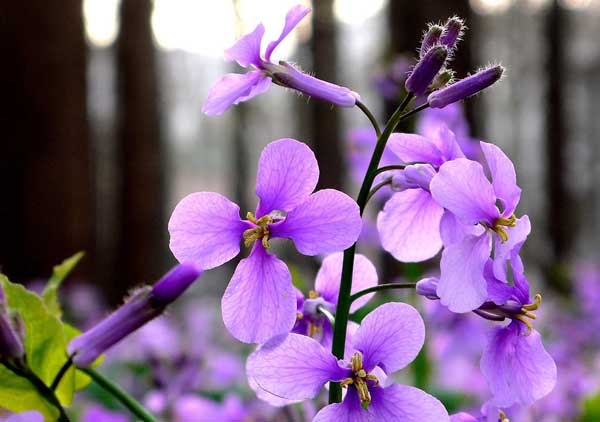
Orychophragmus violaceus (February orchid) mainly grows in the northern regions of China, and in the second lunar month of spring it blooms with purple flowers, making it a relatively early-flowering plant. Orychophragmus violaceus has extremely strong vitality and strong adaptability to the northern environment; in particular, it can endure northern winters and has very strong cold resistance. Orychophragmus violaceus especially prefers shady and damp growing environments and has low requirements for water and light; as for soil, it is suitable for growing in slightly alkaline soil. It is a type of plant that remains evergreen all year round, and it is the first to bloom in early spring, carrying the meaning of heralding the arrival of spring; it is a very plain and lovely plant.
Planting Techniques
Orychophragmus violaceus is mainly propagated by seed and has strong regeneration ability; after the plants wither, seeds that have just fallen will quickly germinate and grow into new plant seedlings. On soil that has not been plowed, seeds sown by hand can also develop into seedlings, and the plant has strong weed resistance. Therefore, cultivation and management can be relatively extensive and fairly easy. Some freshly harvested seeds have a physiological after-ripening phenomenon, so early sowing results in a low germination rate, and germination may continue for 1 to 2 months or even longer. Sowing can be done in summer or autumn, but August to September is the most suitable time. Each gram contains 300 to 400 seeds, and the sowing rate is about 1 kg per mu. If calculated per square meter, it should be 1 to 2 grams per square meter. If the spray-sowing method is used, the amount per unit area should preferably be increased by 10 to 20%.
For the potting soil, mix and blend garden soil, perlite, and plant ash thoroughly in a ratio of 6:2:1. When potting, apply sufficient base fertilizer. After the seedlings stand upright, move the pots to a sunny place for routine fertilizer and water management.
Compared with other flowers, cultivation management is relatively extensive, and little additional care is needed. It has strong cold resistance and shade tolerance, and with a certain amount of scattered light it can grow, bloom, and set seed normally. It is not strict about soil requirements. It is best to choose loose, fertile, and well-drained sandy soil. As long as it is watered and fertilized in a timely manner, it can grow robustly with only a little management. Fertilize 4 times a year: flower bud fertilizer in early spring, vigor fertilizer after the flowers fade, fruit-setting fertilizer after fruit set, and seedling-strengthening fertilizer before winter. If a 0.2% potassium dihydrogen phosphate solution is sprayed on the leaves once during the bud stage and once during the young fruit stage, the flower color will be more brilliant and the fruit will be fuller. The flowering period is from early spring to June. The silique is elongated, maturing in June. The seeds are dark brown and oval. In winter, Orychophragmus violaceus has lush green leaves, and in early spring the flowers bloom in patches. If heavy frost occurs in winter, frost protection measures should be strengthened. If grown for eating, divide the plants frequently to promote the sprouting of tender stems and leaves.
Weed Management
Water before sowing to promote the germination of weed seeds in the topsoil. If soil moisture is moderate, the seeds can germinate within two weeks. Do not plow the soil again, otherwise more weed seeds will be brought to the surface soil. Applying herbicide spray can basically eradicate weeds, but be sure to rest for a period after applying the herbicide before sowing, because herbicides are harmful to any plant.
Be sure to pay attention to safety when using chemical herbicides, and avoid chemical residues affecting the germination and growth of flower seeds. Therefore, generally before sowing a wildflower mix, the soil should be given a 3-4 week recovery period, and then the wildflower mix can be planted, because extensive use of herbicides may delay seed germination or weaken the growth vigor of flower seedlings.
Remove weeds promptly when the flower seeds germinate, so as to prevent them from spreading. If conditions permit, weeds should be pulled out immediately whenever they are found. In addition, a relatively effective method is to use a broad-spectrum herbicide or to cut them with a lawn mower (or brush cutter). Make sure to remove weeds before they shed seed. Many annual or perennial weeds can be controlled with specialized herbicides. These herbicides do not affect the growth and development of broadleaf plants and can be used on wildflower mixes; spraying them on newly emerged small seedlings works very well.
Pruning and Cleanup
To keep a wildflower mix consistently good in ornamental effect in landscape arrangements, it must be prevented from setting seed; generally, during the seed-setting period, use a lawn mower to trim it to a height of 10-15 cm. In addition, when preparing the land for autumn sowing, remove ground debris that hinders good contact between seeds and soil, including dead branches and fallen leaves. At present, in the field of landscaping, creating natural and diverse garden landscapes, exploring plant application forms that return to simplicity and nature, and building a conservation-oriented and sustainably developing ecological environment are the directions for future development. Wildflower mixes can create natural and beautiful landscape effects, and with their extensive management, rich species diversity, abundant wild charm, low establishment cost, and long ornamental period, they will become the most distinctive element in the field of landscaping and be most widely used. Orychophragmus violaceus planting techniques.
Disease Control
The main disease and pest of Orychophragmus violaceus is downy mildew.
Symptoms. In the early stage of the disease, yellow-green, polygonal spots appear on the leaf surface. Subsequently, a white downy mildew layer forms on the underside of the lesions, causing swelling and bending on stems and flowers and greening of the petals.
Pathogen. The pathogen is a fungus in the genus Peronospora. This disease mostly occurs on the lower leaves of Orychophragmus violaceus. Especially in April, when the weather is cold, overcast, and damp, plants are more likely to become infected. Planting too densely can also lead to the occurrence of this disease.
Diagnosis and countermeasures. Choose a site with good ventilation and light transmission for planting. Keep planting density reasonable. Spray a 500-fold dilution of 50% Yimeijing.