Where is okra native to? Introduction to the distribution of its main producing areas
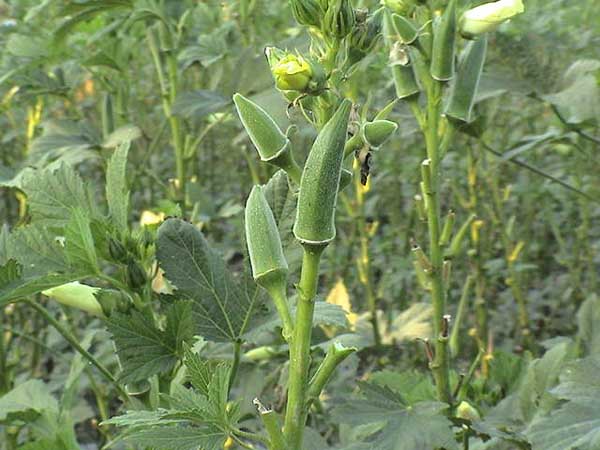
Okra originated in Africa, with relatively extensive cultivation in Egypt and in Antigua and Barbados in the Caribbean, and it is one of the vegetables favored by the people of Africa, the Americas and Southeast Asia. It was introduced into China from India and has been cultivated for about 60 years. There is a small amount of cultivation around cities across the country, mostly in southern cities.
Okra is an annual herb. Its root is a taproot system with a well-developed main root that penetrates deep into the soil. The stem is erect, highly lignified, cylindrical, 1-2 m tall, with lateral branches, green or dark purple, and covered with coarse hairs. The leaves are alternate, usually palmately 5-7 parted, 6-15 cm in diameter, with lobes lanceolate to triangular, irregularly serrate at the margins, occasionally shallowly lobed and resembling maple leaves, with a cordate base, and sparsely covered with stiff hairs on both surfaces.
The petiole of okra is slender, up to 7-15 cm long, and sparsely covered with stiff hairs. The stipules are linear, 7-8 mm long. Above the third node of the main stem, in addition to lateral branches, each node bears 1 flower, bisexual, yellow, with five sepals and five petals. The flowers are solitary in the leaf axils, with pedicels 2-3 cm long, covered with reflexed stiff hairs; bracteoles 8-10, linear, 10-13 mm long; the calyx is spathe-like, 2-3 cm long, 5-lobed, usually caducous; the flower is yellow, dark purple at the base inside, 7-12 cm in diameter; the staminal column is about 2.5 cm long, smooth and hairless; the style has 5 branches, the stigma is discoid, and the flowers often open at 8-9 am and wilt in the afternoon.
The capsule of okra is oblong, 5-6 cm long, pointed at the apex, covered with long yellow stiff hairs; the seeds are reniform, with glandular veins, and aromatic. The flowering period is June to October.