What is tsaoko? A guide to this commonly used spice crop
Tsaoko is a perennial herb, 2-2.5 m tall. Its root system consists of supporting roots (which are actually stems) and nutrient roots. The so-called supporting roots are the thick, jointed horizontal rhizomes formed by the swollen lower part of the main stem, resembling ginger. The nutrient roots are the thinner pink fibrous roots growing on both sides and at the tips of the supporting roots; they penetrate 10-30 cm into the soil and can grow to 1-2 m long, serving to absorb nutrients and water.
The entire tsaoko plant has a pungent odor. The base of the stem is swollen, reaching 6 cm in diameter; the stem is divided into erect stems and rhizomes. The erect stems emerge from leaf buds on the horizontal rhizomes, growing in clumps, reaching 2.5—4 m tall, dark green with purplish-red at the base, light yellow and fleshy inside, cylindrical and jointed, growing upright or following the slope, generally bearing 12-16 leaves. The rhizomes creep and extend underground, also called creeping stems; from the swollen base of the erect stems and the internodes of the rhizomes, new creeping stems grow symmetrically on both sides, about 8-11 in number, penetrating 10-20 cm deep into the soil, 30-80 cm long and 2-3 cm thick, serving to support and store nutrients. When the rhizomes grow to a certain extent, they send up new shoots, which grow into new plants (erect stems) the following year. Latent buds within the scales on the rhizomes can sprout into flower buds and leaf buds; that is, sprouted flower buds can develop into flower spikes, while sprouted leaf buds develop into erect stems. After flowering and fruiting, the nearby erect stem cluster naturally withers.
The leaves of tsaoko are arranged in 2 rows, with short petioles or sessile; the leaf blades are long-elliptic or narrowly oblong, about 55 cm long and up to 20 cm wide, with acuminate tips, attenuate bases, entire margins that are membranous at the edge, and both surfaces smooth and hairless; the leaf sheaths are open and sheath the stem, the ligule is 0.8-1.2 cm long, purple-tinged, and the leaf sheaths are striated. The flowering stem emerges from the base of the stem, long-acuminate, with a cuneate base, entire, hairless on both surfaces. Tsaoko has a spicate inflorescence arising from the rhizome, spherical in shape, with 60-120 flowers per spike. The flowers are bisexual, arranged spirally on the rachis; each floret is enclosed by purplish-red bracts layer upon layer, so the unopened flower spike appears purplish-red. When blooming, the flowers open gradually from bottom to top in a clockwise spiral, and the first flowers to open also fade first. The inflorescence axis is about 18 cm long, densely covered with purplish-red bracts; the bracts are elliptic with gradually pointed tips, 5.5-9.5 cm long and 2.5-3.5 cm wide, with acuminate apex, herbaceous. Within the bracts, each floret bears a small bracteole; the bracteoles are light purplish-red, needle-shaped, about 3.5-4 cm long and 0.8 cm wide, with acuminate tips. The calyx is tubular, about 2.5 cm long and 0.7 cm wide, split to the middle on one side, with two teeth at the apex. The corolla is golden yellow; the corolla tube is about 3 cm long; the labellum is elliptic, about 3.5 cm long and about 0.4 cm wide, with slightly toothed apex, undulate margins, and a fleshy thickened midrib bearing two dark red stripes. The anther is 1.8 cm long; the middle lobe of the anther is fan-shaped, the lateral lobes slightly narrower, with two anther sacs. There is one pistil, located slightly above the anther sacs; the stigma is elliptic with a slightly concave center; the style is 4-4.5 cm long; the ovary is inferior, spherical, three-locular, with numerous ovules; at the top of the ovary are two nectaries, about 0.5 cm long, pale yellow.
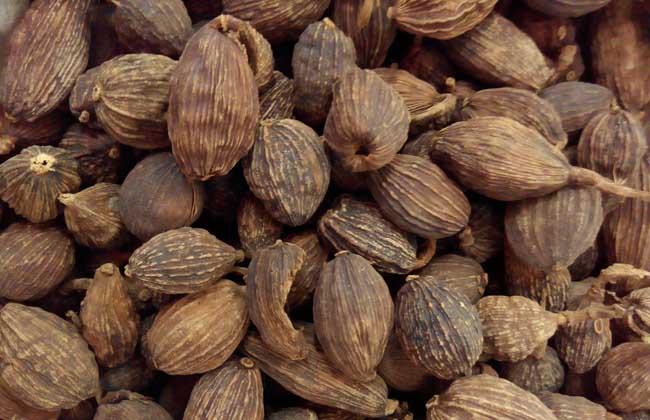
The fruit of tsaoko is a non-dehiscent capsule; the fruit is rich in fiber and hard in texture after drying. The fruit shape is spindle-shaped, ovoid, or nearly spherical, densely arranged in a spiral on a rachis. Each spike bears 15-60 fruits; each fruit is 2.5-4 cm long and 1.4-2 cm in diameter, with a short stalk at its base. Young fruits are bright red, turning purplish-red at maturity and brown after roasting; they do not dehisce, with a gradually narrowed apex forming a thick margin, tough and hard, with relatively neat straight fiber stripes.
Each tsaoko fruit contains 20-66 seeds. The seeds are polygonal, about 0.4-0.7 cm long and about 0.3-0.5 cm wide, each seed covered by a white spongy membrane. The kernel is white, with a rich, fresh, pungent aroma. The average thousand-grain weight is 120-140 g; each kilogram of fresh seeds contains about 6000-7000 grains.
The flowering period of tsaoko is April to June, and the fruiting period is September to December.