Detailed Explanation of Key Points for the Prevention and Control of Cucumber Anthracnose
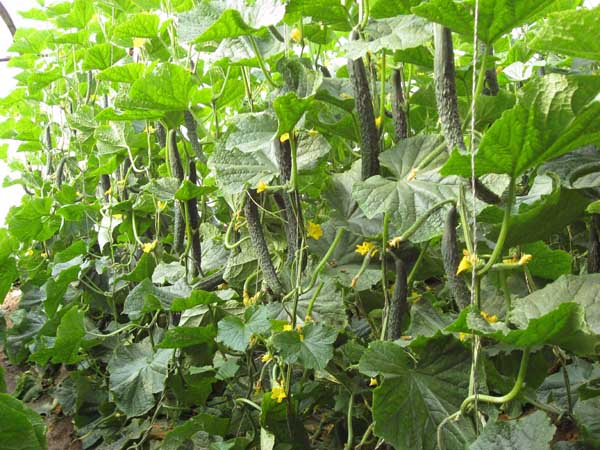
In recent years, cucumber anthracnose has been occurring with increasing severity, caused by contaminated introduced seeds. It occurs in both spring and autumn, is difficult to control, and has a huge impact on production.
Symptoms of Cucumber Anthracnose
Cucumber anthracnose can occur from the seedling stage to the mature plant stage. When seedlings are affected, semi-elliptical light brown lesions mostly appear along the edges of the cotyledons, bearing orange-yellow dot-like gelatinous matter; when mature leaves are infected, the lesions are nearly round, 4-18 mm in diameter, grayish brown to reddish brown, and in severe cases the leaves dry up; when stems and vines and leaf stalks are infected, the lesions are elliptical or oblong, yellow-brown, slightly sunken, and in severe cases the lesions join together, encircle the stem, and the plant dies; when the fruit is infected, the lesions are nearly round, initially light green, later turning yellow-brown, slightly sunken, with pink sticky matter on the surface, and later cracking.
Pathogen of Cucumber Anthracnose
Cucumber anthracnose is caused by infection by the fungus Colletotrichum lagenarium (Glomerella lagenaria anamorph) of the subphylum Deuteromycotina. The pathogen overwinters as mycelium or pseudosclerotia on seeds or in the soil with diseased plant residues.
Disease Characteristics of Cucumber Anthracnose
When conditions are suitable in the following spring, the pathogen produces acervuli and a large number of conidia, which become the primary infection source. The pathogen spreads via wind and rain, irrigation water, and farming operations, causing secondary infection. Seed transport can cause long-distance spread. The suitable temperature for disease onset in the field is 20-27°C, the optimum growth temperature for the pathogen is 24°C, and when the relative air humidity is above 95% and there are dew droplets on the leaves, disease onset is favored; under suitable temperature and humidity the incubation period is only 3 days. Cucumber fields with clay soil, poor drainage, excessive nitrogen fertilizer application, insufficient light in protected cultivation, and delayed ventilation have more severe disease. In Zhejiang and the middle and lower reaches of the Yangtze River, cucumber anthracnose mostly occurs in protected cultivation, with peak disease periods in May-June and September-October.
Prevention and Control Measures for Cucumber Anthracnose
Starting from the seedling stage, spray 30 ml of "Sujing" diluted in 15 kg of water, once every 5-7 days. For treatment: spray 50 ml of "Sujing" + 15-20 ml of "Garlic Oil" diluted in 15 kg of water, once every 3-5 days, for 2-3 consecutive applications.
1. Low temperature and high humidity, poor ventilation and light penetration, humidity above 97%, and humidity around 22-27°C: disease onset is most severe, and open-field cucumbers are prone to mixed infection with bacterial diseases.
2. Choose well-drained sandy loam soil for planting, and avoid low-lying plots with poor drainage.
3. Spray with 150-200 times dilution of Nongkang 120 (pyrimidine nucleoside antibiotic); 600-800 times dilution of 70% mancozeb wettable powder; 800-1200 times dilution of 38% oxadixyl-cymoxanil-copper fungicide; 800 times dilution of 20% flusilazole-prochloraz; 600 times dilution of 56% azoxystrobin-chlorothalonil; 500-600 times dilution of 58% metalaxyl-mancozeb wettable powder; 600 times dilution of Pingfuling (a fruit tree medication) spray; 300 times dilution of a 1:1 mixture of 50% thiram wettable powder and 50% carbendazim wettable powder; 1000 times dilution of 50% Shibaogong wettable powder.