Detailed Guide to Welsh Onion Cultivation: Full-Course Instruction from Sowing to Harvest
The Welsh onion belongs to the allium vegetables. Allium vegetables include garlic, onion, Welsh onion, bunching onion, Chinese chives, leek, rakkyo, and others. They all have a distinctive pungent odor, so they are also called aromatic vegetables. Allium vegetables are rich in vitamin C, carbohydrates, and various minerals, especially containing more sulfur, phosphorus, and iron. Eating allium vegetables can stimulate the appetite, and they are also an antibacterial substance. People have a strong liking for allium vegetables. The edible part of the Welsh onion is mainly the false stem, which is earthed up and blanched during cultivation, so its false stem becomes the white scallion, and such Welsh onions are also called “white onions”.
The Welsh onion is a biennial plant, but in cultivation it is grown as a triennial. In the traditional cultivation method, it is sown in autumn of the first year, overwintering as seedlings; transplanted in summer of the second year, and the white scallion is harvested in early winter; if seeds are to be collected, the grown plants are stored overwinter in the open field or in facilities, pass through the vernalization stage at a temperature of 2—5℃, and are transplanted again to the open field in the spring of the third year, bolting and flowering under long-day conditions, with seeds harvested at the summer solstice.
Welsh onions can be sown in autumn or in spring. Export Welsh onions are generally spring-sown, and the white scallion is harvested from the end of October of the same year, then trimmed and packaged for export. The roots of the Welsh onion are fibrous adventitious roots, mainly distributed in the soil layer 30 cm underground and 15—30 cm laterally.
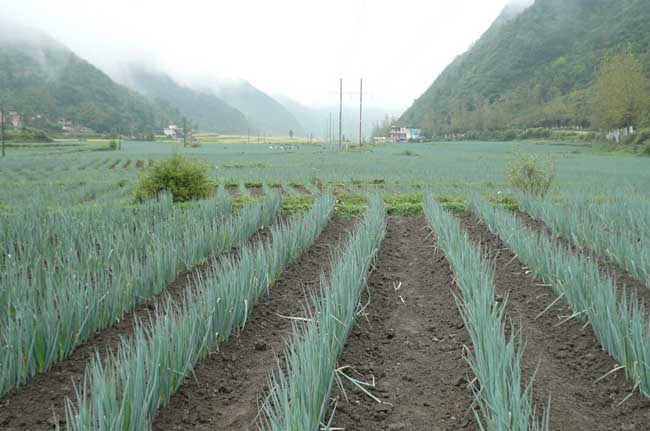
Environmental Requirements
1. Temperature. It prefers cool climatic conditions; the optimum temperature for germination is 13—20℃, the optimum temperature for plant growth is 20—25℃; below 10℃ growth is slow, above 25℃ growth is spindly, leaves turn yellow, and diseases are prone to occur; at 35—40℃ it is in a semi-dormant state, and some outer leaves wither.
2. Moisture. Its drought tolerance is very strong, but because the root system is weak, it requires 70—80% soil moisture, and growth is favorable when air humidity is 60—70%.
3. Light. Its demand for light is relatively low, so dense planting is suitable.
4. Soil and nutrition. It grows well in loam with good drainage and deep, fertile soil. Throughout the growth process, nitrogen fertilizer is the main requirement, but more phosphorus and potassium fertilizer is needed in the later growth stage.
Raising Strong Seedlings
1. Seedbed selection. The Welsh onion is a vegetable that avoids continuous cropping, and the seedling bed also avoids continuous cropping. The seedling bed should be chosen as high-lying land whose previous crop was not an allium crop. Never choose grassy wasteland, otherwise the seedling bed will be overgrown with weeds. Seedling raising must be assigned to a dedicated person.
2. After the previous crop is harvested, plow deeply and sun-bleach twice, and leave fallow for 20 days. The Welsh onion seedling period lasts as long as 50 days, so the seedling bed should be applied with 1000 kg of decomposed manure per mu. The bed width including the ditch is 1.5 m, made into a small flat bed with a net width of 1.1 m. Prepare the soil finely. Open good ditches around the perimeter.
3. For export Welsh onions, the varieties are generally designated by foreign buyers, mainly including: Changbao, Changyue, Mingyan, Jinchang No. 3, etc. For every 100 grams of seed, 35—40 square meters of seedling bed are needed, and the seedlings thus raised can be transplanted to 1 mu of field. Generally broadcast sowing is used, and sowing must be very uniform. The conventional sowing period is early April.
4. After sowing, water (with insecticide added to the water) to reach 60% soil moisture, and make sure not to water again before emergence. After watering, cover with 0.5 cm of fine dry soil; after covering with soil, do not water, to prevent soil crusting. After sowing and before emergence, plastic film can be used as mulch, which helps raise temperature, retain moisture, and prevent rain from causing soil crusting. But beware of the harm of high temperatures.
5. For Welsh onion seed germination, the fastest temperature is around 18℃. Emergence can occur 5—6 days after sowing. After 60% emergence, remove the plastic film promptly; if the film is removed too late, the seedlings will be spindly and weak. After the film is removed, to prevent heavy rain from washing them away, small hoop sheds should be set up, covering them with film before rain and removing the film after rain, especially within the half month after full emergence and before the seedlings stand, otherwise after heavy rain damping-off disease will occur and a large number of seedlings will collapse.
6. When the seedlings stretch their waists, water once to make the cotyledons straighten and the roots take hold and stabilize the seedlings. Afterward, according to the soil moisture conditions, water with 1—2 more light waterings. Do not use too much water, to avoid excessive seedling growth.
7. During the entire seedling period, topdress 3—4 times, alternating quick-acting organic fertilizer and chemical fertilizer; the chemical fertilizer concentration must be low, not exceeding 0.5%, to promote robust seedling growth and lay a good foundation for raising strong seedlings.
8. During the seedling period, if seedlings have exposed roots, promptly cover with dry fine soil, especially after heavy rain. The seedling bed must be promptly weeded and pests and diseases controlled.
9. Standard for strong seedlings: seedling height 30 cm, false stem thickness 1 cm, dark green leaf color, no pests or diseases, and much accumulated nutrients. Seedling age about 50 days.
Field Preparation
1. The Welsh onion is suitable for growing in loam with good drainage and deep, fertile soil. Sandy loam facilitates inserting the onions, loosening the soil, and earthing up, has good aeration, and easily achieves high yield.
2. Because the Welsh onion needs to be blanched, the land must be deeply plowed and finely worked. After the previous crop is harvested, immediately plow the land deeply 25—30 cm, plow and sun-bleach twice, and at the last plowing apply 2000 kg of high-quality decomposed organic fertilizer per mu; for rice stubble fields with lower soil fertility, the amount of organic fertilizer should be increased accordingly. Rotary till to mix evenly. Then open ditches, with a ditch depth of 30 cm, a ditch width of 20 cm, and a distance of 1 m between two ditches.
3. Plow and turn the inside of the ditch to a depth of 20 cm. Apply base fertilizer at the bottom of the ditch, mainly decomposed manure, with 2000 kg of high-quality manure per mu, so that the soil and fertilizer are mixed, and the soil in the ditch is required to be loose and fine. At this time, the ditch ridge should be more than 30 cm higher than the ditch bottom, for later blanching.
4. The ditch system around the field should be complete, and a waist ditch should be opened every 20 m to facilitate drainage.
Fine Transplanting
1. The transplanting time is generally from late May to early June.
2. Before transplanting, separate large and small seedlings, remove diseased seedlings, weak seedlings, overly small seedlings, and obviously bent seedlings; the plant spacing is 35—40 plants per meter, the row spacing is 1 m, and about 23,000 plants are planted per mu. During transplanting, avoid breaking the onion seedlings; the transplanting depth should be such that the onion heart is not buried; too deep is not suitable for seedling development, and too shallow affects the length of the white scallion. When transplanting, the leaf surface should be arranged perpendicular to the planting ditch, which facilitates dense planting and management.
3. For the transplanting tool, a garden iron spike or garden wooden rod about 1.5 cm in diameter can be used. When transplanting, first make a shallow hole perpendicular to the ground, then insert the seedling, then lift it slightly upward so that the fibrous roots spread downward, and keep the onion seedling upright. If it is bent, the stem will also be bent at harvest time, which makes it a substandard product.
4. Transplanting should be done on the same side of the onion ditch, which facilitates drainage after rain.
5. After transplanting, press firm the loose soil on both sides of the onion plant, then water thoroughly.
Field Management
1. Cultivation and watering
After transplanting, if the weather is not very dry, generally it is not suitable to water again; instead, strengthen cultivation and weeding, loosen the surface soil, and store water to conserve moisture, so as to promote root growth. Pay attention to drainage during heavy rain to prevent water accumulation in the onion ditch, which causes high temperature and high humidity, poor soil aeration, and leads to root rot, yellow leaves, and dead seedlings; therefore, preparations for waterlogging prevention and drainage should be made before rain.
After the Beginning of Autumn, as the temperature drops, watering can begin; watering should be light, in the morning and evening. Afterward, as the plants grow vigorously, gradually increase the number of waterings, and the ground must always be kept moist, generally maintaining 70—80% soil moisture.
In October there is generally little rain, and field water shortage is relatively likely to occur; shallow irrigation in the evening can be used to alleviate the drought, but the field water must be drained promptly. This work must be carried out conscientiously. Watering must stop one week before harvest, otherwise the moisture content is too high and affects export quality.
2. Earthing up and topdressing
While ensuring sufficient fertilizer and water, earthing up is an important measure for blanching and increasing the length of the white scallion. Generally after the plants have taken root, a small amount of soil covering is carried out together with cultivation and weeding; the soil covering must not bury the onion heart or cause the onion seedlings to bend. By early August, fill the planting ditch level. After the autumn cools, carry out earthing up, and thereafter earth up once every half month. From mid-August to early October, earth up four times. Each earthing up must keep the false stem of the onion upright; this is an important measure to ensure the quality of export white onions. Earthing up can use a hilling machine or be done by hand; machine hilling saves labor and cost. Earthing up is done in the morning after the dew has dried, when the soil is cool. If the soil temperature is too high and the humidity is too great, it easily causes stem rot. At the first and second earthing up, the plants grow slowly, so earthing should be relatively shallow; at the third and fourth earthing up, the plants grow rapidly, so earthing should be relatively thick. Each earthing up must not bury the onion heart, and earthing up can be combined with supplementary fertilization. To make the white scallion length more than 30 cm, more than 35 cm of the onion stem must be buried in the soil. In some fields, although earthing up reaches four times, if the white scallion length is insufficient, it must be continued. During typhoon season, earthing up should be strengthened even more to prevent lodging and the resulting bending of the onion stem. Welsh onion growth requires more nitrogen fertilizer, but in the later growth stage it needs more phosphorus and potassium fertilizer. Topdressing generally begins after the autumn cools, combined with watering and earthing up. Topdressing is mainly nitrogen fertilizer, with an appropriate increase in phosphorus and potassium fertilizer. In August, topdress twice, each time with 8—10 kg of urea per mu. After early September, the climate is cool, the plants begin to grow vigorously, and the white scallion grows very quickly; attention should be paid to applying heavy topdressing. From September to early October, topdress 2 times, each time with 10—12 kg of urea and 40 kg of imported compound fertilizer per mu. After each topdressing, water thoroughly in time to promote uninterrupted growth of the Welsh onion.
Total fertilizer use per mu of field: for medium-fertility fields, 4000 kg of decomposed organic fertilizer, 80 kg of imported compound fertilizer, and 40 kg of urea.
Pest and Disease Control
The main diseases of the Welsh onion are purple blotch, onion rust, and soft rot; the main pests are onion thrips, leafminer, and armyworm.
1. Purple blotch mainly harms leaves and flower stalks. It initially appears as small water-soaked white spots, then turns into light brown round or spindle-shaped slightly sunken spots, and continues to expand into brown or dark purple. The optimum temperature for disease onset is 25—27℃; it is severe in warm and humid summers, and severe in old seedling fields and fields lacking fertilizer. Control: crop rotation; in the early stage of disease, spray with chlorothalonil 500 times or oxadixyl 500 times or iprodione 1500 times. Once every 7—10 days, 3—4 times continuously.
2. Onion rust mainly harms leaves, stems, and flower stalks. It initially appears as orange-yellow or dark brown blister spots, then releases orange-yellow or dark brown powder. The optimum temperature for spore germination is 9—18℃; above 24℃ the germination rate decreases markedly; it is severe in years with low temperatures, insufficient fertilizer, and poor growth. Control: apply sufficient organic fertilizer and increase phosphorus and potassium fertilizer; in the early stage of disease, spray with difenoconazole 3000 times or mancozeb 1000 times or chlorothalonil 500 times. Once every 10 days, 2—3 times continuously.
3. Welsh onion soft rot is caused by bacteria; high temperature and high humidity, mechanical injury, and insect wounds easily cause the disease to become epidemic. The disease symptoms are that the aboveground part of the Welsh onion lodges and is easy to pull up, the lower part of the stem rots, and there is a foul odor. Control: keep field drainage unobstructed, and do not let water accumulate after rain; control pests in time to prevent disease transmission, and avoid injuring the Welsh onion during earthing up. For chemicals, 77% copper hydroxide (or 77% Kocide) 500 times solution and 72% agricultural streptomycin sulfate 4000 times solution can be used.
4. Onion thrips. The adult body length is 1.2—1.4 mm, and it harms the heart leaves and tender buds of the onion. At 25℃ and relative humidity below 60%, it is favorable for onion thrips occurrence. Control: imidacloprid 4000 times or acetamiprid 2000 times or spirotetramat 20000 times
5. Leafminer. The larvae bore and feed within the leaf mesophyll tissue, gnawing the leaf mesophyll, causing reduced yield and declined quality, and at the same time spreading diseases. In this region there is damage from mid-May to the end of October. Control: spray with diflubenzuron 2500 times or cyromazine 1500 times or abamectin 3000 times or fenvalerate 2000 times solution. The application time is preferably in the morning.
6. Armyworm. The tobacco cutworm and the beet armyworm also harm Welsh onions, gnawing leaves and boring into the Welsh onion. Generally the damage is more severe in the second half of the year. Spray with flufenoxuron 1500 times or tebufenozide 1500 times solution, or indoxacarb 3500 times solution for control. For controlling armyworms, the spraying time in the evening or at dusk gives good control. Welsh onion leaves have a waxy powder; to improve the adhesion of the chemical, neutral soap should be added to the spray solution. Stop using chemicals 10 days before harvest. Pest and disease control must be organized with professional personnel to improve quality and safe use of chemicals.
Product Harvest
Harvesting can begin at the end of October, after the dew has dried. Under good cultivation conditions, the total yield per mu is 3000—4000 kg. First open one side of the ridge platform to expose the white scallion, pull it out gently so that the product is not damaged, and shake off the soil. Export products need to be properly sun-dried, and obviously bent plants and plants with a white scallion length below 30 cm should be removed, then tied into small bundles. Transport to the processing factory without damage.
1. Temperature. The initial temperature for Welsh onion seed germination is 2-5℃, and the optimum temperature for seed germination is 15-25℃, with germination in 2-3 days. The optimum temperature for Welsh onion leaf growth is 15-25℃; at 10-20℃ the white scallion grows vigorously, which is favorable for the leaf sheaths to accumulate nutrients. Above 25℃, growth is slow, and the quality of the formed leaves and false stems is relatively poor. The Welsh onion can endure a low temperature of —20℃. Bunching onion and chives prefer cool conditions, with an optimum growth temperature of 13-20℃, can tolerate low temperatures around 0℃, and decline in quality under high temperatures above 25℃ and strong light; only in spring and autumn do they grow and tiller vigorously.
2. Light. Onions do not require high light intensity; the light compensation point is 2500 lux, and the saturation point is 25000 lux. For robust onion growth, good light conditions are needed; it is not shade-tolerant, nor does it like strong light.
3. Moisture. Onion leaves are tubular, with much wax on the surface, which can reduce water transpiration, so they are drought-tolerant. But the root system has poor absorption capacity, so appropriate moisture must be supplied at all growth and development stages. During the vigorous seedling growth period, vigorous leaf growth period, and flowering and seed-setting period, onions have a relatively high water requirement, and relatively high soil moisture should be maintained. Onions are not waterlogging-tolerant; in rainy seasons, attention should be paid to timely drainage and waterlogging prevention to prevent root rot. Too much water during the bolting period easily causes lodging.
4. Soil and nutrition. Onions have strong adaptability to soil, and sandy loam with deep soil layers, good drainage, and rich organic matter is best. A soil pH of 6.9-7.6 is suitable for onion growth; too low or too high inhibits seed germination and plant growth.