How to grow loofah for high yield? Detailed explanation of key cultivation techniques
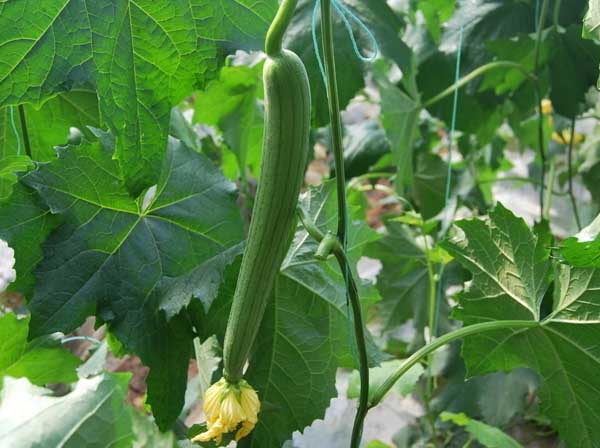
Loofah is called water gourd or winning gourd in Cantonese; in the Pearl River Delta, loofah specifically refers to ridged loofah. It is a plant of the Cucurbitaceae family native to India, also known as vegetable gourd, and is widely cultivated in East Asia. It is a climbing herbaceous plant of the Cucurbitaceae family, and loofah has a strong root system. The stem is vine-like, five-angled, green; both the main vine and side vines grow vigorously, the stem nodes bear branching tendrils, and adventitious roots form easily. It is distributed and cultivated both domestically and abroad.
Cultivation environment requirements
Loofah has strong adaptability to climate and soil and does not require strict selection, but under high temperatures it grows robustly and rapidly, develops vigorously, with thick stems and large leaves, and the fruit also grows quickly. If the temperature is below 15°C, growth is slow; below 10°C, growth is inhibited.
Among cucurbits, loofah has the strongest moisture tolerance, especially common loofah, which is stronger than ridged loofah; its drought tolerance, however, is not strong. The timing and number of female and male flowers in loofah vary significantly depending on the variety. Generally speaking, loofah is a short-day vegetable; during short-day periods, female flowers appear earlier and in greater numbers, while during long-day periods fewer female flowers appear, but sensitivity to day length varies greatly among varieties.
Loofah prefers sufficient sunlight. If there are consecutive cloudy and rainy days, it not only affects the formation of female flowers but also causes bud and flower drop, and young fruit tends to yellow and wither. Loofah is not demanding in its choice of soil, but fertile loam with more organic matter and good drainage, clay loam, and sandy loam with good water retention are most ideal. The suitable soil pH is between PH6.0—6.5.
Loofah roots resist fusarium wilt and are tolerant of root-knot nematodes, so even continuous cropping is acceptable, and the previous crop is not restricted; however, it is best to rotate with rice, because this not only reduces damage from melon flies, aphids, red spiders, thrips, and others, but also results in fewer weeds.
Cultivation management techniques
(1) Sowing period: Loofah can be sown and cultivated year-round, but sowing from December to August is most suitable. In various places, the later the sowing after September, although female flowers occur earlier and in greater numbers, the later growth period gradually enters a low-temperature period, growth becomes weaker, downy mildew becomes more severe, and the plants tend to age easily.
(2) Sowing and seedling raising: The seed coat of loofah seeds is relatively hard, especially for ridged loofah, so germination should be promoted before sowing. That is, soak the seeds for 2 hours, then remove them, crack open the hilum area of the seeds, and place them in darkness at 25—30°C to promote germination. When the young sprout emerges through the seed coat, sow into plug trays filled with medium, placing the seeds flat with the sprout tip downward as the principle, at a sowing depth of about 1.5 cm. When 3 true leaves have unfolded, transplant to the field. During seedling raising, the high-temperature period takes about 11—14 days, and the low-temperature period about 15—18 days. For short-day varieties raised during long-day periods, it is best to carry out shading short-day treatment after the cotyledons unfold, in order to promote the occurrence of female flowers.
(3) Cultivation methods: Loofah generally has 3 economic cultivation methods:
1. Horizontal trellis cultivation: The trellis surface is about 1.5 m above the ground, the bed width is 5—6 m, made as high beds, with two rows planted per bed; loofah is planted on both sides of the bed furrow, with a plant spacing of 0.4—0.5 m. This method can also use grape trellises for cultivation. When loofah is first planted, other short-term crops can still be intercropped on the bed. If horizontal trellis cultivation encounters a hurricane, because the wind-receiving surface is larger, it is easily blown down, so autumn-winter cropping should be the principle; if spring-summer cropping is used, dense planting is not suitable, and slightly sparse planting is preferable, with moderate thinning of some stems and leaves to reduce wind resistance.
2. Tunnel-type semicircular trellis cultivation: The bed width is 4—5 m, with the bed direction running north-south as the principle. On each bed, a semicircular trellis is built on the bed surface, with the highest point of the trellis about 1.8 m above the ground. Loofah can grow in three dimensions, and within a unit area the trellis area is larger than that of a horizontal trellis, with good ventilation and light transmission, which benefits loofah development. Two rows are planted per bed, planted on both sides of the bed furrow, with a plant spacing of 0.4—0.5 m. The semicircular trellis is relatively wind-resistant, and besides being suitable for autumn-winter cropping, it is also suitable for spring-summer cropping.
3. Prostrate cultivation: The bed width is 5—6 m, with two rows planted per bed, planted on both sides of the bed furrow, with a plant spacing of 0.4—0.5 m. This method is suitable for cultivation of short-fruit varieties of common loofah. The fruiting period should be in the dry season; if in the rainy season, the fruit is likely to rot when it touches the ground, so melon pads should be used to cushion the fruit. If long-fruit varieties and ridged loofah are cultivated by the prostrate method, the fruit is easily bent and lacks commercial value. Also, in prostrate cultivation, the fruit is easily shaded by leaves, making harvesting more troublesome.
(4) Fertilizers and fertilization: For the types and amounts of loofah fertilizer and fertilization methods, in principle refer to bitter gourd or bottle gourd. That is, loofah has strong fertilizer absorption, a long growth and fruiting period, growth and fruiting proceed simultaneously, and its fruiting capacity is strong; therefore, after fruiting, fertilization should still continue in order to maintain continued growth of stems and leaves, so that fruiting can continue uninterrupted and yield can increase. Especially after continuous rainfall, part of the nutrients in the soil has been lost with the rainwater, so topdressing should be applied after rain.
Base fertilizer is applied in the base fertilizer furrow, in a band. First apply composted manure, then mix chemical fertilizers and apply them on top of the composted manure, then make small beds and cover with silver-black plastic film. Topdressing should, in principle, be applied about once every 3 weeks. Before topdressing, first irrigate the bed furrow, and after the water seeps into the bed, apply the topdressing on both sides of the bed furrow and at the bottom of the bed.
During the growth period, if magnesium deficiency occurs (ridged loofah is more prone to magnesium deficiency), magnesium sulfate can be added to pesticide for foliar spraying, once a week, for 2—3 consecutive times, at a concentration of 0.4% (diluted 250 times with water). When loofah plants become weak and stagnant in growth during the middle and late fruiting stages, apply urea by foliar spraying, also at a concentration of 0.4%, and it can also be added to pesticide for spraying, once a week.
(5) Land preparation, bed making, and planting: Make high beds. While the soil is semi-dry and semi-moist, first plow open wide and shallow base fertilizer furrows on the planting rows according to the row spacing. After applying base fertilizer, first make small beds, then cover the surface of the small beds with silver-black plastic film. If operated by machine, small bed making and plastic film covering can be completed in one pass, so that both sides of the plastic film are buried into both sides of the small bed to prevent it from being blown open by wind. Later, as the loofah grows, cultivate soil again to make larger beds, completing the wide high-bed form.
Before loofah cultivation, punch planting holes in the plastic film according to the plant spacing, plant one plant in each hole, and irrigate after planting. In the high-temperature period, slightly sparse planting is preferable; in the low-temperature period, slightly dense planting is preferable.
(6) Irrigation and drainage: Loofah has long stems and large leaves, and a high amount of water evaporation, so attention should be paid to irrigation and it should be kept moist at all times. Irrigate by bed furrow irrigation. During rainfall, pay attention to drainage and do not let the roots soak in water; especially ridged loofah is less tolerant of moisture, and roots soaked in water rot easily.
(7) Vine training: Loofah has strong branching. If stems and leaves are too luxuriant, it not only tends to grow excessively and fruit poorly, but in hurricane season when trellis cultivation is used, the trellis is even more likely to be blown down. Therefore, vines should be moderately thinned, single-vine pruning should be carried out, and all side vines should be cut off early.
In prostrate cultivation, make the main vine grow at a right angle to the bed furrow. Also, in trellis cultivation, if stems and vines hang below the trellis, they should be guided onto the trellis so that the vines are evenly distributed on the trellis.
(8) Bed surface mulching: Loofah likes high temperatures, has a long growth period, and wide row spacing, so covering the planting rows (on the small beds) with silver-black plastic film is quite economical and notably effective. If rice straw is used for mulching, the effect is inferior to silver-black plastic film. Also, if short-fruit varieties are cultivated by the prostrate method, the entire bed surface should be mulched with straw to prevent the fruit from contacting the ground and rotting.
(9) Fruit bagging and fruit thinning: To prevent melon flies from laying eggs and causing damage, loofah is usually bagged, and bagging is done at the young fruit stage after the flowers fade. Bagging also has the effect of preventing leaves from scratching the fruit skin and turning it black, and of making the fruit skin become lighter in color; it can also prevent pesticide contamination. Loofah can be bagged with old newspaper bags or relatively thick paper bags.
From after the female flowers wither to the course of fruit development, deformed fruit, cracked fruit, and fruit damaged by pests and diseases should all be removed early to avoid wasting nutrients and reducing the plant's growth vigor.
(10) Pests and diseases and their control methods: Please refer to the company's printed (Control Methods for Major Cucurbit Pests and Diseases), but loofah is relatively sensitive to chemicals and prone to phytotoxicity, so attention should be paid to the pesticide concentration; lower concentrations are safer, and spraying should be avoided under high temperature and strong sunlight.
Downy mildew: It mostly begins on old leaves at the base. Initially there are inconspicuous pale yellow small spots; in short, with leaf veins as boundaries, obvious angular yellow-brown lesions appear, and the lesions dry up and break easily; on the underside of leaves, the lesions have a gray-black appearance, and the leaves die prematurely.
Harvesting and packaging
For edible loofah, those with tender and delicate flesh are best, so it should be harvested before the fruit has fully grown large, before the fruit skin has hardened, before the fibers have developed, and before the flesh has become coarse and old. It is even better to harvest according to the suitable harvest size of each variety, and harvesting too late must be avoided, as it affects quality. However, if harvested too early, not only is yield reduced, but after harvest it easily softens and wilts and does not keep well in storage or transport.
Generally, for common loofah that flowers during the low-temperature period, the suitable harvest time is about 10 days after flowering; for those that flower during the high-temperature period, they can be harvested 8—9 days after flowering. Ridged loofah ages easily after flowering, and its suitable harvest time is about 1—2 days earlier than common loofah.
The growth of loofah fruit at night is about two times greater than during the day, so the harvest time should, in principle, be in the morning before the fruit temperature has risen. Harvest with a knife or scissors, leaving the fruit stalk about 2 cm long, with the cut surface flat. Harvest together with the bag, place into carrying boxes or baskets, and transport to the packaging site for packaging. First remove the bag, then wrap each fruit with wrapping paper to avoid scratching and reduce water evaporation, then pack into bamboo baskets or bamboo crates for transport and sale to the market. During harvesting and packaging, retain the fruit bloom as much as possible to show freshness.
For harvesting loofah sponge, only common loofah can be used; ridged loofah is not suitable for loofah sponge use. At 50—60 days after flowering, wait until the fruit skin turns brown, the fruit becomes lighter, the seeds turn black, and the whole fruit is fully mature or even dry, then harvest. If harvested too early, the fibers are weak and poor. After harvesting mature fruit, if the quantity is small, wait until fully sun-dried, then peel off the outer skin, knock out the seeds, soak in bleaching water for 1—2 hours, then wash thoroughly with water and dry in the sun. Excellent loofah sponge has characteristics such as being neat, white, compact, fine, tough, and elastic.