Detailed Guide to Asparagus Cultivation Techniques: Planting Methods and Management Key Points
Asparagus, also known as shidiao bai or longxu cai, belongs to the Liliaceae family, Asparagus genus, and is a perennial herbaceous plant with persistent roots. Asparagus is eaten for its young shoots, is rich in nutrients, crisp and tender in texture, and delicately fragrant and tasty. It can be eaten fresh or processed into cans. It is a premium delicate vegetable and one of the world's top ten famous vegetables. It is rich in vitamins and minerals, and also contains asparagine and aspartic acid, as well as rutin, folic acid, nucleic acid and other substances. Regular consumption of asparagus has certain therapeutic effects on heart disease, high blood pressure, cystitis, diabetes and leukemia, and can inhibit the development of cancer cells, so it is called an anti-cancer health vegetable.
Botanical Characteristics
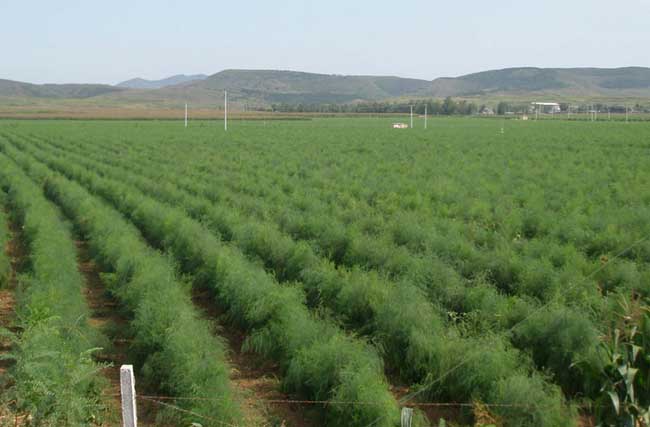
Although asparagus is perennial, the above-ground stems and leaves die back every winter when low temperatures and frost occur. It overwinters and goes dormant as underground rhizomes. When temperatures rise in March-April of the following year, new stems emerge from underground. The newly emerged young shoots are the asparagus. With good management, the harvest period can last more than 10 years.
Requirements for Environmental Conditions
1. Temperature
Asparagus has a relatively wide temperature tolerance range. The suitable temperature for seed germination is 25-30°C, and the optimal temperature for vegetative growth is 20-30°C. Below 15°C, growth is slow and few young shoots emerge. Above 30°C, the outer skin of young shoots tends to become fibrous, the shoot tips easily splay open, and quality is poor. Above 35°C, growth stops.
2. Light
Asparagus is a light-loving plant and requires strong light. With sufficient sunlight, branches and leaves are lush. Photosynthesis is closely related to temperature. High-temperature seasons are unfavorable for asparagus growth, and prolonged rainy weather also affects asparagus yield.
3. Soil
Asparagus has deep roots, and the young shoots require earthing up for shading. Sandy loam soil with deep soil layers, loose and fertile texture, and rich organic matter should be selected. The optimal pH is 5.8-6.5.
Cultivation Techniques
1. Sowing and Seedling Raising
① Sowing period: spring March-April, autumn August-September.
② Seed treatment
Place the seeds in a 400-fold solution of 50% carbendazim or 70% thiophanate-methyl, maintaining the water temperature at 25-30°C, and disinfect for 24 hours. Then rinse clean with clear water, and soak the seeds in warm water at about 30°C for 2-3 days. After the seeds have fully absorbed water, wrap them in gauze or a towel and place them in an incubator or a warm place to promote germination. During this period, spray water or rinse frequently. After 2-3 days, when the seeds have cracked and the white radicle is showing, they can be sown.
③ Seedbed preparation
The seedbed should preferably be loam or sandy loam with good drainage and loose, breathable texture. For base fertilizer, apply 1500-200 kg of high-quality farmyard manure, 10 kg of urea, 7 kg of ordinary calcium superphosphate, and 6 kg of potassium sulfate per mu of seedbed, spread evenly, then turn into the soil layer and mix with the soil.
④ Sowing method
For broadcast sowing, about 10 kg of seed is used per mu. For dibbling and drilling, about 1 kg of seed is needed per mu. After sowing, cover the bed surface with rice straw or pine needles, then water thoroughly and evenly with a watering can. Seedlings begin to emerge 15-20 days after sowing.
⑤ Seedbed management
After 80% of the seeds have emerged, the mulch can be gradually removed. Pay attention to light watering, weeding and topdressing, and promptly control underground pests when found.
⑥ Seedling separation and temporary planting: carried out when the seedlings are about 10 cm tall.
2. Field Planting
① Site selection and trench digging
The planting site should be selected as loam or sandy loam that is sheltered from the wind, facing the sun, with a not-too-high groundwater level, and convenient drainage and irrigation. Turn over and dig the soil to dry the clods and mature the soil, then dig planting trenches at a row spacing of 1.5 m, with a trench depth of 50 cm, a top width of 40 cm, and a bottom width of 50 cm. Asparagus should be given heavy base fertilizer. First fill about 10 cm of topsoil into the trench, then apply 4000-5000 kg of organic fertilizer, 150-200 kg of compound fertilizer or 100-150 kg of oil cake, 50 kg of ordinary calcium superphosphate, 15 kg of potassium sulfate, and 2 kg of carbofuran to prevent underground pests, mix well, then backfill about 20 cm of topsoil, mix and tread firmly. Finally, backfill the trench with topsoil, but the trench surface should still be about 10 cm lower than the bed surface.
② Planting time and density
Spring-sown seedlings are planted in May-June, and autumn-sown seedlings are planted in March-April of the following year. For white asparagus, the row spacing is 1.6-1.8 m, the plant spacing is 30-35 cm, and 1000-1200 plants per mu. For green asparagus, the row spacing is 1.4-1.5 m, and the plant spacing is 20-25 cm.
③ Cut off part of the stems and leaves of the selected asparagus seedlings, leaving 20 cm. According to the set plant spacing, spread the root mass so that it extends obliquely downward in all directions. Do not cover with soil too deeply at one time. After survival, combine cultivation and weeding with two more soil coverings, so that the root crown is buried 10-15 cm below the soil surface.
3. Field Management
① Management of newly planted seedlings
Topdressing can be done one month after field planting, mainly with clear manure water. Thereafter, topdress once every two months, and the concentration can be appropriately increased. Carry out cultivation, loosening of soil and weeding, and combine with cultivation for shallow earthing up 1-2 times to prevent roots from being exposed. All young shoots grown in the year of planting should be retained.
② Removal of flowers and fruits on female plants
Because female plants consume a large amount of nutrients for flowering and fruiting, affecting the yield of the current year and the next year, they should be removed as early as possible.
③ Irrigation and topdressing
During the shoot harvesting period, irrigation must be ensured and drought must not occur, generally irrigating once every 7-10 days. The highest yield occurs after the 3rd-4th year. Each year, heavy application of organic fertilizer-based autumn growth fertilizer and winter fertilizer is also required. Avoid partial application of N fertilizer, and ensure a rational combination of N, P and K.
4. Main Diseases and Pests
There are relatively many diseases and pests harming asparagus, among which the most harmful is stem blight. In addition, there are brown spot disease, rust disease, root rot disease, etc. The main pests include tobacco cutworm, black cutworm, white grubs, etc.
5. Harvesting
A small amount of harvesting can begin from the second year. Every morning or evening, when the young shoots are 15-20 cm tall, cut them off with a sharp knife 1-2 cm above the soil surface, and wrap them in a wet towel. Each time you harvest, all young shoots must be completely harvested, regardless of size.