Detailed Guide to Winter Melon Cultivation Techniques, Hand-by-Hand Teaching You to Grow Winter Melon Well
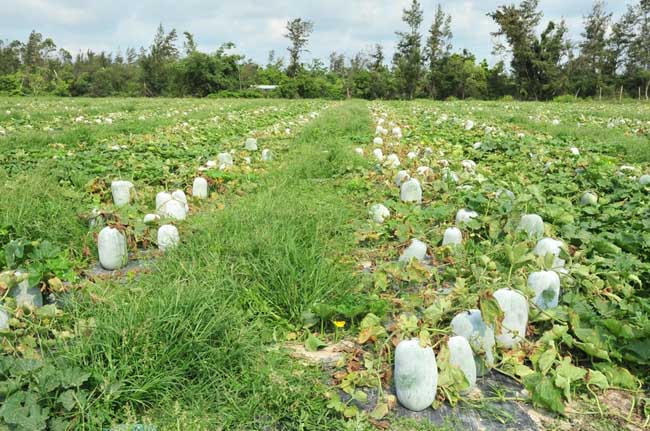
Winter melon (wax gourd) is an annual trailing or trellised herb; the stem is covered with yellowish-brown stiff hairs and long soft hairs, and has angled furrows. The fruit is shaped like a pillow, hence it is also called pillow melon. It is produced in summer, but because when the fruit ripens there is a layer of white powdery substance on the surface, just like the white frost formed in winter, it is called winter melon, and for the same reason it is also called white melon. When selecting, pinch it with a fingernail; a winter melon with harder skin, dense flesh, and seeds that have matured and turned yellowish-brown has good eating quality.
Cultivation Methods for Winter Melon
Winter melon cultivation methods can be divided into three types: ground winter melon, shed winter melon, and trellis winter melon.
1. Ground Winter Melon
The plants trail and grow on the ground, with relatively sparse spacing between plants and rows, generally planting about 300 plants per mu. Management is relatively extensive; the stems and vines are basically left to grow freely, or the side vines are removed before fruit set, and after fruit set they are allowed to grow at will. Its advantages are less labor and lower cost. Its disadvantages are poor fruit shape, requiring frequent fruit support; otherwise the rate of deformed fruit is high; the fruit skin is easily damaged by the external environment, affecting storability; light energy utilization is low, fruit size is uneven, and yield per unit area is relatively low. This method is only suitable for gray-skinned winter melon varieties sold within the island, but is not suitable for varieties with higher commercial requirements for northward transport or export, such as "Qingpi Dong", "Heipi Dong", and "Qingza No. 1".
2. Shed Winter Melon
After the plants begin to vine, a shed is built with bamboo and wood to guide the vines, and there are tall sheds and low sheds. Tall sheds are generally 150-200 cm high, and low sheds are generally 60-80 cm high, with a shed width of 250-300 cm. Hainan melon farmers mostly use the low shed method. Before the plants reach the shed, side vines are removed; after reaching the shed, the stems and vines grow freely. Shed winter melon sets fruit better than ground winter melon, the fruit size is relatively uniform, and the yield per unit area is generally higher than that of ground winter melon, but it basically still uses flat area, which is unfavorable for close planting. Generally, intercropping can only be done before the vines reach the shed, and space cannot be fully utilized. In addition, more shed materials are needed and costs are high. In recent years, to save materials, cost, and labor, an improved net shed trellis has begun to be promoted: first, wooden stakes and wire are used to build a basic shed frame, then a woven fluorocarbon filament net is covered over it. Nylon net can be used for at least three crops, and building the trellis is very convenient and labor-saving.
3. Trellis Winter Melon
There are many forms of supports. There is the "one dragon": that is, each plant has one stake, and at a height of 130-150 cm, horizontal bamboo is used to connect and fix them; there is the "A-frame"; there are "one-star drum frame longan" and "four-star drum frame longan": that is, three or four bamboo poles are used to build a drum frame, and horizontal bamboo is used to connect and fix each drum frame, with one drum frame per plant. Although trellis winter melon has many forms, all are combined with plant adjustment, making better use of space, improving the fruit-setting rate and making fruit size uniform, which is conducive to increasing yield and quality; it is also conducive to intercropping and increasing the number of multiple cropping cycles; and it saves trellis materials and reduces costs compared with shed winter melon. Under current conditions, trellis winter melon is a relatively reasonable and relatively scientific method among the three cultivation methods.
Cultivation Season, Sowing and Seedling Raising, and Planting Density
1. Cultivation Season
Winter melon likes warmth and tolerates heat. To obtain high yield, suitable climatic conditions for winter melon fruit set and fruit development should be selected for planting. Climatic conditions have the greatest influence on the fruit-setting rate of winter melon, so special attention should be paid to seasonal arrangement. Conditions such as clear weather, relatively high temperature, and relatively high humidity are favorable for fruit set; dry air, low temperature, and rainy days mean few insects are active, which is unfavorable for pollination; it also reduces the pollination capacity of the stigma, so fruit set is poor. According to the characteristics of winter melon's requirements for light and temperature conditions, in Lingshui, Sanya, Ledong and other cities and counties in southern Hainan, because winter and spring temperatures are mostly above 20°C and sunlight is abundant, sowing can be done throughout winter and spring, and normal flowering and fruiting can occur; while in northern cities and counties such as Wenchang, Chengmai, Qiongshan, Ding'an, and Lin'gao, in winter and spring, especially from early January to late February, low-temperature and rainy weather below 15°C often occurs, so when sowing, special attention must be paid to avoid having the planted winter melon flower and set fruit during this period. When sowing winter melon, in addition to considering climatic factors, market factors should also be considered. This is because most of the winter melon cultivated in Hainan, especially winter melon cultivated in winter and spring, is sold in large quantities to markets outside the island and to Hong Kong, China and Macao, China. Therefore, in terms of cultivation season, attention should also be paid to avoiding the peak production season of winter melon in inland provinces, especially Guangdong and Guangxi. Only in this way can the goal of high yield and high efficiency in winter melon cultivation be achieved. Under normal circumstances, as long as Hainan-cultivated winter melon is harvested and marketed from late December to early May, its selling price is relatively high; otherwise it is relatively low. Accordingly, the suitable sowing period for winter and spring cultivation of winter melon in southern Hainan is from mid-September to early January; in other areas, sowing from mid-September to early October and from early December to early January is best. If sown from mid-October to late November, because the flowering and fruiting period is mostly affected by low-temperature and rainy weather in January-February, fruit set is very difficult; even if fruit can set, the fruit grows slowly, develops poorly, and the rate of deformed fruit is relatively high.
2. Sowing and Seedling Raising
For winter and spring cultivation of winter melon in Hainan, because it is often affected by low temperatures, seedling raising in nutrient pots is advisable. The required nutrient soil should be prepared in advance. Fertile garden soil that has been baked, sun-dried, and sieved can be selected, mixed with decomposed pig and cattle manure residue, rice husk ash or coconut coir, etc. The volume ratio of the three is about 6:2:2. In addition, a small amount of nitrogen-phosphorus-potassium compound fertilizer can be added, and its addition amount is generally best controlled at 0.2%-0.3%. It must be finely crushed and mixed evenly to prevent damage to seeds and roots. For winter melon seed germination, generally first soak in warm water at 50-55°C for 10-15 minutes (stir while soaking), then continue soaking at room temperature for 10-12 hours, and finally place at about 30°C for germination. A longer soaking time results in faster and more uniform germination; in one and a half to two days, most seeds will germinate. A shorter soaking time results in poorer germination vigor. Seeds with smooth seed coats and no edges (such as green-skinned winter melon seeds) are prone to oxygen deficiency and seed rot during germination because the seed coat has poor permeability, resulting in a low germination rate. Therefore, for germinating this type of seed, the seed coat must first be rubbed and washed with fine sand to remove adhering matter, and then germinated at a constant temperature of 28-30°C. Before germination, rinse the seeds once with clean water in the morning and evening each day, drain the water in time, and then continue germination. If there is no constant-temperature equipment, it is safer to sow directly into seedling bags or seedling beds after soaking. According to the author's experiment, soaking seeds with 100-150 ppm gibberellin can make germination rapid and uniform. One day before sowing, water the nutrient soil in the pots thoroughly. The sowing depth is 2-3 cm. Sow 1-2 germinated seeds per nutrient pot. The seeds should be placed flat or with the sprout tip pointing upward. Immediately after sowing, cover with shade netting or straw and other coverings; if a cold wave or rainy weather occurs, plastic film covering is advisable. After sowing and before emergence, attention should be paid to watering, but do not overwater, to prevent seed rotting and root rot; just keep the soil moist. When about 70% have emerged, remove the covering in time. Before the seedlings break the heart, appropriately control water to promote root growth; after breaking the heart, often keep the nutrient soil in a semi-dry, semi-moist state to make the melon seedlings grow steadily. After about 25-30 days, they can be transplanted into the field. Two to three days before planting, seedlings can be drenched with 10% dilute human manure water and 800 times 80% zineb or 600 times 75% chlorothalonil liquid, so as to transplant with fertilizer and pesticide.
3. Planting Density
The planting density of winter melon differs according to variety, cultivation method, and cultivation season. The yield per unit area of small winter melon is composed of three aspects: the number of plants per mu, the number of fruits per plant, and the weight of a single fruit. Proper close planting can increase yield. Most large winter melon varieties have one fruit per plant, and their yield per unit area is composed of two factors: the number of plants per mu and the weight of a single fruit. Therefore, on the basis of ensuring single fruit weight, proper close planting should be carried out. Ground winter melon plants have vines and leaves growing on the ground, which is inconvenient for plant adjustment, so close planting is not suitable; shed winter melon basically also grows on a flat surface, so it is also not conducive to close planting; trellis winter melon can use space for growth, and combined with plant adjustment and vine guiding, it is conducive to close planting. At present, most winter melon varieties cultivated in Hainan production are large varieties. With flat shed trellis cultivation, the bed width is generally about 350 cm (including ditches), double-row planting, plant spacing 70-80 cm, and about 500 plants per mu; for trellis winter melon cultivation, the general row spacing and plant spacing are 150×(70-80) cm, and about 600 plants can be planted per mu; for ground winter melon, the bed width is generally about 400-500 cm (including ditches), double-row planting, plant spacing about 80-100 cm, and about 300 plants per mu. The planting density of winter melon is also related to the level of fertilizer and water management. If fertilizer is sufficient, drainage and irrigation are convenient, and management level is high, then emphasis should be placed on growing large fruits to strive for high yield and high quality, and it should not be too dense. On the basis of removing all side vines, topping the main vine can allow denser planting than not topping.
Land Selection and Preparation, Applying Sufficient Base Fertilizer
The root system of winter melon is very developed, and the growth period is long. In order to obtain relatively high yield, it is necessary to choose sandy loam to clay loam with deep soil layers, rich organic matter, and a pH value of 6-6.5 for planting; at the same time, in order to avoid cold waves during the seedling stage of winter and spring cultivation of winter melon, early spring drought, and late summer rain, it is advisable to choose fields facing north with the back to the south and convenient drainage and irrigation; autumn and winter melons often encounter typhoon rain effects, so land selection should be sloping dry land with convenient irrigation and drainage.
After the melon field is selected, it should be deeply plowed and harrowed as early as possible, with a depth of about 30 cm being best. For winter and spring cultivation of winter melon, late rice fields with convenient drainage and irrigation are best. After the late rice is harvested, the field should be plowed early and sun-bleached white, and then plowed and harrowed finely again before planting. After land preparation, the planting layout should be planned and the bed surface made; then ridges should be made on the bed surface, with a ridge width of 80-100 cm and a ridge height of about 30 cm. Half a bed is left on each side of the ridge, and a shallow ditch is left between the ridge and the half-bed for later ridge hilling and topdressing during the vine-extending period. Planting holes are determined along the ridge according to plant spacing, with hole depth about 30 cm and hole width about 40 cm. Winter melon has a relatively long growth period and strong root absorption capacity, so sufficient base fertilizer should be applied. Base fertilizer is generally mainly high-quality farmyard manure, more than 2000 kg per mu, 30-50 kg bean cake, and 40-50 kg superphosphate. After composting, mix well and apply in furrows or holes, and mix thoroughly with soil before sowing or transplanting. For loamy soil or clayey soil, when conditions permit, 30-40 kg ternary compound fertilizer and 15-20 kg urea per mu can also be applied in full-layer mixed application to meet balanced nutrient supply. For soil with relatively heavy sand, the amount should be reduced to prevent fertilizer damage.
Plastic Film Mulching
To ensure high and stable yield, plastic film mulching cultivation of winter melon can create superior environmental conditions for cultivation such as temperature, light, water, fertilizer, and soil, promote the growth and development of the winter melon root system and plants, and reduce the harm of certain diseases and insects as well as cold, drought, and heavy rain. Therefore, it can achieve obvious yield-increasing effects. Experiments have shown that plastic film mulching cultivation of winter melon in winter and spring in Hainan generally increases yield by 30%-50% compared with open-field cultivation; under severe weather conditions, the yield increase can sometimes even reach more than 1 times.
For plastic film mulching cultivation of winter melon, the method is generally just to cover the melon ridge. The film width selected is 80-120 cm, and the colors include white, black, and silver-gray, etc. White film has a good warming effect, but weeds are likely to grow, so before mulching, a pre-emergence herbicide must first be sprayed, such as butachlor or acetochlor, etc., with a dosage of 75-100 mL per mu, diluted with about 30 kg of water and sprayed on the soil surface, and then the film is covered; black film has a slightly poorer warming effect, but can prevent and control weed occurrence; silver-gray film can repel aphids and reduce the occurrence and spread of viral diseases. Before mulching, be sure to level and finely prepare the land, apply sufficient base fertilizer, and keep the soil moist. When mulching, be sure to stretch the film flat and press the film edges tightly. When planting melons after mulching, be sure to water enough settling water, and seal the openings well with fine soil. After that, be careful not to let the humidity inside the film become too high, so as to avoid root rot. As long as the soil is moist when mulching, generally no further watering is needed within about 20 days after transplanting. If water is lacking later, the method of furrow irrigation should be adopted, and only half the ditch needs to be irrigated.