How to Grow Carrots for High Yield? A Detailed Guide to Cultivation Techniques
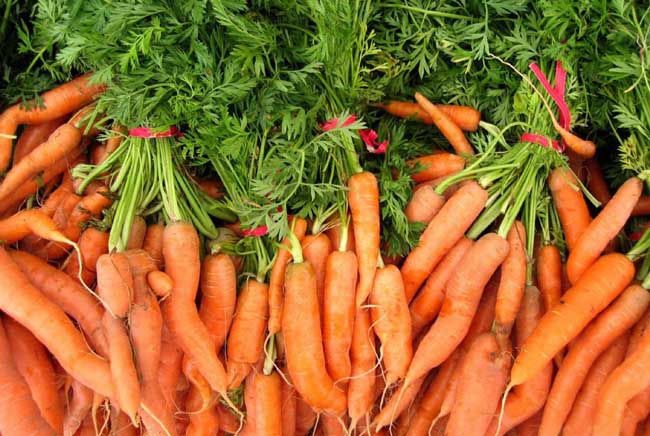
The carrot belongs to the Apiaceae family and is a biennial herbaceous plant. Its fleshy root is rich in sucrose, glucose, starch, carotene, as well as potassium, calcium, phosphorus and other elements. Every 100 grams of fresh weight contains 1.67-12.1 mg of carotene, which is 5-7 times higher than that of tomatoes. After consumption, it is broken down into vitamin A through digestion in the stomach and intestines, which can prevent night blindness and respiratory diseases. It can be stir-fried, boiled, pickled in sauce, or preserved in salt. It stores well. It is distributed throughout the world, and is cultivated in both northern and southern China, with production ranking second among root vegetables.
Biological Characteristics of Carrots
The carrot root system is a taproot system, with the main roots distributed within a 20-90 cm soil layer and extending 180-250 cm deep. The upper part of the taproot, including a small portion of the hypocotyl, thickens to form the fleshy root, on which four rows of slender lateral roots are borne. The leaves grow in a rosette on a shortened stem, are tri-pinnately compound, with slender petioles, dark green in color, small in area, and densely covered with fine hairs. After the fleshy root is stored through the winter, it bolts and flowers, with the main bolt emerging first, followed by lateral branches, forming a compound umbel. The seed embryo is very small, often poorly developed or without an embryo, with weak emergence ability and a germination rate as low as about 70%.
The stage development of carrots belongs to the green-plant vernalization type. If sown too early in spring, once the seedlings reach a certain size, they will bolt prematurely due to receiving prolonged low temperatures. The vegetative growth period is 90-140 days, the germination period is about 10-15 days, the seedling period is about 25 days, the leaf growth period is about 30 days, followed by the fleshy root growth period of 30-70 days. Seeds can germinate at 4-6°C, with the optimal germination temperature being 20-25°C. The leaves have strong adaptability in growth, and the taproot enlargement period requires 13-23°C, with night temperatures of 13-18°C. The soil requirement is sandy soil, pH 5-8, and the required soil moisture is 60-80% of field capacity.
Variety Characteristics and Traits
1. Hanhong Six-Inch Ginseng. Introduced from South Korea, with strong disease resistance, wide adaptability, easy to cultivate, and suitable for both spring and autumn seasons. The fleshy root is nearly cylindrical, with a good taper at the tip, excellent marketability, and a high finished product rate. The skin, flesh, and core are all red, with a crisp and tender texture, sweet and juicy flavor, and excellent quality, suitable for fresh eating and dehydration processing. The root length is 20-26 cm, root diameter 4-4.8 cm, root weight about 280-300 grams, with high yield.
2. Japanese Ganghong Seven-Inch Ginseng. Introduced from Japan, with strong disease resistance, wide adaptability, easy to cultivate, and suitable for both spring and autumn seasons. Through several years of demonstration and promotion, it has become the first-choice variety for farmers in the Central Plains region. The fleshy root is nearly cylindrical, with a good taper at the tip, excellent marketability, and a high finished product rate. The skin, flesh, and core are all red, with a crisp and tender texture, sweet and juicy flavor, and excellent quality, suitable for fresh eating and dehydration processing. The root length is 20-26 cm, root diameter 4-4.8 cm, root weight about 280-300 grams, with high yield.
3. Baimutian Improved Five-Inch. Introduced from South Korea, a spring and autumn variety. Its main characteristics are: fast and uniform emergence, rapid root development, strong inherent resistance, able to quickly escape disaster attacks in years with heavy rain, with very few forked roots and split roots, and an extremely high marketable rate. This variety's root does not show above the soil, meaning no green top, the root is cylindrical, with both upper and lower ends nearly straight, good taper at the bottom, and an attractive root shape, making it the best choice for market. The skin, flesh, and core are all red, seamlessly integrated, with a smooth surface, crisp and tender texture, sweet and juicy flavor, and a crystalline appearance, suitable for fresh eating and dehydration processing. It can be planted early or sown late, with extremely strong disease resistance, no premature aging, and a general yield of 4000-5000 kg per mu.
4. Hongxing Improved Five-Inch. Introduced from South Korea, can be cultivated in both spring and autumn. The fleshy root is cylindrical, 20-25 cm long, about 5 cm in diameter, with a single root weight of about 300 grams, and can reach over 750 grams at maximum; the skin, flesh, and core are all red, with a smooth surface, crisp and tender texture, and sweet and juicy flavor, suitable for fresh eating and dehydration processing. It has strong disease resistance, no premature aging, good taper at the tip, high marketable rate, and high yield. Autumn cultivation can reach 4000-5500 kg per mu, with a maximum of over 6000 kg.
5. Huiyuan New Kuroda Five-Inch. With strong heat tolerance and fast growth speed, it begins to be harvested 100-110 days after sowing, suitable for early summer and midsummer cultivation. It has a good root shape, easy to enlarge, uniform and consistent, with excellent marketability. The outer skin is orange-red, smooth, and glossy, the flesh color is bright red, and the core is small. The root length is 18-22 cm, root diameter 4.2-4.8 cm, root weight 280 grams, with high yield and easy cultivation.
6. Dongya Improved New Kuroda Five-Inch. Produced by Japan's Shida Company, it has shown not only excellent but also stable performance through many years of promotion in China. The root shape is cylindrical, three-red, with relatively good processing quality, and can be used in both spring and autumn seasons.
7. Super Red Crown. Produced by Japan's Musashino Company, long cylindrical, three-red, with good taper at the tip, relatively good marketability, longer root shape, relatively good quality, and excellent overall traits. Can be used in both spring and autumn seasons.
8. Hongge. Produced by Orient Zhengda Company. The leaves are dark green with strong upright growth, able to tolerate short periods of high temperature and drought. Strong disease resistance, uniform root shape, columnar, root length 20-24 cm, about 4.5 cm thick, weighing about 300 grams. Smooth surface, crisp and tender texture, three-red, with good taper at the tip. Can be harvested about 100 days after sowing. Suitable for both spring and autumn seasons.
9. Hongge No. 2. Another excellent imported carrot variety launched by Orient Zhengda Company after Hongge. Root length 20-24 cm, weight about 300 grams, with high yield. Good taper at the tip, finished product rate above 90%, and fast growth speed. Wide adaptability and strong disease resistance. Suitable for both spring and autumn seasons.
High-Yield Summer and Autumn Cultivation Techniques for Carrots
1. Land Preparation and Ridging
After the previous crop is harvested, deep plow the land promptly, with a depth of 23-30 cm being appropriate. During land preparation, apply 3000-5000 kg of decomposed organic fertilizer per mu, 30 kg of diammonium phosphate, and 15 kg of potassium sulfate. The organic fertilizer and soil particles must be broken up fine. Remove debris, rake the ground level, and mark lines at 50 cm intervals to form ridges. The ridge width is 27 cm, height 10-15 cm, and the ridge top is bluntly rounded. If using bed cultivation, high beds 60-80 cm wide and 10-15 cm high can be made, with furrows between beds 20 cm wide, i.e., high-bed deep-furrow cultivation. We advocate ridge cultivation, and the cultivation techniques in this section are described using autumn ridge cultivation as an example.
2. Timely Sowing
The suitable sowing period for autumn cultivation in the Central Plains region is from mid-July to mid-August, with sowing before the Beginning of Autumn being preferable. When sowing, open double rows on the ridge top at 10 cm row spacing, with a furrow depth of about 1 cm. Water first, then scatter the seeds, cover with soil, and mulch with wheat straw, dry grass, etc. When the sprouts show white, remove the mulch (preferably in the evening), then use a sprayer to moisten the bed surface, spraying once daily for 3-4 consecutive days.
3. Scientific Management
① Spraying herbicides. Before seedling emergence after sowing, spray 33% pendimethalin EC at 100-150 ml per mu, mixed with 40-50 kg of water, evenly over the soil surface. The weeding effect can reach over 90%, greatly saving labor and reducing management difficulty. Alternatively, after sowing and before emergence, spray 100 ml of pendimethalin EC mixed with 50 kg of water.
② Reasonable watering. After sowing, water 2-3 times consecutively to ensure complete emergence, and frequently maintain moisture on the ridge surface, preventing alternating dry and wet conditions to ensure uniform emergence. Generally, seedlings emerge 5-7 days after sowing. During the seedling stage, as long as there is no drought, water as little as possible to encourage the fleshy root to grow downward. During the fleshy root enlargement period, water demand is greatest, so sufficient water and fertilizer must be ensured. Throughout the entire growth period of carrots, watering must be moderate, not flood irrigation, and field water accumulation must be strictly controlled. After heavy rain, drain promptly, otherwise it easily leads to forked fleshy roots, well-developed lateral roots, protruding or sunken lenticels, and even root nodule protrusions, seriously affecting the marketable traits of the fleshy root.
③ Thinning and final singling. After complete emergence, thin promptly. At the 2-true-leaf stage, carry out the first thinning with a plant spacing of about 3 cm. At the 4-true-leaf stage, carry out the second thinning. At the 6-true-leaf stage, carry out final singling with a plant spacing of about 10 cm, leaving 26,000-30,000 plants per mu. When thinning, remove weak and small seedlings, seedlings with too many leaves, and thick but short leaves, as well as seedlings with particularly dark leaf color and densely covered coarse hard hairs on leaves and petioles, because these types of seedlings easily form forked roots, thick cores (well-developed xylem), or small fleshy roots.
④ Topdressing. From final singling to harvest, topdress 2-3 times in total. If the base fertilizer is insufficient, carry out a topdressing immediately after final singling, applying 15 kg of urea per mu flushed with water. When the fleshy root begins to enlarge, topdress with 30 kg of compound fertilizer per mu. During the peak fleshy root enlargement period, topdress with 30 kg of compound fertilizer per mu.
⑤ Intertillage and hilling. After each watering, carry out timely intertillage to keep the soil loose, aerated, and moisture-retaining, facilitating seedling growth and fleshy root enlargement. During the fleshy root enlargement period, appropriate hilling should be done to prevent green shoulders in carrots and improve appearance quality.
⑥ Disease and pest control. Common diseases include black leaf blight and soft rot. The former is mostly caused by drought, and spraying 800 times diluted 70% thiophanate-methyl wettable powder can prevent its spread. The latter mostly occurs in hot and rainy seasons, and diseased plants should be promptly removed, with quicklime used for soil disinfection. Pests include aphids and root-knot nematodes. Aphids can be controlled with pirimicarb and omethoate. Controlling root-knot nematodes is more difficult, and integrated control techniques must be used: crop rotation, rotating with gramineous crops and allium crops, which can significantly reduce the disease; deep plowing, taking advantage of the aerobic nature and weak mobility of nematodes, deep plowing the soil more than 25 cm. After deep plowing, large numbers of eggs are turned from the surface layer to the lower layer, which can eliminate some overwintering sources. The deeper the soil layer, the poorer the aeration, and the less favorable it is for nematode survival; after harvest, thoroughly remove residual plants and burn them in a centralized manner; soil disinfection, taking advantage of high summer temperatures and intense sunlight, scatter 100 kg of lime per mu on the bed surface, plow the soil, water thoroughly once, cover with plastic film, and use the high temperature under the film to effectively kill nematodes; chemical control, 3% miral granular formulation at 3 kg per mu, mixed with 50 kg of fine soil; 80% dichlorvos EC at 1000 times diluted for root irrigation.
4. Harvesting
In the Central Plains region, harvesting generally begins in early to mid-November. At this time, leaf growth stops, no new leaves emerge, and outer leaves turn yellow and wilt. However, there is no strict harvest period for carrots. As long as the market price is good, they can also be harvested and sold in mid-to-late October.
High-Yield Spring Cultivation Techniques for Carrots
1. Variety Selection
Variety selection for spring carrots is one of the keys to high yield. Varieties that are early-maturing, high-yielding, late-bolting, cold-tolerant, and drought-tolerant should be selected. The varieties introduced by Minfa Agriculture can all be cultivated in spring, among which Japanese Ganghong Seven-Inch Ginseng, Hanhong Six-Inch Ginseng, and Xinhong are the preferred varieties.
2. Crop Rotation Arrangement and Sowing Period
In central China, greenhouse cultivation begins sowing in late February, plastic film mulching cultivation begins sowing in late March, and open-field cultivation begins sowing in early April. At present, spring cultivation area is relatively large in Inner Mongolia, Shandong, and Hebei in China, while the cultivation area in Henan is relatively small. Currently, only the suburbs of Zhengzhou have greenhouse cultivation with relatively high benefits, and the Shangqiu area has plastic film mulching cultivation. Early spring cultivation has good benefits and can be successfully cultivated in central China, so there is great potential for promoting spring carrot cultivation in central China.
3. Land Preparation and Fertilization
Land preparation has a significant impact on carrot yield and quality, requiring loose soil conditions and sufficient fertility. Spring carrot cultivation methods have even higher requirements for plot conditions, so selecting deep, fertile, humus-rich, and well-drained loam or sandy loam is more suitable. After selecting the plot, carry out deep plowing and fine land preparation, with a depth of about 30 cm. After deep plowing, rotary tillage can be carried out, but rotary tillage alone should not be used because the rotary tillage layer is too shallow, which is unfavorable for carrot growth. During deep plowing, use 3 kg of phorate per mu for soil treatment, and simultaneously apply 3000 kg of farmyard manure, 50 kg of phosphate fertilizer, and 50 kg of compound fertilizer per mu. The farmyard manure must be fully decomposed.
4. Sowing
Greenhouse cultivation can use high-bed cultivation, making high beds 1-2 m wide and 10 cm high. Plastic film mulching cultivation uses single-ridge double-row cultivation. Prepare the land and form ridges 7-10 days before sowing, making ridges 15 cm high and 50 cm wide, using double-row cultivation, and cover with film after sowing. Before planting spring carrots, carry out seed treatment. First, rub off the fine hairs on the seed surface. Both direct sowing and sprout-promoting sowing can be used. For sprout promotion, soak in 40°C warm water for 2 hours, drain the water, wrap in gauze to ensure a certain humidity, and promote sprouting at 20-25°C for 5-7 days. When 60% of the seeds show white, they can be sown. When sowing, use a 3 cm diameter hole punch on the film surface, open holes and sow in spots, with a plant and row spacing of 16 cm square, 5 rows per film surface, planting 20,000 plants per 667 square meters, sowing depth 1 cm, placing 5-8 seeds per hole, then cover with soil and seal tightly.
5. Scientific Management
After sowing and before emergence, water according to soil moisture conditions to keep the soil moist. Greenhouse cultivation requires attention to temperature management. Plastic film cultivation requires field observation at any time, the film should be pressed and covered tightly in a timely manner, and necessary measures should be taken to promote emergence. After the seedlings emerge completely, thin at the 2-true-leaf stage, and carry out final singling at the 3-true-leaf stage. After final singling, begin watering and topdressing to promote root enlargement. The entire growth period can be topdressed and watered 2-3 times. Pay attention to frequently maintaining soil moisture to prevent the fleshy root from being thin, rough, or cracked. Spring-planted summer-harvested carrots generally have fewer diseases and pests, but are prone to aphid damage during the growth period. They can be sprayed with 1000-1200 times diluted 40% omethoate or Yibianjing, etc.
6. Harvesting
The harvest period for spring carrots is generally 90-100 days after sowing. They can be harvested in stages and batches. When the temperature rises to 30°C, in order not to affect the yield and quality of carrots, they should be harvested promptly.