What are the key cultivation techniques for Houttuynia cordata?
Houttuynia cordata, also known as fish mint, pig nostril, ji cai, dog ear, etc., is a perennial herbaceous plant with persistent roots in the Saururaceae family, genus Houttuynia. It is both a medicinal and culinary plant, and the entire plant is edible. Its tender roots, young stems and leaves are rich in nutrients and have a unique flavor. They contain protein, fat, carbohydrates, calcium, phosphorus, and volatile oils, among other nutrients, and have effects such as clearing heat and detoxifying, promoting diuresis and reducing swelling, and stopping bleeding. It has excellent edible and medicinal value, and has been officially designated by the Ministry of Health of China as one of the resources with great development potential that is "both a medicine and a food." In recent years, due to its good market returns, it has developed rapidly in Guangtong Town, playing an important role in increasing farmers' income and meeting people's consumer demand.
Morphological Characteristics
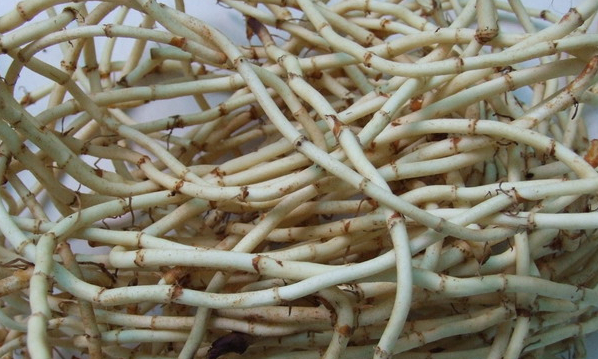
The Houttuynia cordata plant is semi-prostrate, with the upper part of the stem erect and the lower part creeping along the ground. The plant height is 15-60 cm, sometimes slightly purple, with a fishy odor. The stem has distinct nodes, with the lower part lying on the ground and fibrous roots growing from the nodes, usually hairless. The underground rhizome is slender, creeping and spreading for reproduction, white, circular in cross-section, with internodes 3-4.5 cm long; each node can produce both roots and shoots. The leaves are simple, alternate, heart-shaped or round, commonly green, occasionally purple. The inflorescence is a spike, white or pale green, with a flowering period from May to June. The capsule is ovoid, with a fruiting period from September to October.
Adaptation Conditions
Houttuynia cordata prefers a warm and humid climate and has a wide temperature tolerance. The underground stems can overwinter normally at -10 to 0°C. At 12°C, the aboveground stems grow and seedlings emerge. The optimal temperature for early growth is 16-20°C, and the optimal temperature for the underground stem maturation stage is 20-25°C. It grows well under shady and moist conditions and requires moist soil. Normal growth occurs when the field soil water-holding capacity is 75%-80% and the relative air humidity is 50%-80%. It is not demanding regarding light and can grow and develop normally even under weak light conditions. It is not strict about soil conditions, but slightly acidic soil with a pH of 6-7, deep and fertile sandy loam is best.
Cultivation Key Points
1. Strong adaptability: Houttuynia cordata is highly adaptable and can grow in most soils, and can also be cultivated on barren slopes and poor, thin soils. Generally, soil without "three wastes" pollution, with relatively deep soil layers, good water retention, strong air permeability, and slightly sandy texture is selected for cultivation, and crop rotation should be appropriately adopted.
2. Land preparation and bed formation: Before planting Houttuynia cordata, remove weeds and residual roots, then plow, harrow, and level the soil, and form beds about 1.30-1.60 m wide with a bed spacing of about 33 cm. Then open sowing furrows on the bed surface that are 13-15 cm wide and 10-15 cm deep, with a distance of 20 cm between two sowing furrows. 3. Apply sufficient basal fertilizer. Houttuynia cordata is mainly marketed for its rhizomes, and its growth period is relatively long. The quantity and quality of basal fertilizer directly affect the yield of Houttuynia cordata. Therefore, after leveling the plot, sufficient organic basal fertilizer and phosphorus and potassium fertilizers should be applied in the sowing furrows. Apply 2500-4000 kg of decomposed organic fertilizer (barnyard manure, compost), 50-70 kg of calcium superphosphate, and 60-80 kg of potassium chloride per mu.
3. Plot selection and land preparation and bed formation: For Houttuynia cordata cultivation fields, choose soil with convenient transportation, deep and loose fertile soil, high organic matter content, slightly acidic, and good water retention and air permeability, such as paddy fields, to achieve high yield and high quality. Before planting, plow and level the land, deep plowing 20-30 cm, remove weeds and residual roots, and after leveling, form beds 1.3-1.5 m wide, with sowing furrows opened across the bed surface 12-15 cm wide and 10-15 cm deep, with a spacing of about 20 cm between sowing furrows. The bed length depends on the plot, and the distance between two beds is about 35 cm.
4. Seed stem selection and planting: Because the seed germination rate of Houttuynia cordata is low, root division propagation is generally used. At present, there are two sowing methods: long stem sowing and short stem sowing. Long stem sowing requires a large amount of seed material, so short stem sowing is often used in production. Select fresh, thick, pest-free, mature old stems as seed stems. Cut the selected seed stems at the internodes, each segment 4-6 cm, retaining 2-3 nodes per segment. Before sowing, disinfect them in a 50% carbendazim 800-fold solution, then place them flat in the sowing furrows with a plant spacing of 5-8 cm, cover with 5-6 cm of soil. If the soil is dry, water to settle the roots. Cover the bed surface with plastic film or rice straw to keep the soil moist, increase soil temperature, and promote seed germination. Use 80-100 kg of seed material per 667 sq m.
5. Fertilization: Applying sufficient basal fertilizer is the foundation for achieving high yield. Apply 2500-3000 kg of organic fertilizer, 50 kg of calcium superphosphate, and 25-30 kg of potassium sulfate per 667 sq m. Houttuynia cordata mainly requires nitrogen and potassium, with relatively little phosphorus. Potassium fertilizer is especially important for rhizome formation and for improving aroma.
6. Cultivation Management
① Weeding: After Houttuynia cordata emerges, promptly remove weeds, diseased plants, and weak plants to keep the land clean and reduce the occurrence of pests and diseases. At the same time, loosen the soil between plants and rows, but not too deep; shallow cultivation is sufficient. Generally, before the rows close, cultivate and weed 2-3 times.
② Fertilizer and water management: Topdressing depends on the amount of basal fertilizer applied and plant growth. Growth is slow in the early stage. From seedling emergence until the rows close, apply 8-10 kg of urea per 667 sq m as a seedling fertilizer. During the vigorous growth period of stems and leaves, the nutrient requirement is greater, and 10-15 kg of compound fertilizer per 66 sq m can be applied as topdressing. After each harvest, a small amount of topdressing can be applied once. To improve the aroma and yield of artificially cultivated Houttuynia cordata, foliar topdressing is carried out in the middle and late growth stages, spraying 0.2%-0.3% potassium dihydrogen phosphate solution 2-3 times. Houttuynia cordata prefers moisture and is not tolerant of drought, so attention should be paid to watering during drought to keep the soil moist and ensure normal growth and development. During the rainy season, pay attention to drainage and avoid water accumulation on the bed surface.
③ Pinching and bud removal: For plants whose aboveground stems and leaves grow excessively, pinch the growing tips to inhibit height growth, promote side branching, and earth up to protect the roots, promoting underground stem growth and ensuring the stems are thick, white, and tender. Removing buds can reduce nutrient consumption from flowering and promote underground stem growth.
④ Crop rotation: Because Houttuynia cordata has good economic returns, some farmers, in order to save effort, plant it continuously after sowing, causing soil structure damage, decreased fertility, severe pest and disease occurrence, reduced yield, and even total crop failure. Adopting a crop rotation model, especially paddy-upland rotation, can effectively prevent continuous cropping obstacles.
Pest and Disease Control
Houttuynia cordata itself has a fishy odor and strong resistance to pests and diseases, so it rarely develops diseases. However, in old planting areas, diseases and pests such as southern blight, purple blotch, black cutworm, and tobacco cutworm have appeared.
1. Southern blight: Mainly damages the stem base and underground stems of the plant. Before sowing, soak and disinfect seed stems with a 50% carbendazim 800-fold solution. In the early stage of disease occurrence, dig out diseased plants with soil and destroy them, apply quicklime to disinfect the diseased area, and drench surrounding plants with 40% dimethachlon wettable powder 800-fold solution or 5% validamycin aqueous solution 1500-fold solution.
2. Purple blotch: When the plant disease incidence reaches 20%, spray 3% polyoxin aqueous preparation or 78% Kobo (bordeaux mixture · mancozeb) wettable powder, once every 7-10 days, 2-3 times.
3. Black cutworm: Remove weeds in the field in time before sowing to eliminate some eggs and weed hosts. When the damaged plant rate reaches 10% or the insect population density is high, dissolve 50 mL of 40.7% Lorsban (chlorpyrifos) in 1 L of water, then evenly mix it with 5 kg of chopped fresh vegetable leaves, and evenly scatter it in the field in the evening; or mix 0.25 kg of 90% crystalline trichlorfon with 3 kg of water, mix with 2.5 kg of chopped fresh green grass or bran, and evenly scatter it in the field in the evening to trap and kill adults.
4. Tobacco cutworm: When the larval damage rate reaches 25%, spray with 4.5% beta-cypermethrin emulsifiable concentrate 2000-fold solution or 10% imidacloprid wettable powder 2500-fold solution, once every 10 days, for 2-3 consecutive times. For adults, a poison liquid can be prepared with sugar : vinegar : white liquor : water = 6:3:1:10 plus an appropriate amount of trichlorfon and used in the field for trapping and killing.
Harvesting and Sales
There is no strict limit on the harvesting time of Houttuynia cordata, and it can be harvested in batches. For fresh consumption of leaves and aboveground parts, Houttuynia cordata can be harvested 25 days after growth. The leaves contain 20% volatile oil components and are relatively rich in houttuynine (decanoyl acetaldehyde) and manganese, and are nutritious when served as a cold dish or used in soup. When harvesting the underground parts, first cut off the aboveground parts, tie them in bundles by grade for fresh sale, or dry them for sale as medicinal material. After cutting off the stems and leaves, harvest the underground rhizomes and cover them with rice straw or other shading material to reduce water loss. After washing the underground rhizomes, tie them in bundles by grade and bring them to market for sale.