Detailed Explanation of Asparagus Lettuce Cultivation Techniques and Management Key Points
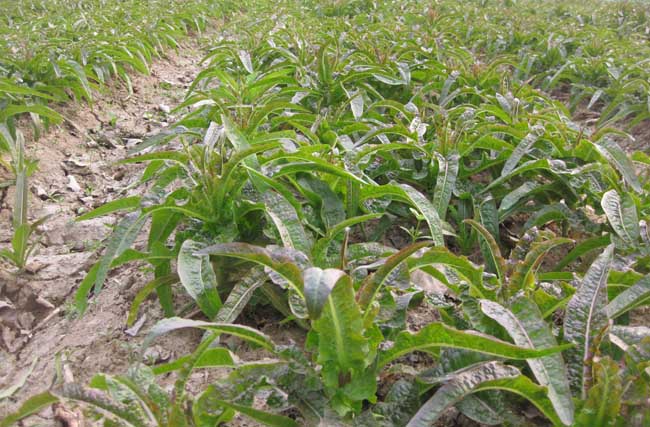
Asparagus lettuce (Lactuca sativa var. angustana) is a 1—2 year crop of the Asteraceae family, Lactuca genus, with shallow and dense roots mostly distributed within 20-30 cm of the soil layer. Asparagus lettuce prefers cool climates; short-day and low-temperature conditions favor its growth and development, while long-day and high-temperature conditions tend to cause bolting and flowering. Asparagus lettuce has crisp and tender tissues with high water content, and requires a uniform and relatively abundant water supply throughout the entire growing period.
Planting Season
Asparagus lettuce has wide adaptability. According to market demand, different varieties can be selected for staggered sowing to achieve balanced year-round production and supply. In Tonghai (main season), autumn-winter sowing and winter-spring harvest are predominant, with main varieties including Yubang No. 1, No. 5, Round Leaf No. 1, and Four-Season Round Leaf hybrid, etc. In summer, Large Flower Leaf and Bamboo Leaf Green are predominant.
Land Preparation and Fertilization
It is advisable to select soil that is loose, well-drained, rich in organic matter, and with strong water and fertilizer retention capacity. Deep plow and sun-expose the land, apply 2-3 tons of decomposed farmyard manure per mu, sun-expose the clods for 7-10 days, then finely prepare the land, making beds at 1.8-1.9 m. Flat beds are used for main-season planting, and raised beds are used for off-season planting.
Sowing
After the seedling bed is prepared, sow the seeds directly onto the seedling bed. After watering, apply 4.5% Baishida emulsifiable concentrate at 3000 times dilution and 5% Kungfu emulsifiable concentrate at 3000 times dilution to the seedling bed to prevent underground pests. For each mu of field planting, 15-20 sq m of seedling bed is needed. Generally, the seed rate per mu of field is 25-30 g. Cover with a shade net, then press down firmly.
Generally, transplant at a plant-to-row spacing of 32×35 cm, planting 4800-5200 plants per mu. During transplanting, eliminate seedlings whose stems have already swollen, to avoid early bolting.
Field Management
Water promptly after transplanting. After the transplants have established, apply ammonium bicarbonate at 8-10 kg per mu plus 10 kg of calcium superphosphate diluted in water. Thereafter, control water and fertilizer, strengthen intertillage. From the rosette stage until the leaves close the rows, water and topdress, applying 10-15 kg of urea per mu and 5 kg of potassium sulfate. Thereafter, water alternately between dry and moist conditions. When the stems begin to thicken, apply the third topdressing, with 50 kg of ternary compound fertilizer, 10 kg of potassium sulfate, and 15 kg of urea per mu applied in holes.
Pest and Disease Control
1. Diseases
① Downy mildew: Downy mildew is particularly severe in asparagus lettuce, and easily occurs under high temperature and high humidity. Apply metalaxyl-mancozeb and Sandofan 20 days after transplanting. In the early stage of the disease, use 687.5 g/L Infinito suspension concentrate at 1000-1500 times dilution, 66.8% Medok wettable powder at 1000-1500 times dilution, or 77.2% Propamocarb aqueous solution at 1000-1700 times dilution to control downy mildew.
② Leaf spot and brown spot: Use 75% chlorothalonil (Daconil) wettable powder at 1500-2000 times dilution; or 10% Score (difenoconazole) water-dispersible granules at 3000-3500 times dilution.
③ Sclerotinia rot: In recent years, sclerotinia rot damage has also been relatively severe. It is a low-temperature, high-humidity disease. When the temperature is around 5-15°C and relative humidity is above 85%, it favors the occurrence and invasion of the pathogen. Use 50% iprodione wettable powder at 1500-2000 times dilution, 50% procymidone wettable powder at 2000-2500 times dilution, or thiophanate-methyl, etc. for control. In addition, for viral diseases, use Duxiao, Haopu, etc. for control.
2. Insect Pests
① Aphids: 50% imidacloprid emulsifiable concentrate at 3500-4000 times dilution.
② Leaf miners: For adults, use 1.8% abamectin emulsifiable concentrate at 4000-5000 times dilution; for larvae, use 75% Qianke (cyromazine) wettable powder at 4500-5000 times dilution for control.
Harvest
When the top of the main stem of asparagus lettuce is level with the tip of the highest leaf, it can be harvested. At this time, the tender stem has reached full length, is crisp and tender, and of good quality. Remove the old leaves and it is ready for market.