What conditions are needed to grow wood ear mushrooms? Explained in one article
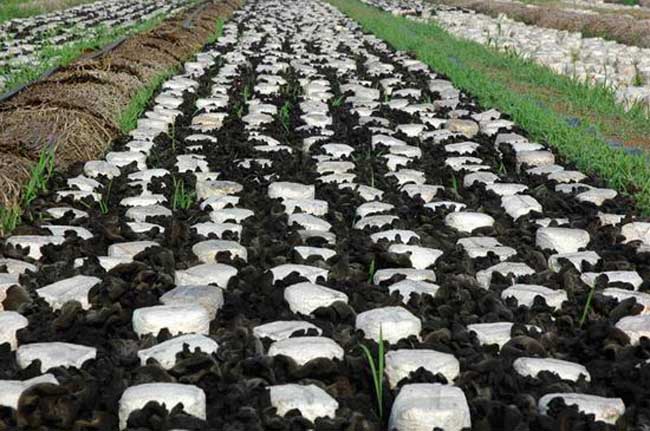
During the growth and development of wood ear mushrooms, the external conditions they mainly need are nutrients, temperature, moisture, light, air and pH. The factors with the greatest influence here are moisture and light.
1. Nutrients: The nutrient requirements for wood ear mushroom growth are mainly carbohydrates and nitrogen-containing substances, and a small amount of inorganic salts is also needed. During the growth and development of the mycelium of wood ear mushrooms, it continuously secretes a variety of enzymes, and therefore has a very strong ability to decompose wood or culture substrates. Wherever the mycelium spreads, it decomposes there, obtaining the nutrients it needs through decomposition and supplying the needs of the fruiting bodies. If we choose wood to cultivate wood ear mushrooms, especially if we choose Qinggang oak from sunny hillsides to cultivate them, we do not need to consider the nutrient issue, because the nutrients in the wood are generally relatively sufficient and can fully meet the needs of wood ear mushroom growth. If sawdust or other substitute materials are used for cultivation, a small amount of gypsum, sucrose and potassium dihydrogen phosphate, etc. should be added to meet the nutritional needs of wood ear mushroom growth and development. Nutrients are added once and supplemented a second time, referred to as “first add, then supplement.”
2. Temperature: The wood ear mushroom is a mesophilic fungus. Its mycelium can grow and develop between 15°C and 36°C, but 22°C to 32°C is the most suitable. Below 14°C and above 38°C it is inhibited, but the wood ear mushroom mycelium in wood has considerable resistance to short-term high and low temperatures. The fruiting bodies of the wood ear mushroom can form and grow between 15°C and 32°C, but between 22°C and 28°C the wood ear pieces produced are large, thick-fleshed and of good quality. Wood ear mushrooms grown above 28°C have slightly thinner flesh, a pale yellow color and poor quality. Although wood ear mushrooms grown between 15°C and 22°C are thick-fleshed, dark-colored and of good quality, their growth period is slow, affecting yield. Cultivating mycelium requires a higher temperature, while fruiting body growth requires a slightly lower temperature, referred to as “first high, then low.”
3. Moisture: Moisture is one of the important factors in the growth and development of wood ear mushrooms. Both the mycelium and fruiting bodies of wood ear mushrooms need a large amount of moisture during growth and development, but their requirements differ. Under the same suitable temperature, the mycelium develops and colonizes relatively quickly under low-humidity conditions, while the fruiting bodies develop rapidly under high-humidity conditions. Therefore, when inoculating, the moisture content of the wood ear logs is required to be 60%-70%, and the moisture content of the substitute culture medium is 65%, which is beneficial for the development and colonization of the mycelium. Although the growth and development of fruiting bodies requires relatively high moisture, it is necessary to combine dry and wet conditions, and also to mist appropriately according to the temperature. When the temperature is suitable, the relative humidity of the air in the cultivation site can reach 85%-95%, so that the fruiting bodies grow and develop relatively quickly. When the temperature is relatively low, too much moisture should not be given, otherwise it will cause rotten wood ear mushrooms. The mycelium cultivation stage requires dryness; fruiting body growth requires moisture. That is, "first dry, then wet."
4. Light: The wood ear mushroom lives a saprophytic life. Light originally has little to do with the mycelium; the mycelium and fruiting bodies can both grow in dim, dark environments. However, light promotes the formation of the primordia of wood ear mushroom fruiting bodies, and the ear buds can only unfold sturdy ear pieces under a certain amount of direct sunlight. According to experience, when the wood ear cultivation site has a certain amount of direct light, the wood ear mushrooms produced are both thick and large and dark black, while in a wood ear cultivation site with no direct light, the wood ear mushrooms produced have thin flesh, pale color, lack elasticity, and appear unhealthy. Although the wood ear mushroom has a relatively strong tolerance for direct light, appropriate humidity must be provided, otherwise the ear pieces will shrink, dry out, stop producing, and affect yield. Therefore, in production management, it is best to create a kind of "dappled sunlight" for the wood ear cultivation site to promote the rapid development and growth of fruiting bodies. In darkness, the mycelium can form fruiting body primordia, but they do not open. Only when there is a certain amount of scattered light do they open and form fruiting bodies. That is, "first dark, then bright."
5. Oxygen: The wood ear mushroom is an aerobic fungus. During the formation, growth and development of the mycelium and fruiting bodies, it continuously carries out oxygen-absorbing and carbon dioxide-exhaling activities. Therefore, it is necessary to constantly maintain air circulation in the wood ear cultivation site (indoors) to ensure the oxygen needed for the growth and development of wood ear mushrooms. Prevent stuffy environments and avoid rotten wood ear mushrooms and the spread of contaminating microorganisms. Mycelial growth requires little oxygen, while fruiting body growth requires a large amount of oxygen, that is, “first weak, then strong.”
6. pH (pH value): The wood ear mushroom is suitable for living in a slightly acidic environment, with pH 5.5-6.5 being best. When cultivating wood ear mushrooms with wood ear logs, this factor is generally rarely considered, because after the wood ear logs are stacked, sun-dried and fermented, they have already formed a slightly acidic environment themselves. However, in strain isolation and strain cultivation and substitute material cultivation, this is a problem that cannot be ignored, and the pH of the culture medium (substrate) must be adjusted to a suitable level. During substitute material cultivation, first adjust it to the alkaline side of the suitable range, and through natural fermentation it will reach the most suitable level. In short, the requirement is “first alkaline, then acidic.”