Detailed Guide to High-Efficiency Winter Celery Cultivation
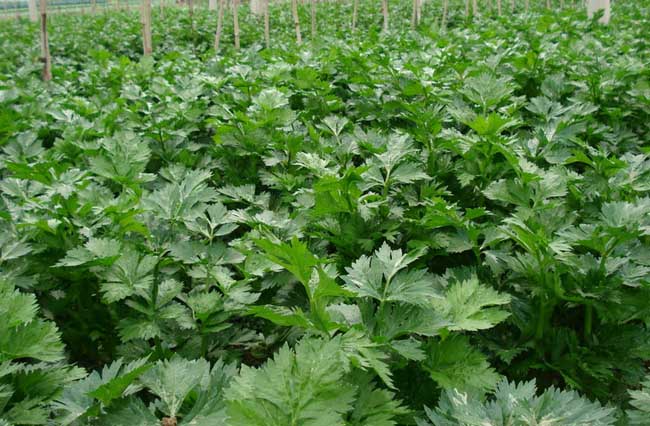
Celery is a new type of health vegetable, deeply welcomed by people for its good taste and high nutritional value. Its cultivation methods mainly include open-field cultivation in spring, summer and autumn, and protected cultivation in autumn and winter. To achieve high quality, high yield and high efficiency in autumn-winter celery cultivation, the first step is to select excellent varieties and cultivate strong seedlings of the right age; the second is to adopt cultivation models and management measures matching the excellent varieties; the third is to harvest in good time according to the market.
Variety Selection
For Western celery (stem celery), choose varieties with larger plants, thick leaf stalks, strong growth vigor, good stress resistance, few fibers and excellent quality, such as Ventura, Italian Winter Celery, FS Western Celery No. 3, Victory Western Celery, etc. Chinese celery (leaf celery) is a cultivation type of our country, with slightly smaller plants and slender leaf stalks, but a rich aroma; suitable choices include Jinnan Solid Celery, Baimiao Celery, Weifang Green Seedling Celery, etc.
Seedling Raising
In each region, the seedling-raising time should be arranged according to the celery market supply time and the arrangement of the next crop. Generally, Western celery is sown and raised from early to mid-June to early July, and Chinese celery from late June to late July. Transplanting takes place from late August to late September; the seedling age is 65-75 days for Western celery and 55-65 days for Chinese celery. The seedling-raising period for autumn-winter celery falls in the hot, rainy season, which is unfavorable for seed germination and seedling growth. If management measures are improper, problems such as difficult emergence, low emergence rate, a long seedling period and poor seedling quality will occur. The key to seedling-stage management is to create cool, moist environmental conditions and prevent drought, waterlogging, excessive growth and seedling death. The specific practices are as follows.
① Low-temperature treatment to break seed dormancy. Celery prefers cool conditions; if the temperature is above 25°C, the seeds are difficult to germinate, and they can only sprout smoothly at 15-20°C. Therefore, seeds sown in summer must undergo low-temperature treatment. After soaking the seeds for 12 h, they can be placed in a 10°C refrigerator for low-temperature treatment for 7-8 days to break dormancy before sowing.
② Shading the seedbed surface for sowing. Choose sandy loam soil with higher terrain and good drainage and irrigation conditions as the seedbed; the seedbed is about 10 m long and 1.2-1.5 m wide. Sieve thoroughly decomposed organic fertilizer and spread it evenly over the seedbed surface, then turn it into the soil so that manure and soil are mixed evenly. Then level the bed surface, water it thoroughly, mix the treated seeds with fine sand evenly, and sow them evenly over the bed surface, then cover with 2-3 mm of sieved fine soil. To plant 667 sq m of celery, 50-80 g of high-quality seed is needed, with a seedbed of 30-50 sq m. After sowing, build a frame over the seedbed with bamboo poles or similar materials, and place some branches or a shade net on the frame to provide shade, preventing strong sunlight and heavy rain from hitting the bed, so as to favor emergence and prevent excessive seedling growth.
③ Water the seedbed well. After sowing, the surface soil of the seedbed must always be kept moist. When the seeds push through the soil after 7-8 days, sprinkle water lightly once to help the seedlings emerge smoothly; full emergence occurs in 8-10 days. When the seedlings have 2-3 leaves, water lightly once more. Do not overwater during the seedling stage, to prevent excessive growth and damping-off disease.
④ Apply good strong-seedling fertilizer and remove weeds in time. When the seedlings have 3-4 leaves, apply a quick-acting nitrogen fertilizer once with irrigation, and fertilize afterward as conditions require. In summer high temperatures, pay attention to spraying calcium fertilizer on the leaves to prevent heart rot. Celery emerges slowly and also grows slowly, and its competitive ability against weeds is very weak, so it is easily "eaten" by weeds; remove weeds immediately or use herbicides reasonably.
⑤ Thin the seedlings in stages. Because celery seedlings die very easily in summer, after full emergence first thin out clustered seedlings and overly dense seedlings. At the 2-leaf stage, thin a second time, with a seedling spacing of about 1-1.5 cm; at the 4-leaf stage, thin a third time, keeping a seedling spacing of 3-5 cm. After each thinning, water lightly once to settle the roots.
⑥ Transplant at the right time. From late August to late September, transplant in time when the seedlings are 10-15 cm tall and have 5-6 leaves.
Transplanting
After the previous crop is harvested, apply about 5.000 kg/667 sq m of thoroughly decomposed organic fertilizer, plow deeply 25-30 cm, fully sun the soil clods, then fine-plow and level it, and make flat beds 1-1.5 m wide; transplant on cloudy or partly cloudy days. When lifting seedlings, leave roots 4-6 cm long, and transplant large and small seedlings by grade. The planting depth should be such that the roots are not exposed below and the heart is not buried above. If planted too deep or too shallow, celery is prone to slow seedling recovery, low survival rate and slow growth after survival. After transplanting in dry soil, water thoroughly once, but the water flow should be gentle to prevent washing out the seedlings. The wet-planting method trialed and promoted in recent years is simpler: after preparing the bed, water it thoroughly first, use a self-made rake with teeth spaced according to the row spacing to draw lines along the bed, and plant the celery seedlings at the plant spacing into the wet mud along the drawn lines. The wet-planting method allows fast transplanting, fast seedling recovery and good root development, and is superior to traditional dry-soil transplanting. Plant spacing and row spacing depend on the variety: generally Chinese celery 12 cm x 15 cm, planting 28,000-33,000 plants per 667 sq m, appropriately dense; Western celery large seedlings 20 cm x 30 cm, medium seedlings 20 cm x 25 cm, small seedlings 20 cm x 20 cm, planting 10,000-15,000 plants per 667 sq m, ensuring sparse planting with large heads to achieve high quality and efficiency.
Management After Transplanting
After transplanting, to promote seedling recovery, keep the soil moist and water twice in 7 days. After seedling recovery, carry out intertillage in time to promote the growth of new roots and new leaves. The first intertillage should be careful, removing weeds as much as possible and breaking up the surface soil, but not injuring the seedlings. After two intertillages, when new leaves begin to grow vigorously, apply a seedling-promoting fertilizer once, applying 10 kg of urea per 667 sq m. After mid-October, when celery plants have grown and the weather gradually turns cool, attack with both fertilizer and water: every 15-20 days apply 15-20 kg of urea per 667 sq m, and in between apply 1-2 times of dilute manure water. Entering late October, greenhouse cultivation should be covered in time for heat preservation; in mid-to-late December, add a small arch shed inside the greenhouse, and cover the outside of the greenhouse with straw mats, doing a good job of heat preservation and freeze prevention.
Pest and Disease Control
Autumn celery is prone to late blight (leaf spot). For this disease, choose 75% chlorothalonil 600-fold solution, or 70% mancozeb 500-fold solution, or 50% carbendazim 500-fold solution, and spray once every 7-10 days in the early stage of disease onset, for 2-3 treatments. After transplanting and before covering the greenhouse, pay attention to using abamectin to control leafminer damage; generally spray once immediately after transplanting. Western celery varieties are prone to heart rot at the seedling stage, so spray calcium fertilizer on the leaves 2-3 times.
Harvest
Harvest in time; do not harvest too late, otherwise nutrients are easily transported to the roots, causing declines in yield and quality. For greenhouse cultivation, all should be harvested before the Spring Festival or 10 days before transplanting the next crop. Generally, the yield is 7500-10000 kg per 667 sq m.