A soybean yield of 1200 jin per mu is in fact almost impossible.
Can soybean yield reach 1200 jin per mu? Looking at many netizens' comments, they say that during China's Great Leap Forward, soybean yield was even more than 1200 jin per mu; in reality, that only ever happened during the Great Leap Forward. In today's normal field yield...
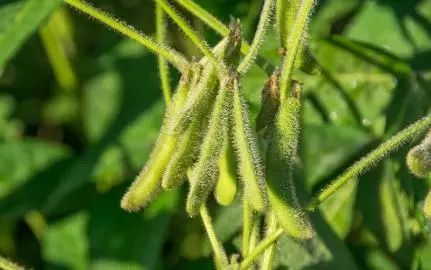
Can soybean yield reach 1200 jin per mu? Looking at many netizens' comments, they say that during China's Great Leap Forward, soybean yield was even more than 1200 jin per mu; in reality, that only ever happened during the Great Leap Forward. In today's normal field yield experiments, such exaggerated figures are basically impossible to achieve. Why? Because the law of conservation of energy must also be followed.
We should be clear that soybeans are composed of two main parts, protein and oil, and the ratio between the two is roughly 8:2. Friends who have studied biology should all understand that among the substances that store energy - the three major substances of sugar, protein and fat - protein and fat have the highest energy, which is to say that the energy required to synthesize these two substances is the highest.
The reason crops such as millet, corn and rice have higher yields than soybeans is precisely that the storage substance they synthesize is starch (a polysaccharide). Biologists' expectations for plant yields can basically be calculated through models. That is, the light energy received per unit area, after photosynthesis by plant leaves, can be converted into energy (sugar), which is then converted into starch yield for estimation; in other words, in reality this is also quite closely related to the weather. After all, there is a difference between photosynthesis on cloudy days and on sunny days.
However, at present this calculation is still too ideal, since energy conversion also involves the issue of conversion efficiency. But we can be certain of one thing: crop yields have a limit, and once a certain limit is reached, they can no longer continue to increase.
At present, in 2007 the soybean high-yield record in Missouri, USA was 1388.5 jin/mu, and this record has never been repeated; currently there is only one such record in the whole world. And Xinjiang in China once set a record of 811 jin per mu; it can be said that the 1200 jin record is hard to surpass, since even wheat has not yet become widely able to reach 1200 jin per mu.
If the dry matter yield of sugar-storing crops reached 1200 jin per mu, then soybeans might also be expected to achieve a breakthrough. However, with current science and technology, it is still difficult to cross this record.