Hollyhock Planting Methods and Key Technical Points
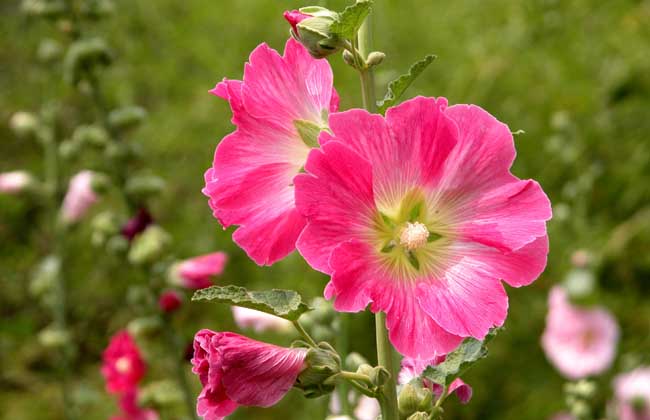
Hollyhock, also known as yizhanghong, dashuji, rongkui, wukui, doupenghua and so on, is a biennial upright herbaceous plant of the genus Alcea in the mallow family (Malvaceae), native to Sichuan, China, and now widely distributed across China; its tender leaves and flowers are edible, its bark yields high-quality fiber, and the whole plant is used as medicine, having the effects of clearing heat and detoxifying, relieving cough and promoting urination; the root can be used as an emollient, and it has high cultivation value. Let's take a look at the planting methods of hollyhock below!
Growth Habits of Hollyhock
Hollyhock is widely distributed in China, found in East China, Central China, North China and South China, and widely cultivated around the world. It likes full sunlight and tolerates partial shade, but dislikes waterlogging. It has strong salt-alkali tolerance and can still grow in soil with a salt content of 0.6%. It is cold-resistant and can overwinter safely in the open field in North China. It grows well in loose, fertile, well-drained sandy soil rich in organic matter.
Propagation Methods of Hollyhock
1. Sowing: In North China, sowing generally results in flowering in the same year. Seeds germinate after about one week, and when 2 to 3 true leaves have grown, transplant once.
2. Division: Hollyhock can be propagated by division in August to September; dig up the old plant, divide the stem buds with fibrous roots for renewal planting, water thoroughly immediately after planting, and it can bloom the following year.
3. Cuttage: For hollyhock cuttage in spring, it is advisable to use stem shoots sprouting from the base as cuttings; the cuttings should be 7 to 8 cm long, with sandy soil as the substrate, and after cuttage, shade them until roots form.
Hollyhock Planting Methods
1. Watering: When hollyhock seedlings grow 2 to 3 true leaves, they should be transplanted once with increased row and plant spacing, and watered in a timely manner after transplanting. During the flowering period, water appropriately to encourage a long flowering period and good blooms, flowering all the way to the top of the stem.
2. Fertilizing: During the seedling growth period of hollyhock, attention should be paid to fertilizing, weeding and loosening the soil to make the plants grow robustly. After flower buds form in the leaf axils, apply additional phosphorus and potassium fertilizer, and prune off a few leaves from the base.
3. Root cutting: When planting hollyhock, to keep the plant low and prevent lodging, in June you can cut the roots around the plant in a conical downward manner with a spade, cutting the roots once every 2-3 weeks, then water immediately for maintenance.
4. Harvesting: Hollyhock fruits should be harvested immediately when they turn yellow and ripe, to prevent the seeds from scattering. After the flowering period ends, the above-ground part of the plant can be cut off; when new shoots sprout, a clustered plant can form. Hollyhock tends to age easily, and should be renewed after 2-3 years of cultivation.
Pest and Disease Control of Hollyhock
1. Hollyhock Rust
[Harm] Perennial old hollyhock plants are prone to hollyhock rust; affected plants have leaves that turn yellow or die, and brown, powdery spore masses can be seen on the undersides of the leaves.
[Control] Spraying Bordeaux mixture on the plants in spring or summer, or disinfecting the seeds before sowing, can achieve control effects. In the early stage of the disease, spray 15% triadimefon wettable powder at 1000 times dilution, or 70% thiophanate-methyl wettable powder at 1000 to 1500 times dilution, or 75% chlorothalonil wettable powder at 600 times dilution, etc., once every 7 to 10 days, for 2 to 3 consecutive sprays, all with good control effects.
2. Red Spider Mite
[Harm] During the growth period, hollyhock is harmed by red spider mites.
[Control] When the infestation is severe, spray evenly with 1.8% abamectin emulsifiable concentrate at 7000 to 9000 times dilution for control, or use 15% pyridaben emulsifiable concentrate at 2500 to 3000 times dilution, both with good control effects. Do not use dichlorvos to kill mites, as dichlorvos has the effect of stimulating mite proliferation. Do not use pyrethroid pesticides, as they are basically ineffective against mites.
3. Cotton Leaf Roller
[Harm] Sometimes the cotton leaf roller also harms hollyhock leaves.
[Control] When it occurs, spray Bt wettable powder with a content of 16000 IU/mg at 500 to 700 times dilution, or 25% chlorbenzuron suspension concentrate at 1500 to 2000 times dilution, or 20% miman suspension concentrate at 1500 to 2000 times dilution, etc.
4. White Spot Disease
[Harm] Hollyhock white spot disease mainly harms the leaves of hollyhock; in the early stage of the disease, small brown spots appear on the leaf surface, and as the disease progresses, the spots gradually expand into round, oval or irregular shapes, with the center of the spots grayish-white and the outer edge reddish-brown. In humid environments, a grayish-brown mold layer can develop on the spots.
[Control] Remove diseased leaves promptly, pay attention to the density of branches and stems to keep the plants ventilated and light-transmitting. Increase the application of phosphorus and potassium fertilizer, and apply less or no nitrogen fertilizer. In the early stage of the disease, spray 75% chlorothalonil wettable granules at 800 times dilution, or 50% carbendazim wettable granules at 500 times dilution, or 70% thiophanate-methyl wettable granules at 1200 times dilution for control, once every 10 days, for 3 to 4 consecutive sprays to effectively bring the disease under control.