Cultivation techniques for Aristolochia debilis
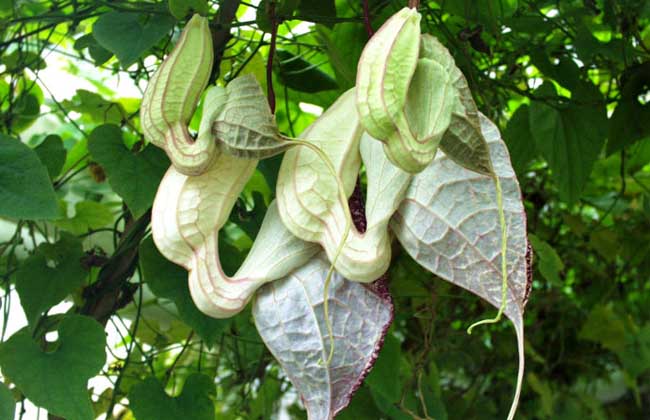
Aristolochia debilis is also known as Shuima Xiangguo, Sheshenguo, Sanjiaocao and Qiumu Xiangguan. Its Chinese name comes from its ripe fruit, which looks like a bell hanging from a horse's neck. It is a perennial twining herbaceous plant of the genus Aristolochia in the family Aristolochiaceae. Its roots, stems and fruits are used as medicine and have the effects of clearing the lungs and directing qi downward, relieving cough and calming asthma, and clearing the intestines and eliminating hemorrhoids. Now let us take a look at the cultivation techniques for Aristolochia debilis.
Growth habits of Aristolochia debilis
Aristolochia debilis grows at an altitude of 200-1500 m in valleys, beside ditches, in shady and damp places along roadsides and in mountain thickets. It likes light, is slightly tolerant of shade, prefers sandy yellow soil, is cold-resistant and highly adaptable. It is distributed in all provinces and regions of China south of the Yellow River to south of the Yangtze River basin, as well as Shandong (Mengshan) and Henan (Funiu Mountain). It is often cultivated in Guangdong and Guangxi, and is also distributed in Japan.
Seedling-raising techniques for Aristolochia debilis
1. Seed harvesting: When the fruits of Aristolochia debilis turn from green to yellow, harvest them in batches; if too late, the fruits split open. The seeds do not tolerate dry storage. After harvest, they should be sown immediately or buried in moist sand and stored in a cool place.
2. Seedbed site selection: For the seedling-raising land of Aristolochia debilis, choose sandy loam with fertile, loose soil, good drainage and a water source. After plowing the seedbed, apply 75000 kg of decomposed barnyard manure or compost per hectare as base fertilizer, then level and harrow finely, and make seedbed surfaces 1.2 m wide.
3. Seed treatment: If Aristolochia debilis seeds are taken out and sown in late autumn or the following spring, germination will be uneven. Under alternating temperature conditions of 10-20°C, the germination rate is high. After harvest, the seeds can also be soaked in gibberellin 5*10-4 for 1 day and then stored in sand in a greenhouse. Spring sowing is suitable from late March to early April, and both direct sowing and seedling raising can be used.
4. Sowing method: Open furrows on the seedbed with a row spacing of 25 cm, furrow depth of 3-6 cm and sowing width of 10 cm. Sow the seeds, cover with soil and press lightly, then cover with rice straw to keep the seedbed moist. After seedlings emerge, remove the cover. Use 15-22.5 kg of seeds per hectare. By April of the following year, open holes at a row spacing and plant spacing of 40*30 cm for field planting. For direct sowing, use hole sowing or furrow sowing.
5. Fertilization at the seedling stage: During the seedling stage, Aristolochia debilis needs appropriate irrigation and 1 application of nitrogen fertilizer. After field planting until the flowering stage, apply nitrogen fertilizer 2 times as a top dressing. When flowering in mid-to-late August, increase the application of phosphorus and potassium fertilizers. Carry out timely intertillage and weeding. After the plant height reaches 30 cm, set up trellises to facilitate the climbing growth of its stems and vines.
Cultivation techniques for Aristolochia debilis
1. Land selection and preparation: For the planting site of Aristolochia debilis, choose loam rich in humus. After the previous crop is harvested, plow once to a depth of about 30 cm. While preparing the land, apply 45000 kg of farmyard manure or compost per hectare as base fertilizer. Before planting, plow once more, level and harrow finely, make seedbed surfaces 1.2 m wide, and prepare drainage ditches around them for planting.
2. Timely transplanting: Before the winter freeze, dig planting holes 20 cm deep for Aristolochia debilis at a row spacing and plant spacing of 35×25 cm. Apply 10 kg of farmyard manure per hole as base fertilizer, fill the holes with fine soil until full, and let it stand 10 cm above the ground. In spring of the following year from March to early April, open the planting holes and plant the well-grown seedlings into the holes, 1 plant per hole, then water thoroughly to set the roots.
3. Loosening soil and weeding: During the seedling stage, Aristolochia debilis should be loosened and weeded frequently. Generally, when the seedlings are 5 cm high, carry out intertillage and weeding once, and it should be shallow to avoid damaging the roots. Afterward, carry out intertillage and weeding another 3-4 times together with top dressing to prevent weed overgrowth. When the seedlings are 5 cm high, thin them while loosening soil and weeding, removing the weak and keeping the strong. When the seedlings are 10 cm high, thin to a stand at a plant spacing of 3-5 cm. When the seedlings are 15-20 cm high, they can be lifted from the nursery for field planting.
4. Reasonable top dressing: In winter or early spring, control the amount of nitrogen fertilizer applied to Aristolochia debilis to avoid excessive growth of stems and leaves and damage from pests and diseases. Before flowering, mainly apply decomposed barnyard manure and add an appropriate amount of phosphate fertilizer. In the late growth stage, in mid-August, apply 750 kg of superphosphate and 150 kg of potassium fertilizer per hectare as top dressing, which can both increase the fruit-setting rate and benefit root growth. This is an important step for increasing yield.
5. Watering and trellising: Aristolochia debilis is drought-tolerant and afraid of waterlogging, so it generally does not need watering. However, if it is too dry during the growing period, water appropriately. In the rainy season, drain promptly to avoid root rot. Aristolochia debilis is a trailing herb. After transplanting, when the seedlings are 30 cm high, set up trellises in time. Set up supports with bamboo poles between the rows, stretch ropes in the middle, with a height of 1.8-2 m, to guide the stems and vines to climb and grow.
6. Pruning and earthing up: When Aristolochia debilis plants enter vigorous growth in May-June, cut off the overly vigorous stems and vines without flower buds to reduce nutrient consumption. After harvesting the fruits in October, cut off all stems and vines, remove all weeds in the field, and carry out earthing up and top dressing before winter to help preserve warmth for overwintering and lay the foundation for a high yield the following year.
7. Pest and disease control
① Root rot: It mostly occurs in July and August. After the roots rot, the plants die. Control methods are to pull out diseased plants and burn them, and spray the holes with a 1000-fold solution of 50% wettable powder Tuzet.
② Leaf spot: It mostly occurs in the rainy season, and spots easily appear on the leaves. Pay attention to clearing drainage ditches, drain accumulated water promptly, and spray with 1:1:150 Bordeaux mixture.
③ Aristolochia swallowtail butterfly: The larvae bore into and eat the leaves, forming notches, and it mostly occurs in July-August. Control methods are to clean the field sanitation, clear the garden in winter, and dispose of residual plants. During the young larval stage, spray a 1500-fold solution of 50% phosphamidon or a 500-fold solution of Qingchongjun (100 billion spores/g).