A Detailed Guide to Ephedra Planting Techniques and Cultivation Management Methods
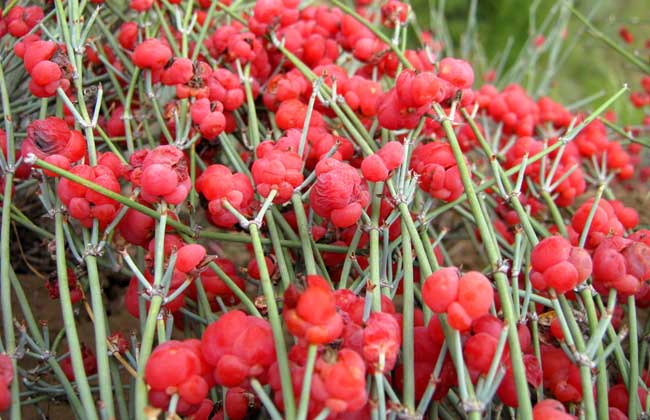
Ephedra, also known as Caomahuang (Ephedra sinica), Huamahuang and other names, is a herbaceous shrub plant of the genus Ephedra in the family Ephedraceae. There are three species: Ephedra sinica, Ephedra equisetina and Ephedra intermedia. It grows 20-40 cm tall, with a short or prostrate woody stem. In China it is produced in Liaoning, Jilin, Inner Mongolia, Hebei, Shanxi, northwestern Henan and Shaanxi and other places. It has high cultivation value. Let us take a look at Ephedra planting techniques below!
Ephedra Growth Habits
Ephedra often grows on hillsides, plains, dry wasteland, riverbeds and grasslands, distributed in areas with low humidity and relatively little water, often forming large pure communities. It can survive under extreme temperature conditions of -31.6 to 42.6°C, possessing characteristics of both heat-tolerant and cold-tolerant plants, and has a relatively high survival probability under extreme habitat conditions. Ephedra is suitable for growing in sandy soil. Soil is closely related to the distribution and growth of Ephedra. The soil matrix layer at 0-20 cm of topsoil is especially important for the distribution and development of Ephedra's horizontal roots. It grows well at a pH of around 8.
Ephedra Propagation Techniques
1. Seed propagation: Ephedra is mostly sown and raised in flat beds. Select mature, plump seeds and begin sowing in April in spring. For drilling, open furrows 5 cm deep with a row spacing of 30-40 cm. Sow the seeds evenly in the furrows, cover with fine soil, press down, and water with a small amount of water. For dibbling, the hole spacing is 30 cm, sow about 20 seeds per hole, cover with 3-5 cm of soil, press down and water with a small amount of water. The seed germination rate is generally 60-80%, and seedlings emerge in 7-15 days.
2. Division propagation: Ephedra can also be propagated by division. Usually in autumn or after the spring thaw, dig out mature plants and divide them into 5-10 individual plants according to the size of the clump. Open furrows at a row spacing and plant spacing of 30 cm each, plant, cover with soil up to the root buds, compact the surrounding soil and water. Careful management is required to promote normal growth and development.
Ephedra Planting Techniques
1. Selecting improved varieties: There are 11 species of medicinal Ephedra in China. The main varieties in the Hexi Corridor are Ephedra intermedia, Ephedra equisetina, Ephedra sinica and Ephedra przewalskii. Among them, Ephedra intermedia has a large distribution area, high grade and good quality, is the main purchasing target of Ephedra processing plants, and is also the main variety for cultivation.
2. Land preparation and fertilization: Ephedra is best planted in neutral sandy loam with deep soil layers, good drainage and rich nutrients. Before sowing, deep plowing and land preparation are required, with deep plowing of 40 cm being appropriate, achieving depth, fineness, levelness, firmness and evenness. At the same time, sufficient base fertilizer should be applied in combination with land preparation. Generally, apply more than 5000 kg of decomposed farmyard manure per mu, 40-45 kg of standard nitrogen fertilizer, and 45 kg of potassium dihydrogen phosphate.
3. Fine sowing: Before sowing Ephedra, soak the seeds in warm water at 30°C for 4 hours to promote germination. Sowing can be done by drilling or dibbling, with a sowing depth of 1.50-2 cm. After sowing, cover with 2 cm of river sand. Generally, seedlings emerge 10-15 days after sowing. The sowing rate per mu is 300 g, with a plant spacing and row spacing of 20 cm × 20 cm. If plastic film mulching or seedling transplanting is used, the effect is even better.
4. Intertillage and weeding: Ephedra is a perennial plant, and it is often accompanied by many weeds that compete with Ephedra for water and fertilizer. This greatly affects the yield and alkali content of Ephedra. Therefore, weeding should be done in a timely manner in combination with intertillage. Loosen the soil 3-5 times per year, and remove weeds 3-5 times in combination with soil loosening.
5. Timely harvesting: Ephedra generally has a vigorous growth period from May to June, and September to October is the high-value period for ephedrine accumulation. Harvesting should not be carried out during the high-value period. For Ephedra directly sown from seed, late October or early November of the third year is appropriate. The regenerated plants growing after harvest are best harvested in rotation every two years. During harvesting, retain 3 cm of the rhizome base to facilitate regeneration.
Ephedra Pest and Disease Control
1. Damping-off: Before sowing Ephedra, disinfect the soil by drenching with 15 kg of ferrous sulfate per mu. After the seedlings have fully emerged, immediately spray or drench with fungicides such as cycloheximide thiram, chlorothalonil 2787, benomyl, kangkuening or mancozeb. Spray once more after two weeks. Whether to apply again afterward depends on the seedling infection situation. At the same time, for areas prone to disease, control the amount and frequency of irrigation, and try not to raise seedlings in low-lying shady and wet areas with high or low groundwater levels.
2. Damping-off disease: For Ephedra damping-off disease, spraying with baiweiling, anpropylin, dimethachlon and others is effective. Spray once at the initial stage of the disease, and spray once more after two weeks. If the disease spreads over a larger area, spray once every 5 days.
3. Aphids: During the aphid occurrence period on Ephedra, timely use insecticides in rotation for control. You can spray 50% fenitrothion 000-2000 times dilution, or 40% omethoate emulsifiable concentrate 1000-1500 times dilution, or 20% sumicidin emulsifiable concentrate 4000-000 times dilution, or insecticides such as menazon and pirimicarb. After an interval of one week, spray once or twice more continuously to eliminate the occurrence and spread of the pest.
4. Dodder: Ephedra is a strongly heliophilic plant, so weed occurrence must be firmly prevented. For Ephedra fields with only scattered patchy dodder parasitism, the host plants attached with dodder can be cut off with a sickle or pulled out with roots. If large patches of dodder appear and cause harm, herbicides can be used to eliminate them.