Detailed Explanation of the Planting Techniques and Management Methods for Chinese Holly
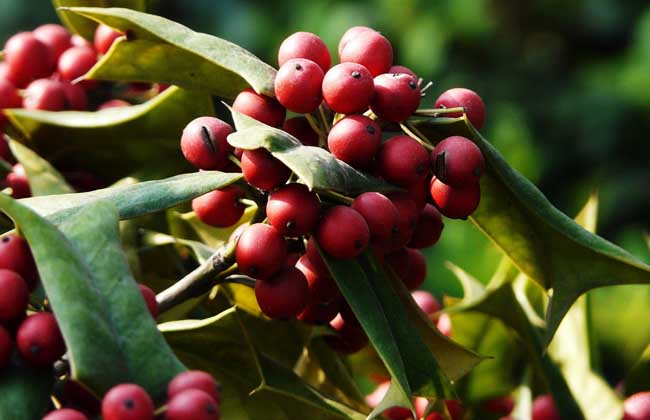
Chinese holly (Ilex cornuta) is an evergreen tree in the genus Ilex of the family Aquifoliaceae, also known as cat's thorn, tiger's thorn, etc. It is produced in the Yangtze River basin, parts of the Qinling Mountains, and areas to the south in China. It grows very slowly and is mostly found scattered on hillsides, in valleys, and in mixed forests or thickets by streams. It is cultivated in Qingdao and Jinan in Shandong and has relatively high cultivation value. Let's take a look at the planting techniques for Chinese holly below!
Growth Habits of Chinese Holly
Chinese holly is produced in Jiangsu, Shanghai, Anhui, Zhejiang, Jiangxi, Hubei, Hunan and other provinces and regions. It is cultivated in gardens in cities such as Kunming, Yunnan, and is also cultivated in botanical gardens in some European and American countries. It prefers light and is slightly shade-tolerant. It likes a warm climate and fertile, moist, well-drained, slightly acidic soil. Its cold tolerance is not strong, but it adapts quite well to urban environments and has strong resistance to harmful gases. It grows slowly, has strong sprouting ability, and tolerates pruning.
Propagation Techniques for Chinese Holly
1. Sowing: For Chinese holly, mature seeds can be collected from September to October. The seeds need 3 months of after-ripening before they can germinate. Store them stratified in sand and sow in March to April of the following year, which gives a relatively high germination rate. For varieties of Chinese holly with colored stripes, seedlings may show reversion and the leaf color may turn green.
2. Cuttings: Chinese holly can be propagated by hardwood or softwood cuttings. Softwood cuttings are generally taken during the rainy season and have a high survival rate. Cut cuttings from plants with abundant fruit and robust growth, 12-15 cm long, and insert them 8-10 cm deep. After inserting, provide shade and keep them moist. To promote rooting and improve the propagation effect of the cuttings, certain treatments should be applied to the cuttings before insertion. If conditions permit, using ABT No. 2 rooting powder during cutting can greatly increase the rooting rate.
3. Grafting: Grafting propagation of Chinese holly is mainly used for propagating types with colored stripes on the leaves. It is usually carried out before bud break in spring, using Chinese holly as the rootstock and adopting the cut-grafting method or bud-grafting method, with a high survival rate.
Planting Techniques for Chinese Holly
1. Transplanting: Chinese holly can be transplanted in spring and autumn, but transplanting in March to April in spring or in autumn with soil is better. Because Chinese holly has few fibrous roots, special care must be taken during operation to prevent the root ball from breaking apart. At the same time, some branches and leaves should be pruned to reduce transpiration; otherwise, it will be difficult to survive.
2. Watering: During the vigorous growth period of Chinese holly, it needs frequent watering. Generally, the potting soil should be kept moist but not waterlogged. In summer, water should often be sprayed on the leaf surface to facilitate evaporation and cooling.
3. Fertilizing: For Chinese holly, generally apply a dilute cake fertilizer water once every 2 weeks in spring, topdress once a month in autumn, no fertilization is needed in summer, and apply fertilizer once in winter.
4. Pruning: Chinese holly has very strong sprouting ability and is very tolerant of pruning. For finished bonsai works, unnecessary water sprouts, sprouting branches, and excess buds can usually be pruned away to maintain a certain tree shape. For tree material that needs processing, a certain number of branches can be retained as needed to facilitate shaping.
5. Repotting: Chinese holly bonsai is usually repotted once every 2-3 years, often in February to March in spring, or after autumn when the tree enters dormancy. When repotting, some old roots can be trimmed away, sufficient base fertilizer should be applied, 1/2 of the old soil should be retained, and it should be repotted.