What kind of grass is Wula grass? What are its characteristics and uses?
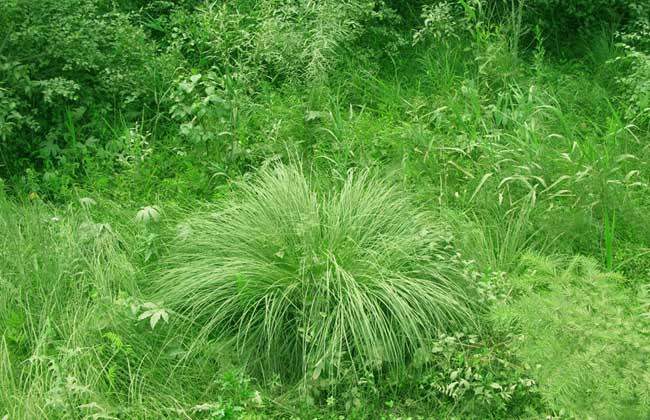
Wula grass, also known as Wula grass (Carex meyeriana), is a perennial herbaceous plant in the sedge family (Cyperaceae), genus Carex. It grows in swamps of forest regions or in the meadow swamps of the Sanjiang Plain in China, and can still grow at an altitude of 3460 m. It is mainly distributed in the Changbai Mountains of Northeast China and south of the Stanovoy Range (including Sakhalin), and can be used as medicine. Its main effects are removing and eliminating odors, promoting meridians and activating collaterals, eliminating fatigue, improving blood microcirculation, and enhancing immunity. Together with ginseng and marten fur, it is known as one of the Three Treasures of Northeast China.
Wula grass has a short rhizome that forms tussocks. The culms are densely tufted, 20-50 cm tall, 1-1.5 mm wide, slender, trigonous, and hard. The basal leaf sheaths have no blades, are brown, glossy, and slightly split or fibrous. The leaves are shorter than or nearly equal to the culms, bristle-like, folded inward, hard in texture, with rough edges. The lowest bracts are bristle-like and sheathless, while the upper ones are scale-like. There are 2-3 spikelets, close together; the terminal 1 is male, cylindrical, 1.5-2 cm long. The lateral spikelets are female, spherical or ovate, 0.5-1.2 cm long, about 5 mm wide, with densely arranged flowers.
The male flower scales of Wula grass are dark brown or pale brown, with blunt tips. The female flower scales are ovate-elliptic, with blunt tips, about 2.8-3.5 mm long, dark purple-black or reddish brown, lighter in the middle of the back, with inconspicuous 3 veins, and the margins are narrowly white-membranous. The perigynia are equal to or slightly longer than the scales, ovate or elliptic, flatly trigonous, 2.5-3 mm long, pale grayish green, densely covered with papillate protrusions, with 5-6 veins, slightly rounded at the base, with a short stalk, abruptly contracted at the apex into a columnar short beak, with the beak orifice entire. The nutlets are tightly enclosed in the perigynia, obovate-elliptic, flatly trigonous, brown, 1.5-2 mm long, with a short stalk, rounded at the apex, the base of the style not enlarged, and 3 stigmas. Flowering and fruiting period is June to July.
Wula grass has slender, soft leaves and tough fibers that are not easy to break. It can be used as a good material for straw sandals, straw mattresses, artificial cotton, fiberboard, straw weaving crafts, papermaking, and more. It can also be used for warmth and can be stuffed into Wula shoes, providing warmth and protection against the cold. The people in the mountainous areas of Northeast China are very fond of it. On the surface, Wula grass looks very ordinary, with slender green stems and leaves, growing in clusters, and greenish-brown flower spikes. However, for hundreds of years, this ordinary little grass has been closely related to the lives of the people in the Changbai Mountain area and has become an indispensable necessity. Every autumn, people go up the mountains to cut Wula grass, dry it, and store it. In winter, they stuff it into their shoes to prevent their feet from getting chilblains.
In winter, temperatures in Northeast China are relatively low, and ordinary cotton shoes are hard-pressed to keep out the cold. In the old days, people in the Guandong region used leather sewn and filled with softened Wula grass to make cold-weather shoes, which were the beloved "straw footwear" of the poor people in the north. Wula is also written as "Wula" and "Wula," and its name comes from the transliteration of the Manchu term for leather boots. It is a kind of "local leather shoe" worn by Northeasterners in winter. The stems and leaves of the original plant are hammered and then placed into felt boots; they are breathable, moisture-proof, and able to keep out the cold. It was formerly called one of the "Three Treasures of Guandong." Before Wula grass is used, it must also be beaten with a wooden stick; after being softened, it does not hurt the feet. There are many wild grasses in Northeast China that resemble Wula grass in shape, but only Wula grass has the best warmth retention.