How to cultivate goji berry saplings? A detailed explanation of the key points of seedling cultivation techniques
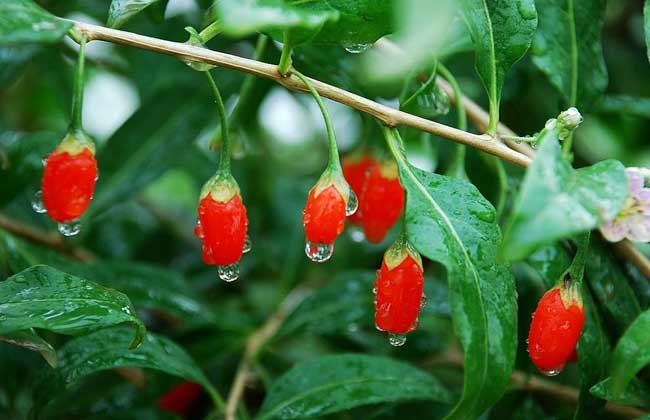
The goji berry tree is a multi-branched shrub plant of the genus Lycium in the nightshade family (Solanaceae). It often grows on hillsides, wasteland, hilly land, saline-alkali land, roadsides and beside villages and homes. It can be planted in gardens as hedges, as potted bonsai, or used as a shrub for soil and water conservation. Its fruit, the goji berry, together with Qiongzhen lingzhi, Changbai Mountain ginseng, and Dong'e ejiao, is known as one of the four treasures of traditional Chinese medicine. Let's take a look at goji berry sapling cultivation techniques together below!
Goji berry cutting propagation
In spring, before the plants begin to sprout, select plants with large fruit, high yield and good quality, cut 1-year-old branches with a diameter of 0.5 cm, cut them into cuttings 15-20 cm long, quickly dip the lower end of the cut in 0.05% rooting powder or 0.05-0.1% indolebutyric acid solution for 10-15 seconds, and insert the cuttings after drying. When cutting, open furrows on the prepared seedbed surface at a row spacing of 40 cm, with a furrow depth of 15-20 cm, and insert the cuttings at a plant spacing of 10 cm, with the cuttings exposed about 1 cm above the soil surface. After cutting, build a shade frame, keep the seedbed moist frequently, strengthen cultivation and weeding, and apply appropriate topdressing. When the seedlings reach 80 cm in height, they can be lifted from the nursery and planted out.
Goji berry division propagation
Division and transplanting are mostly carried out in early to mid-March to April. Directly dig up root-sucker seedlings from the goji berry orchard for transplanting. After digging up the clustered plants, cut off most of the branches, divide and plant them, water them immediately, and keep the soil moist frequently. They survive very easily and can bloom and bear fruit in the same year. Goji berry division propagation saves labor, but the quality of the variety is not easy to distinguish. To avoid the above shortcomings, you can cut and take the divided seedlings growing on the horizontal roots at the lower part of the mother plant's root crown or within a range of 3-7 cm from the mother plant for transplanting.
Goji berry seed propagation
1. Seed selection and collection: In the planting area, select robust plants with large red fruit, free of pests and diseases, and more than 6 years old as mother plants for seed production. Pick the fruit promptly from June to November when the fruit turns red. Soak the picked fruit in warm water at 30-35°C for 24 hours, remove and rub them, and wash out the seeds in clean water. Remove the pulp and skin, take out the mature and plump seeds that sink to the bottom, and sow them after drying. If not sowing immediately, mix 1 part seeds with 3 parts wet sand evenly, put them in a wooden box, and stratify them indoors at 20°C to promote germination. In the following spring, when 30-50% of the seeds have cracked and sprouted, take them out for sowing.
2. Timely sowing: Sowing can be carried out in spring, summer and autumn, and sowing in late March in spring is best. On the prepared nursery seedbed, open sowing furrows horizontally at a row spacing of about 25 cm, with a furrow depth of 2-3 cm and a sowing width of 5 cm. Then evenly scatter the seeds into the furrows. After sowing, cover with fine soil, press lightly, and cover the seedbed surface with grass to keep warm and moist. The seed rate per mu is 150-200 grams.
3. Seedling stage management: After sowing, water frequently to keep the seedbed soil moist, so as to facilitate seed germination and seedling growth. After the seedlings emerge, remove the grass covering the seedbed. Then carry out cultivation and weeding 4-5 times. Thin the seedlings in combination with cultivation and weeding. The first thinning is when the seedlings are 5 cm high, pulling out weak seedlings and keeping seedlings at 5-6 cm. The second thinning is in early to mid-July, removing the weak and keeping the strong, and final thinning at 10-15 cm. At the same time as thinning and final thinning, apply 1000-1500 kg of dilute human and livestock manure urine per 667 sq m each time to promote robust seedling growth. When the seedlings grow to 30 cm high, promptly remove the side branches growing from the base of the seedlings. When the seedlings are 60 cm high, top them to accelerate the thickening and vigorous growth of the main trunk and main side branches. Spring-raised seedlings can be lifted from the nursery and planted after autumn, while summer- and autumn-raised seedlings should be irrigated once with sealing ice water in winter and lifted from the nursery and planted after the following autumn.