Where is Poria's producing area? A detailed explanation of the distribution of the main producing areas nationwide
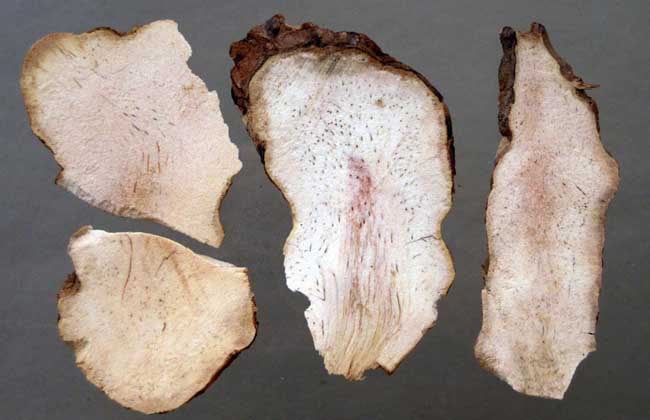
Poria is the dried sclerotium of the fungus Poria cocos (Schw.) Wolf of the family Polyporaceae, shaped like a sweet potato, spherical, with a pale brown or dark brown outer skin and a pink or white interior. The ancients called Poria the "divine medicine of the four seasons" because its effects are extremely broad and it is not limited to any season. When combined with various medicines, it can exert its unique effects regardless of cold, warm, wind, or damp disorders. Now let us take a look at where Poria's producing area is!
Where is Poria's producing area?
Poria often parasitizes the roots of plants in the Pinaceae family such as Japanese red pine or masson pine, and is occasionally seen on the roots of other coniferous and broadleaf trees. In China it is distributed in Hebei, Henan, Shandong, Anhui, Zhejiang, Fujian, Guangdong, Guangxi, Hunan, Hubei, Sichuan, Guizhou, Yunnan, Shanxi and other places, with main production in Anhui, Yunnan and Hubei. It is also distributed in Vietnam, Thailand and India.
The growth process of Poria
When external conditions are suitable, the Poria mycelium decomposes the substrate components, selectively absorbs them and converts them into its own nutrients, gradually increasing in size. When the mycelium forms in large quantities and occupies the entire substrate, it gathers into clumps at suitable places to form a sclerotium. When the sclerotium develops in the soil to a certain extent, it gradually swells upward and grows, with its upper part emerging above the soil surface, and on the lower side of the exposed part it produces a milky white, sheet-like, small honeycomb-like fruiting body. After the fruiting body matures, a large number of spores are released from within the fruiting body layer. Under suitable conditions, the spores germinate and grow, forming new mycelium and beginning a new generation of life.
Common types of Poria
1. Poria skin: Poria skin is the black outer skin of the Poria sclerotium. It is especially good at promoting diuresis and reducing edema, and is suitable for edema, difficult urination and other patterns. It is often combined with ginger skin, mulberry root bark, tangerine peel and areca peel, namely Wupi San.
2. Poria with skin: Poria with skin is Poria cut into pieces, using the red Poria with the skin shell. Its effects and indications are the same as Poria skin. If there is no Poria with skin, a mixture of 3/4 Poria and 1/4 Poria skin can be used instead.
3. Red Poria: Red Poria is the red part of the Poria sclerotium. It is especially good at promoting diuresis and draining dampness, and is suitable for water-dampness, retained fluids and other patterns. It is often combined with Polyporus umbellatus and Alisma orientale.
4. White Poria: White Poria is the white part of the Poria sclerotium. It is especially good at strengthening the spleen, and is suitable for spleen deficiency with fatigue, poor appetite and loose stools. It is often combined with Codonopsis pilosula, Atractylodes macrocephala and licorice.
5. Fushen: Fushen is the small piece cut from the part of the Poria sclerotium that runs through the pine root. It is especially good at calming the heart and soothing the spirit, and is suitable for restlessness, palpitations, insomnia and other patterns. To enhance the therapeutic effect, it is also often mixed with cinnabar and used, called Zhu Fushen or Zhuyi Poria.