What plant is Tufuling? This article will introduce you to Tufuling
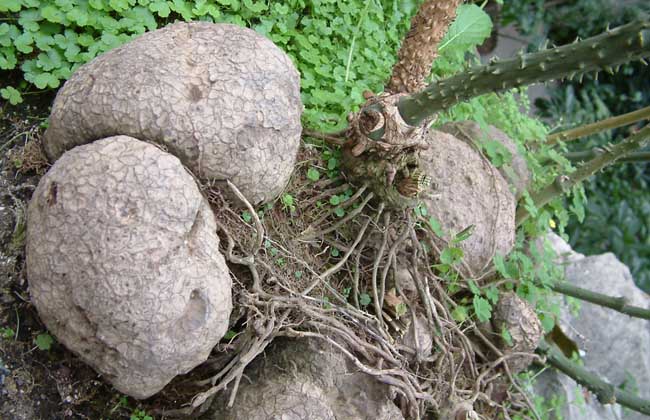
Tufuling, also known as Baiyuliang, Cizhuling, Guoshanlong, Lengfantuan, and other names, is the dried rhizome of the liliaceous plant Smilax glabra Roxb. Smilax glabra Roxb. mostly grows on hillsides or under forests and is distributed in Anhui, Zhejiang, Jiangxi, Fujian, Hunan, Hubei, Guangdong, Guangxi, Sichuan, Yunnan, and other places in China. Only its dried rhizome is selected for medicinal use, and it has the effects of detoxification, removing dampness, and benefiting the joints.
Tufuling is a climbing shrub, 1-4 mm long. The stem is smooth and thornless. The rhizome is thick and blocky, often connected by stolons, 2-5 cm thick. Leaves are alternate; the petiole is 5-15 mm long, accounting for about 3/5-1/4 of the total length, with a narrow sheath, often having 2 slender tendrils, and the abscission point is near the apex. The leaf blade is thinly leathery, narrowly elliptic-lanceolate to narrowly ovate-lanceolate, 6-12 cm long and 1-4 cm wide, with an acuminate apex and a rounded or obtuse base, usually light green beneath.
The umbel of Tufuling is solitary in the leaf axil, usually with more than 10 flowers. The peduncle of the male inflorescence is 2-5 mm long, usually distinctly shorter than the petiole, rarely nearly equal to the petiole in length, and there is 1 bud between the peduncle and the petiole. The peduncle of the female inflorescence is about 1 cm long; the female flowers resemble the male flowers in appearance, but the inner tepals have no teeth on the margin and have 3 staminodes. The berry is 6-8 mm in diameter, black when ripe, with a powdery bloom. The flowering period is from May to November, and the fruiting period is from November to April of the following year.
The dried rhizome of Tufuling is irregularly blocky, slightly flattened-cylindrical and curved rather than straight, mostly branched, with nodular swellings, about 5-15 cm long and about 2-5 cm in diameter. The surface is earth-brown or brown, rough, often with knife cuts and remnants of lateral roots, and the upper end has stem scars. It is hard in texture, not easy to break, and the fracture surface is rough, powdery, and light brown. The odor is slight, and the taste is sweet and bland.
Tufuling slices are long thin slices of varying sizes, about 1-3 mm thick, with irregular edges, light brown or light yellow, and a smooth or slightly rough surface. There are slightly visible vascular bundle dots in the middle, and on close observation a gritty luster can be seen; longitudinal slices often show patterns. The vessels are irregular, rich in powdery material, and slightly elastic; after moistening with water, they feel smooth to the touch. Those that are light brown, sufficiently powdery, and low in fiber are considered better.