What is Poria? A comprehensive guide to Poria in one article
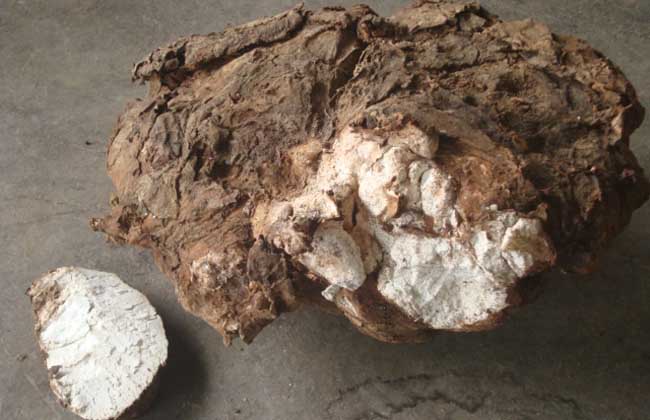
Poria, commonly known as Yunling, Songling, or Fuling, is a fungus that parasitizes the roots of pine trees. Its shape resembles a sweet potato, with a dark brown outer skin and a white or pinkish interior. Its original form is the dried sclerotium of the fungus Poria cocos (Schw.) Wolf of the family Polyporaceae, mostly parasitizing the roots of masson pine or Japanese red pine. It is produced in Yunnan, Anhui, Hubei, Henan, Sichuan and other places. It is mostly harvested from July to September. After digging out, the soil and sand are removed, and after piling for “sweating,” it is spread out to dry until the surface is dry, then “sweated” again, repeated several times until wrinkles appear and most of the internal moisture has dissipated, then dried in the shade. This is called “Poria whole.” Alternatively, fresh Poria is cut into pieces according to different parts and dried in the shade, separately called “Poria blocks” and “Poria slices.”
The Poria mycelium includes two types: monokaryotic and dikaryotic mycelium. The monokaryotic mycelium, also called primary mycelium, is formed by the germination of Poria spores and exists only in the early stage of germination. The dikaryotic mycelium, also called secondary mycelium, is the main form of the mycelium, formed by the meeting of two monokaryotic mycelia of different sexes after plasmogamy. The mycelium appears white and fluffy, with a distinctive multi-concentric-ringed colony. Under a microscope, the mycelium can be seen to be composed of many branched hyphae, and the hyphae are divided by septa into linear cells, about 2-5 micrometers wide, with clamp connections commonly seen at the tips.
The Poria sclerotium is a dormant body formed by a large number of hyphae and nutrients densely aggregated together. It is spherical, ellipsoidal, oblate, or irregularly block-shaped, with small ones weighing several liang and large ones weighing several jin or tens of jin. When fresh, it is soft and easy to break open; after drying, it is hard and difficult to break open. The outer layer of the sclerotium is crust-like, with a rough surface and nodular wrinkles. When fresh, it is light brown or brown; after drying, it becomes dark brown. Inside the crust, it is white and light brown. Under a microscope, the hyphae in the white part of the sclerotium mostly appear as lotus-root-segment-like or mutually compressed masses. Near the crust, there are relatively slender, densely arranged light brown hyphae.
The Poria fruiting body usually grows on the surface of the sclerotium, occasionally on older mycelium. It is honeycomb-shaped, varies in size, sessile, and flat-lying, about 0.3-1 cm thick. Initially white, it becomes lignified and light yellow when old. The hymenium is borne on the inner surface of the pore tubes and is composed of numerous basidia. Each mature basidium produces 4 spores (i.e., basidiospores). Poria spores are grayish-white, long-elliptical or nearly cylindrical, with one oblique tip, 6×2.5-11×3.5 micrometers.
Poria is sweet and bland in flavor, neutral in nature, and enters the heart, lung, and spleen meridians. It has the effects of draining dampness and promoting diuresis, strengthening the spleen and harmonizing the stomach, and calming the heart and soothing the mind. It can treat difficult urination, edema and distention, phlegm-fluid cough and counterflow, vomiting, morning sickness, diarrhea, spermatorrhea, strangury with turbid discharge, palpitations, forgetfulness, and other conditions. The ancients called Poria the “divine medicine of the four seasons” because its effects are very broad and it is not limited to any season. When combined with various medicines, it can exert its unique effects regardless of whether the disease is cold, warm, wind, or damp in nature.