What plant is wild notoginseng? A complete guide
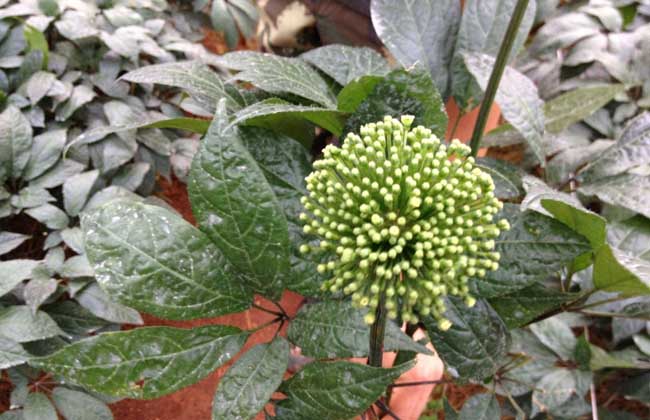
Wild notoginseng, also known as Xiangci, Tusanqi, Zhujieqi, Baisanqi, Pingbian Sanqi and other names, is the root of Pingbian Sanqi, a plant in the Araliaceae family. It grows in moist valleys and forests at an altitude of 1100-1700 m, and is distributed in southeastern Yunnan. It can be used as medicine. In autumn, the tuberous roots are dug out, the mud, sand and fine roots are removed, and they are sun-dried or oven-dried. It has the effects of dispersing blood stasis and stopping bleeding, reducing swelling and relieving pain.
Wild notoginseng is a perennial herbaceous plant. The rhizome is creeping, has nodules, and bears sunken stem scars. The roots are block-like and spindle-shaped. The stem base has persistent scales. The leaves are alternate, palmately compound, with 3 leaves whorled at the top of the stem. The petiole is 4-7 cm long and hairless. The stipules are ovate. There are 5 leaflets, rarely 7, pinnately parted, with unequal lobes; the middle ones are larger, and those at both ends are smaller.
The umbel of wild notoginseng is solitary at the top of the stem, with 50-80 flowers. The pedicel is 8-10 cm long and hairless. The calyx is 5-toothed and hairless. The flowers are pale green, with 5 petals, from long ovate to long elliptic. There are 5 stamens, and the filaments are as long as or slightly longer than the petals. The ovary is inferior, 2-locular, with 2 styles united into 1, and the stigma is slightly swollen and slightly curved. The drupe-like berry is spherical and kidney-shaped, and turns red when mature. There are 2 seeds, nearly spherical, white. The flowering period is May-June, and the fruiting period is July-August.
Wild notoginseng is mainly distributed in moist valley forests at an altitude of 1100-1700 m in Maguan, Malipo, Pingbian and other places in southeastern Yunnan, and also in Lao Cai in northern Vietnam. The tuberous roots are usually dug out in autumn, the mud, sand and fine roots are removed, and they are sun-dried or oven-dried and stored for medicinal use.
Wild notoginseng tastes slightly bitter and sweet, and is warm in nature. It has the effects of dispersing blood stasis and stopping bleeding, reducing swelling and relieving pain. It is mainly used for traumatic injuries, rheumatic pain, coughing blood, trauma, bleeding, vomiting blood, nosebleed, blood in the stool, abnormal uterine bleeding, weakness after illness, pulmonary tuberculosis and other conditions. It is taken internally as a decoction, or made into pills, powders, or medicinal wine, and applied externally as a powder. However, pregnant women should take it with caution.