Where is the production area of Agrimonia pilosa? Learn about its main production area distribution
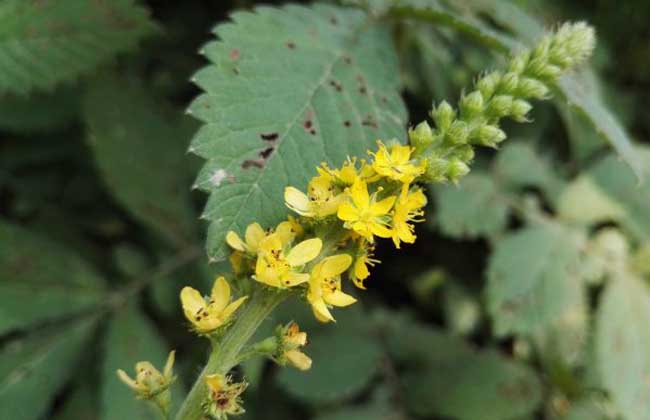
Agrimonia pilosa, also known as Tuoli Cao, Guaxiang Cao, Laoniujin, Langya Cao, etc., is a perennial herbaceous plant of the genus Agrimonia in the Rosaceae family. The dried aboveground parts of the plant, after removing residual roots and impurities, washing and drying, can be used as medicine. It has the effects of astringing to stop bleeding, treating malaria, stopping diarrhea, detoxifying, and tonifying deficiency. Now let us take a look at where the production area of Agrimonia pilosa is!
Where is the production area of Agrimonia pilosa?
Agrimonia pilosa grows up to 1 m tall, with the whole plant bearing long white hairs, a short rhizome, often producing 1 or several root buds, an erect stem, alternate pinnately compound leaves, a terminal raceme, an obconical calyx, yellow petals, and a calyx tube that thickens and droops when the fruit ripens, with a whorl of upright hooked prickles at the tip, closely resembling the head of a crane, hence the name Agrimonia pilosa. Its flowering and fruiting period is from May to December. The production areas are mainly located in Jiangsu, Zhejiang, Hubei and other places, and it is also produced in other parts of the country.
The production environment of Agrimonia pilosa
Agrimonia pilosa prefers a warm and humid environment, with a suitable growth temperature of 20-30°C. It has no strict requirements for soil, but deep, loose and fertile sandy loam is best. It is propagated by seeds or root division. For spring sowing, in the south it is in late March, and in the north in mid-to-late April; for autumn sowing, in the south it is from late September to early October, and in the north from late October to early November before the ground freezes. Root division propagation can be carried out in both spring and autumn.
Variety classification of Agrimonia pilosa
1. Agrimonia coreana: Agrimonia coreana, also known as Da Tuoye Longyacao, Chaoxian Longyacao, etc., has an underdeveloped main root, more lateral roots, and a thick and short rhizome that is lignified and often has underground buds. The stem is 70-100 cm tall. The leaves are interrupted odd-pinnately compound, the petiole is sparsely pilose and pubescent, the stipules are broad and fan-shaped or broadly ovate, the inflorescence is extremely loose, the petals are yellow and obovate-oblong, and the fruit is conical and hemispherical. Its flowering and fruiting period is July to August. The production areas are distributed in Jilin, Liaoning, Shandong, Zhejiang and other places, and it is also distributed in the Soviet Union, Korea and Japan.
2. Agrimonia eupatoria: The leaflets of Agrimonia eupatoria are sessile or occasionally short-stalked, elliptical, oblong, or obovate-elliptical. The stipules are broad, herbaceous, semicircular, with coarse acute serrations or shallow lobes at the margin. The inflorescence is usually unbranched, the inflorescence axis is relatively thick, covered with pubescence and long soft hairs, the pedicels are very short, and the petals are yellow. The fruit is bell-shaped, sparsely pubescent, with several layers of hooked prickles at the tip. The flowering period is June, and the fruiting period is July. The production areas are distributed in **, China, and it is also distributed in central and southwestern Asia.
3. Agrimonia nipponica: Agrimonia nipponica has a thick and short main root, a slightly longer rhizome, and often underground buds at the base. The stem is 30-90 cm tall, densely pubescent in the upper part and densely covered with long yellow stiff hairs in the lower part. The leaves are interrupted odd-pinnately compound, the petiole is sparsely pilose and pubescent, and the leaflets are sessile or short-stalked. The inflorescence is usually branched and slender, and the flowers are small. The fruit is small, and the calyx tube is bell-shaped and hemispherical. Its flowering and fruiting period is August to November. The production areas are distributed in Anhui, Zhejiang, Guangdong, Guangxi, southeastern Guizhou, Jiangxi, and also in northern Laos.
4. Agrimonia gryposepala: Agrimonia gryposepala has a thick rhizome and a stem 30-100 cm tall. The stem, petiole, leaf rachis, and inflorescence axis all have spreading long soft hairs and pubescence. The leaves are irregularly odd-pinnately compound, the stipules on the upper stem are kidney-shaped, and the lower stipules are lanceolate. The spike-like raceme is borne at the top of the branches, many-flowered, with yellow flowers. The fruit is obconical, with hooked bristles at the tip and a persistent calyx. Its flowering and fruiting period is July to September. It is native to the United States, Canada, Europe and other regions, and has been introduced and planted in various parts of China.
5. Agrimonia parviflora: Agrimonia parviflora has a thick and short main root, and the stem is 30-90 cm tall, densely pubescent in the upper part and densely covered with long yellow stiff hairs in the lower part. The leaves are interrupted odd-pinnately compound, the petiole is sparsely pilose and pubescent, the leaflets are sessile or short-stalked, the stipules are falcate or semicircular, and the stipules on the lower stem are often entire. The inflorescence is usually branched and slender. The fruit is small, and the calyx tube is bell-shaped and hemispherical. Its flowering and fruiting period is August to November. The production areas are distributed in Anhui, Zhejiang, Guangdong, Guangxi, southeastern Guizhou, Jiangxi, and also in northern Laos.
6. Agrimonia grandis: Agrimonia grandis has a thick, cylindrical root and a thick, short rhizome. The stem is 35-120 cm tall and densely covered with long stiff hairs. The leaves are interrupted odd-pinnately compound, and the leaflets are sessile or occasionally short-stalked. The stipules are broad, herbaceous, semicircular, with coarse acute serrations or shallow lobes at the margin. The inflorescence is usually unbranched, the inflorescence axis is relatively thick, and the petals are yellow and obovate-elliptical. The fruit is bell-shaped and sparsely pubescent. The flowering period is June, and the fruiting period is July. The production areas are distributed in **, China. It is sparsely distributed and also found in central and southwestern Asia.