Where are the main places of origin of Prunella vulgaris distributed?
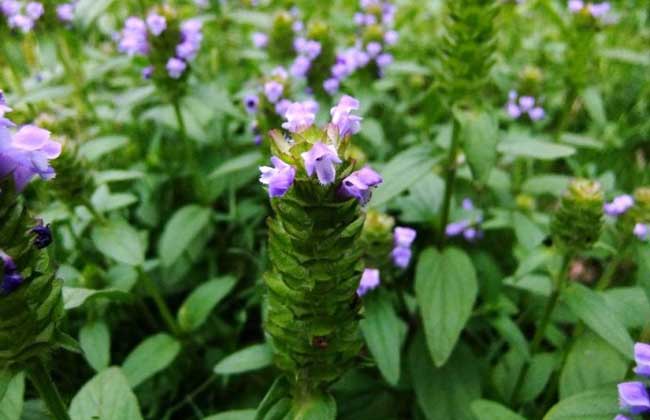
Prunella vulgaris, also known as wheat-ear Prunella vulgaris, iron-wire Prunella vulgaris, etc., is a perennial herb of the genus Prunella in the Lamiaceae family. Its dried fruit spikes can be used as medicine and have the effects of clearing the liver and purging fire, improving eyesight, and dispersing nodules and reducing swelling. It mainly treats red, swollen and painful eyes, nighttime eyeball pain, headache and dizziness, scrofula, goiter, acute mastitis, breast nodules, breast distension and pain, etc. Now let us take a look at where the place of origin of Prunella vulgaris is!
Where is the place of origin of Prunella vulgaris?
The global distribution of Prunella vulgaris is mainly throughout Europe, and it is also widely distributed in North Africa, Siberia in the Soviet Union, West Asia, India, Pakistan, Nepal and other places, and is occasionally seen in Australia and North America. In China, it is mainly distributed in Shaanxi, Gansu, **, Henan, Hubei, Hunan, Jiangxi, Zhejiang, Fujian, Taiwan, Guangdong, Guangxi, Guizhou, Sichuan and Yunnan and other provinces and regions.
The habitat environment of Prunella vulgaris
Prunella vulgaris grows in wet places in mountain gullies or in wet grass thickets, wasteland and roadsides on both sides of riverbanks. It likes a warm and humid environment, can tolerate cold, and has strong adaptability, but sandy loam with sufficient sunlight and good drainage is best. It can also be planted on dry sloping land, at the foot of mountains, in grassland at the edge of forests, roadsides and fields, but low-lying land prone to waterlogging is not suitable for cultivation. There are very few pests and diseases throughout its entire growth process.
Variety classification of Prunella vulgaris
1. Prunella grandiflora: Prunella grandiflora is a perennial herb of the genus Prunella in the Lamiaceae family, with a plant height of about 15 cm and square stems. Leaves are opposite and ovate. The verticillaster has 6 flowers, gathered into a dense terminal cylindrical spike. The corolla is more than 2.5 cm long, the corolla tube is white, and the two lips are deep violet. There are varieties such as white flowers, red flowers, carmine, rose red and fernleaf. It is native to Europe and extends through the Balkan Peninsula and West Asia to Central Asia.
2. Prunella hispida: Prunella hispida is a perennial herb of the genus Prunella in the Lamiaceae family, with creeping rhizomes and erect ascending stems. Leaves are ovate to ovate-lanceolate, acutely pointed at the apex, rounded at the base, with shallow wavy to crenate-serrate margins, and both surfaces are densely covered with articulated bristles. The verticillaster usually has 6 flowers, mostly densely forming a terminal spike 2-3 cm long and 2 cm wide, with a purple calyx. The nutlets are ovoid. The flowering and fruiting period is from June to January of the following year. It is produced in Yunnan and southwestern Sichuan, and also occurs in India and Sikkim.
3. Prunella vulgaris var. lanceolata: Prunella vulgaris var. lanceolata is a perennial herb of the genus Prunella in the Lamiaceae family, with creeping rhizomes that produce fibrous roots at the nodes, and creeping ascending stems. The stem leaves are papery, ovate-oblong or ovate, obtuse at the apex, rounded, truncate to broadly cuneate at the base, decurrent into narrow wings, with inconspicuous wavy shallow teeth or nearly entire margins, and with short bristles or nearly hairless on the upper surface. The dense spike is 2-4 cm long, the calyx is campanulate, and the corolla is purple, blue-purple or reddish purple. The nutlets are yellow-brown, oblong-ovoid.
4. Prunella alba: Prunella alba is a perennial herb of the genus Dracocephalum in the Lamiaceae family, 10-25 cm tall, with numerous stems, lower stem leaves broadly ovate to long ovate, middle stem leaves with petioles equal to or shorter than the leaf blade, and upper stem leaves becoming smaller. The verticillasters are borne in the leaf axils of the upper stem, the bracts are obovate or oblanceolate, the calyx is distinctly bilabiate, and the labiate corolla is pale yellow or white. The nutlets are oblong. It is distributed in Inner Mongolia, Shanxi, Ningxia, Gansu, Qinghai, Tibet and other places in China.
5. Mountain spinach: Mountain spinach is a perennial herb of the genus Dracocephalum in the Lamiaceae family, with creeping rhizomes and numerous stems. The stem leaves are ovate or ovate-oblong, with conspicuous petioles. The verticillaster has 6 flowers, gathered at the top of the branches to form a spike 3-5 cm long, and each verticillaster is subtended by bracts below. The apex of the calyx is red or purple, and the corolla is pale purple or dark purple. The nutlets are ovoid, brown and hairless. The flowering period is from May to July, and the fruiting period is from August to September.