Detailed Explanation of Prunella vulgaris Planting Techniques and Field Management Key Points
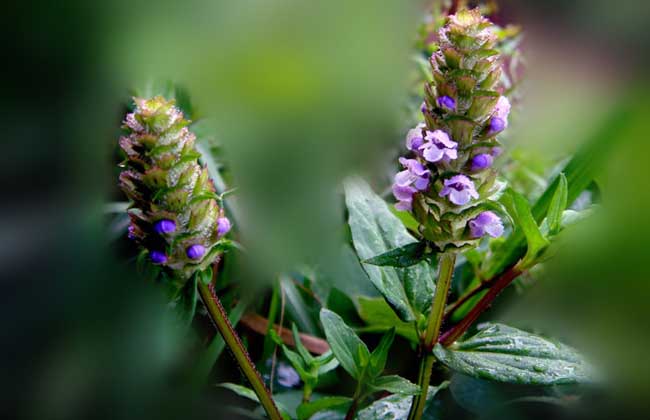
Prunella vulgaris is a perennial herbaceous plant of the genus Prunella in the Lamiaceae family, also known as wheat-ear selfheal, iron-wire selfheal, iron-wire prunella, etc. It is a common Chinese medicinal herb with the effects of clearing the liver and improving eyesight, dispersing nodules and detoxifying, and is mainly used to treat eye deviation, pulmonary tuberculosis, breast cancer and other conditions. Planting Prunella vulgaris is a good way for farming families to get rich. Let us take a look at Prunella vulgaris planting techniques together below!
Growth Habits of Prunella vulgaris
In China, Prunella vulgaris is mainly distributed in Shaanxi, Gansu, **, Henan, Hubei, Hunan, Jiangxi, Zhejiang, Fujian, Taiwan, China, Guangdong, Guangxi, Guizhou, Sichuan and Yunnan and other provinces and regions. It prefers a warm and humid environment, can tolerate cold, and has strong adaptability, but sandy loam soil with sufficient sunlight and good drainage is best. It can also be planted on dry sloping land, at the foot of mountains, in grassland at forest edges, along roadsides, and in fields, but low-lying land prone to waterlogging is not suitable for cultivation.
Propagation Techniques of Prunella vulgaris
1. Division propagation: For division propagation of Prunella vulgaris, the old roots are mostly dug out in late spring before sprouting and divided. Dig holes at a row spacing of 25×10 cm, plant 1-2 plants per hole, cover with soil and press firm after planting, water, and keep the soil moist. Seedlings emerge in 7-10 days.
2. Seed propagation: When the flower spikes of Prunella vulgaris turn yellow-brown, pick the fruit spikes, dry them in the sun, shake out the seeds, remove impurities, and store them for later use. In the north, spring sowing is from late March to mid-April, and autumn sowing is in late August. Drill sowing is mostly used. Open furrows on the seedbed at a row spacing of 20-25 cm, with a furrow depth of 0.5-1 cm. Sow the seeds evenly into the furrows, cover with fine soil, press lightly, water, and keep the soil moist regularly. Seedlings emerge in about 15 days. The seeding rate is 0.5-1 kg per mu.
Planting Techniques of Prunella vulgaris
1. Land selection and bed preparation: For planting Prunella vulgaris, choose sandy loam field plots or land plots with sufficient sunlight, good drainage, and moisture retention for sowing. Before sowing, plow deeply and harrow finely so that the soil is fine and the beds are level. Apply 2000 kg of decomposed manure or 25-30 kg of 48% imported compound fertilizer per mu, mix the soil and fertilizer evenly, then form bed surfaces 1.2 m wide, and at the same time open the three ditches properly for sowing (or seedling raising).
2. Seedling raising and sowing: Usually mid-to-late August to the end of September is the best time for sowing and raising seedlings. When soil moisture is good, broadcast sow or sow in holes. When broadcasting, the seeds can be mixed with fine sand or fine soil and sown evenly, and the sowing rate should be controlled well. For broadcast sowing, use 1.0-1.5 kg of seed per mu. For hole sowing, the seeds can be sown directly, with 8-10 seeds per hole, 17,000 holes per mu, and 0.5-1.0 kg of seed per mu. After sowing, cover lightly with soil. If drought occurs after sowing, replenish water in time or irrigate once with a running-water irrigation. Seedlings emerge after 15-20 days. During the seedling stage, carry out manual weeding 1-2 times.
3. Weeding and thinning: When Prunella vulgaris seedlings have about 4 leaves, combine weeding with removing small seedlings and keeping large ones, and removing weak seedlings and keeping strong ones. When they have about 10 leaves (beginning of tillering), finalize the seedlings, setting the basic seedling population at a spacing of 5-6 cun between plants and rows, basically ensuring 2-3 strong seedlings per clump.
4. Reasonable topdressing: Topdressing for Prunella vulgaris is generally carried out 2 times. The first time is around mid-March at the beginning of the tillering stage, applying 5-10 jin of urea per mu by broadcasting. The second time is around mid-May at the late flowering stage, applying 10-15 kg of imported compound fertilizer per mu by broadcasting. Choose to carry out topdressing when soil moisture is good or before rain so that the fertilizer can be better absorbed by the crop.
5. Harvesting and processing: Prunella vulgaris sown in spring is harvested in the same year, and that sown in autumn is harvested in the second year. Because the seed heads mature in stages, they are harvested in stages. Generally, those with a length of more than 8 cm (with more than 13 layers in the seed head) can be exported and can be packed separately by grade. When most of the seed heads show yellow-brown, the stems together with the seed heads can be cut, dried in the sun, and stored in stacks. When there is slack time in farming, the seed heads and stems can be graded and packaged for sale. After harvesting, the old stumps can be retained and can continue to grow.