Where is the producing area of Tetrapanax papyrifer? A detailed explanation of the main producing areas
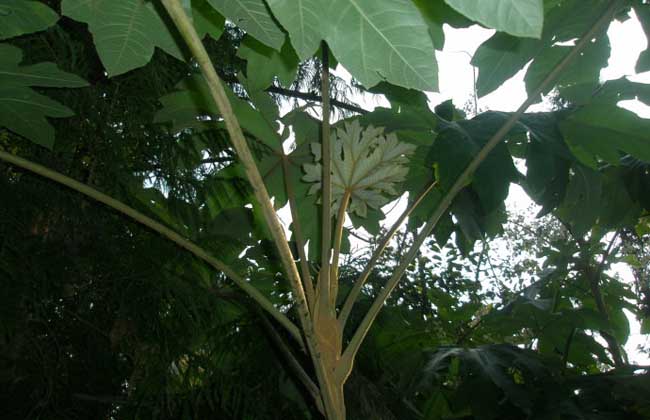
Tetrapanax papyrifer, also known by the aliases Koutuo, Linan, Huotuo, Yishang, Huacao and others, is the stem pith of the green shrub or small tree Tetrapanax papyrifer of the Araliaceae family. It has the effects of clearing heat and promoting diuresis, and promoting qi and lactation. It mainly treats damp-warm disease with red urine, strangury with painful urination, edema with scanty urine, failure of milk secretion and other conditions. Now let us take a look at where the producing area of Tetrapanax papyrifer is!
Where is the producing area of Tetrapanax papyrifer?
The producing areas of Tetrapanax papyrifer are distributed across the southwest as well as Shaanxi, Jiangsu, Anhui, Zhejiang, Jiangxi, Fujian, Taiwan, China, Hubei, Hunan, Guangdong, Guangxi and other places. At present, the Chinese market mostly uses Caulis Clematidis Armandii, Akebia trifoliata (Baitongcao) and Tetrapanax papyrifer as substitutes, while Japan uses Akebia quinata and Akebia trifoliata, and the Taiwan, China market mostly uses Caulis Clematidis Armandii and Akebia longeracemosa (Taiwan Akebia). The mainland once used Caulis Aristolochiae Manshuriensis as a substitute, but it was banned because of toxicity.
The producing environment of Tetrapanax papyrifer
Tetrapanax papyrifer grows in sunny, fertile and thick soil at an altitude of several 10 to 2800 meters, or is cultivated in gardens. It likes light and warmth, and grows well in moist and fertile soil. Its roots have a strong lateral growth capacity and can form a large number of root suckers. It is not very cold-tolerant, and the overwintering temperature should be above 5°C. It is suitable for cultivation in fertile sandy loam. It has strong vitality and can reproduce on its own, but it sheds its leaves in winter. It is suitable for planting on both sides of highways and at the edges of gardens under large trees, where it can suppress weed growth and reduce soil erosion.
Cultivation techniques for Tetrapanax papyrifer
1. Site selection and land preparation: The cultivation site for Tetrapanax papyrifer should be selected in mixed wood forests with convenient irrigation and good drainage, valley areas and gentle slope areas of secondary forest mountainous regions, with a slope not exceeding 10 to 15 degrees, and fertile brown forest soil or sandy soil. Land preparation should be carried out before sowing.
2. Propagation techniques: Tetrapanax papyrifer is propagated by seeds. The suitable planting time is from April to October. On rainy days or in the afternoon of a sunny day when the sun is slanting, open furrows at a row spacing of 20 to 25 cm for drilling. The plant spacing can be determined according to soil fertility, management intensity, and the difficulty of drainage and irrigation. After the seeds are sown in the furrows, cover with 2 to 3 cm of soil and press down.
3. Field management: After sowing Tetrapanax papyrifer, keep the soil moist, and attention should be paid to drainage during the seedling growth period. When the seedlings are more than 30 cm tall, trellises should be set up to support the vines. When artificial trellises are used, various branches can be built into fence supports, and small trees or shrubs such as Vitex trifolia and Tephrosia purpurea can be used. Apply farmyard manure 2 to 3 times each year during the growing period.
4. Pest and disease control: Tetrapanax papyrifer has fewer diseases during the growing period, mainly insect pests. The larvae of the Akebia swallowtail butterfly bite leaves and stems from July to September. During the outbreak period, spray with 500 to 800 times dilution of 90% trichlorfon. Aphids damage the leaves; spray with 2000 times dilution of 40% dimethoate emulsion.
5. Harvesting and seed reservation: In autumn and winter, cut the base of Tetrapanax papyrifer, remove the head, tail and young branches, scrape off the rough outer woody bark, and dry in the sun. During drying, straighten the vine stems, and when they are about 70% to 80% dry, sort them by diameter and tie them into bundles, then continue drying until complete. For seed reservation, select seeds that are large, plump and free from pests and diseases.