Detailed Explanation of Dendrobium officinale Propagation Techniques and Methods
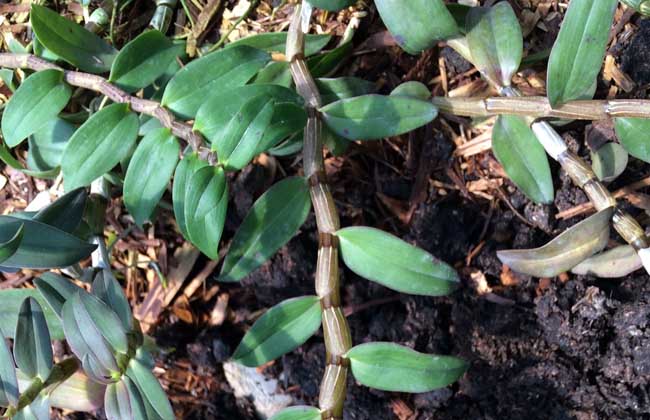
Dendrobium officinale, also known as black-joint grass, Yunnan ironbark, etc., is a perennial epiphytic herb of the genus Dendrobium in the family Orchidaceae, order Microspermae. It is distributed in Anhui, Zhejiang, Fujian and other places in China. Its stems are used as medicine and belong to the yin-tonifying drugs among tonic medicines. Its propagation methods mainly include division propagation, bud propagation and cutting propagation. Let us take a look at Dendrobium officinale propagation techniques together below!
Division Propagation
Select relatively densely growing Dendrobium officinale plants. After flowering, take them out of the pot, remove the old roots, and cut open from the base of the clustered stems. When dividing, damage the root system as little as possible, only cut open the interconnected rhizome-like parts, and separate the roots by hand; there is no need to use a knife. Take the main plant as one group, and further prune away the old roots. Place the new buds close to the center of the pot, fill in new substrate and press it firm, and a new plant is formed.
Bud Propagation
For potted plants grown for more than 3 years, or when small plantlets grow at the top or base of some Dendrobium phalaenopsis stems, bud cutting propagation can be carried out. Select small plantlets with 3 to 4 leaves, 2 to 3 roots, and roots 4 to 5 cm long, cut them off from the mother plant, treat the wounds with plant ash or 70% mancozeb, and plant the plantlets into pots. Note that they should be planted shallowly. After 2 years of cultivation, they can generally flower and become commercial flowers.
Cutting Propagation
Cutting propagation of Dendrobium officinale can be carried out together with repotting after flowering and division. Select whole stems that have not flowered and are relatively plump as cuttings, cut the stems into several sections, each with 2 to 3 nodes, and coat the wounds with plant ash or 70% mancozeb to treat them. Insert the stem sections one by one into a substrate mixed with moss and peat, with half exposed outside, and place them in a semi-shaded, humid place. Do not water for 1 week after insertion, then mist frequently to maintain moisture and provide appropriate shading. After 1 to 2 months, new buds grow at the nodes, and 2 to 3 small roots grow from the lower part of the new buds to form new plants. Plant the new plants together with the old stems into pots. After 2 to 3 years of cultivation, they can flower. The best time for cuttings is from April to August.
Rapid Tissue Propagation
Before cultivating tissue-cultured seedlings of Dendrobium officinale, they should first undergo 14 to 21 days of hardening. The specific measure is to move the tissue-cultured seedlings to a hardening room so that they gradually adapt to the natural environment in an open and changing environment. When the leaves of the tissue-cultured seedlings are dark green, they can be taken out of the bottles for planting. Before taking them out of the bottles, first open the bottle caps and let the bottle seedlings stand in outdoor air for 2 to 3 days so they adapt to natural temperature and humidity. Then wash the seedlings. When washing, gently take out the young seedlings with culture medium and place them in a basin to clean. Contaminated seedlings and bare-root seedlings or seedlings with few roots should be placed separately. Tissue-cultured seedlings should first be washed with tap water, mainly to wash off agar, so as to prevent the agar from becoming moldy and causing root rot, and then rinse once with clean water. When washing seedlings, it is best to grade them simultaneously according to size and quality, so as to facilitate cultivation and management, improve the survival rate of tissue-cultured seedlings and make their growth uniform.