What to Do When Dendrobium officinale Leaves Turn Yellow? Causes and Solutions
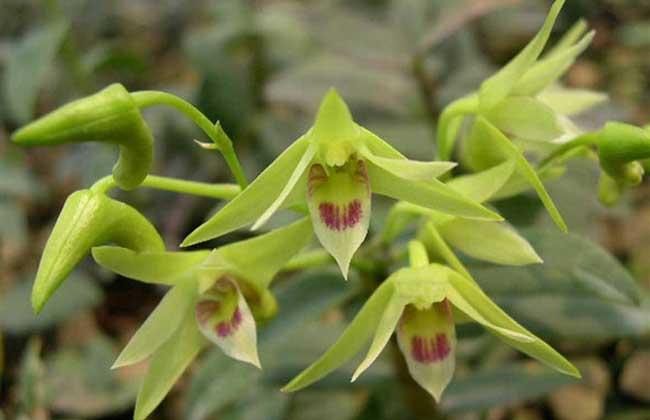
Dendrobium officinale has high medicinal value, and many people are growing it. I believe many Dendrobium officinale growing operations have encountered this problem: when growing Dendrobium officinale, the leaves turn yellow and some even become dry. Do you know what causes this? Do you know how to handle and solve it? Let's take a look together below!
Unsuitable substrate
[Cause] The aerial roots of Dendrobium officinale are exposed to the air, absorbing air and rainwater.
[Solution] The first choice for substrate material is tree bark, followed by sawdust. Both need to be crushed, sterilized, and fermented. Usually, several materials and substrates of different coarseness levels are mixed together.
Substrate too wet
[Cause] Too much watering causes the substrate to be too wet, and the root system rots.
[Solution] For potted Dendrobium officinale, water once every one or two weeks. After watering thoroughly, mist normally, and control factors such as air circulation on the balcony. If the stems and rhizomes of Dendrobium officinale have not died, they can sprout again after spring warms up, but watering should be controlled to prevent root rot.
Lack of water and drought
[Cause] Lack of water causes yellow leaves. Some growers control water excessively, and combined with the current relatively low humidity, this leads to yellow leaves. Although it is now winter, water control should not be excessive, especially for bed-planted Dendrobium officinale. In winter, yellow leaves caused by lack of water are relatively common.
[Solution] Water with slightly acidic to neutral water; avoid water containing too much calcium, magnesium, and other minerals. In spring, summer, and early autumn, sufficient water is required. After mid-autumn, it gradually enters dormancy, and the amount of watering should be reduced accordingly until watering is completely stopped. You can start reducing watering before the leaves turn yellow, further reduce it as the leaves yellow and fall, and stop watering when the leaves have all fallen. In North China, after stopping watering, relatively high indoor air humidity should be maintained to prevent the pseudobulbs from shrinking. If the indoor air is too dry, water the pot once every 1 to 2 weeks.
Too many miscellaneous bacteria
[Cause] The substrate has too many miscellaneous bacteria, and the symbiotic bacteria of the root system are not competitive enough, causing the leaves to turn yellow.
[Solution] Use fermented tree bark or wood chips, coconut shells, bagasse, decomposed fallen leaves, or moss as the growing substrate. It must be fully dried in the sun and treated with phoxim for insect control to kill residual pests and insect eggs in the soil.
Light too strong
[Cause] The growing environment of Dendrobium officinale needs to be controlled in a moist, semi-shaded place. If sunlight is too strong, the Dendrobium will feel dry, which is not good for its aerial root respiration. Therefore, controlling its growing environment is very important.
[Solution] Provide sufficient light. In spring, summer, and autumn, control the shading amount between 30% and 50%. Sufficient light is needed to form a large number of flower buds.
Temperature too high
[Cause] Too high or too hot a growing temperature causes the leaves of Dendrobium officinale to turn yellow.
[Solution] Dendrobium does not like too high temperatures in summer. In the hot summer, it often stops growing and should be placed in a well-ventilated location. After flower buds emerge, maintain a greenhouse temperature of 20°C to 25°C during the day and around 15°C at night. It should not be too high or too low, otherwise flower buds are prone to dropping.
Lack of potassium fertilizer
[Cause] The leaves of Dendrobium officinale first turn yellow starting from the leaf tips, then the entire leaf turns yellow and falls off. This phenomenon may be potassium deficiency, which causes the leaf tips to turn yellow first, and then the whole leaf falls off.
[Solution] Spray potassium fertilizer.
Physiological yellowing
[Cause] In winter, yellow leaves appearing on the middle and lower parts of old plants (mature plants grown from last year's autumn buds or this year's spring buds) are normal, so there is no need to worry.
[Method] No need to worry.