What conditions are needed to grow Dendrobium officinale?
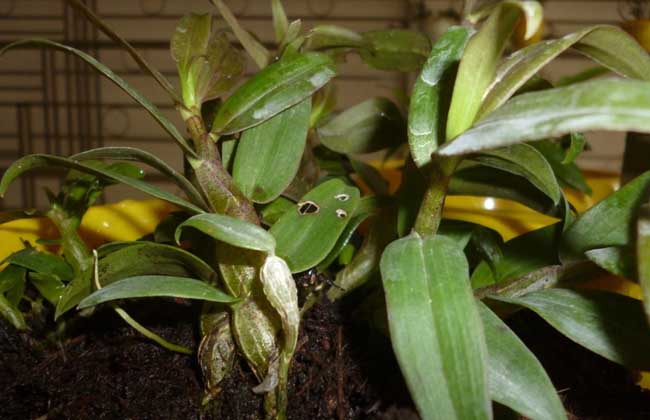
Dendrobium officinale is also known as Tiepilan, Tiediaolan, Lishucao, and is commonly called Heijiecao in Yunnan. In China it is distributed in the mountainous areas of Anhui, Zhejiang, Yunnan, Guizhou, Sichuan and other places south of the Qinling Mountains and the Huai River, mainly growing on high mountain cliffs and in rock crevices in those areas. Due to the special growing conditions and limited distribution of Dendrobium officinale, and after long-term harvesting, its natural resources are on the verge of exhaustion, and domestic market supply is in short supply, so its growing environment has even stricter requirements.
Seedling production of Dendrobium officinale
Collect healthy, well-growing broad-leaf red-stem type Dendrobium officinale from the wild as seed stock, and care for it carefully. When Dendrobium officinale blooms, carry out artificial pollination to obtain authentic Dendrobium officinale seed pods. After the seeds mature, sow them to form the Dendrobium officinale mother bottle; through transfer -> strengthening seedlings -> rooting, healthy, authentic Dendrobium officinale mother bottles are obtained.
Environmental conditions for Dendrobium officinale
Dendrobium officinale has relatively strict environmental requirements, and choosing a suitable environment is half the battle for successful cultivation. Dendrobium officinale should be planted at an altitude of about 800-1600 m in a humid, cool environment. The suitable growth temperature is 15-30°C; during the growing period, 16-21°C is more suitable; the nighttime temperature is 10-13°C; the day-night temperature difference should be kept at 10-15°C; the best frost-free period is 250-300 days. Annual rainfall should be above 1000 mm. Seedlings are prone to freezing below 10°C, and generally Dendrobium officinale begins to shed leaves below 5°C. A relative humidity of about 80% is more suitable for Dendrobium officinale; it avoids dryness and waterlogging, especially when new buds begin to sprout and new roots form, when sufficient water is needed. Shading of 70% in summer and autumn and 30-50% in winter is appropriate; if the light is too strong, the stems will swell and turn yellow, the leaves will be yellow-green, and growth will slow or stop.
Facility conditions for Dendrobium officinale
Because Dendrobium officinale has relatively high environmental requirements, it needs to be grown in a facility environment. Simple bamboo-and-wood frame greenhouses and steel-frame greenhouses are both acceptable, but good ventilation inside the greenhouse must be ensured, and internal and external shade nets should be installed. If funds are sufficient and Dendrobium officinale is to be cultivated long term, building a steel-frame greenhouse can be considered, as it has a long service life and a low repair rate. Plastic film can be chosen at 12-15 si according to funds, heat preservation and service life.
1. Ground planting: The soil needed in the greenhouse should be fully dried in the sun and treated with phoxim for insect control to kill residual pests and eggs in the soil. Inside the greenhouse, use bricks or stones to build seedbeds 15-20 cm high and 1-1.5 m wide, with the length depending on the terrain; spread a 5-10 cm thick layer of gravel and other materials with good water permeability on top, and finally spread a layer about 10-12 cm thick of fermented bark or sawdust, coconut shell, bagasse, decomposed fallen leaves or moss as the growing substrate. Leave a 40-50 cm wide passage between seedbeds for daily cultivation operations.
2. Bed planting: According to the funding situation, build bamboo or steel-frame seedbeds about 1.2-1.5 m wide and about 80 cm high, with 40-50 cm wide passages between seedbeds for daily cultivation operations. Movable steel seedbeds can also be built, with bed width and height similar to fixed seedbeds, but only one passage needs to be left to increase the utilization rate inside the greenhouse. Spread a 10-12 cm layer of fermented bark, wood chips, sawdust, coconut shell, bagasse, decomposed fallen leaves or moss on the bottom layer of the seedbed as the growing substrate.
Summary: Bed planting is recommended for Dendrobium officinale, because bed planting has better water permeability than ground planting, helps prevent water accumulation in the seedbed from causing root rot in Dendrobium officinale, and reduces the advantages of soil-dwelling pests such as snails, slugs and cutworms, which is beneficial to the healthy growth of Dendrobium. If long-term cultivation is considered, the choice of growing substrate is very important. Stack-fermented bark, wood chips and sawdust have good corrosion resistance and, compared with moss, bagasse and rotted leaves, have good air permeability and always remain in a semi-decomposed state, making them more suitable for Dendrobium officinale cultivation and a relatively ideal growing substrate.