Is growing Dendrobium profitable? Analysis of Dendrobium cultivation prospects and benefits
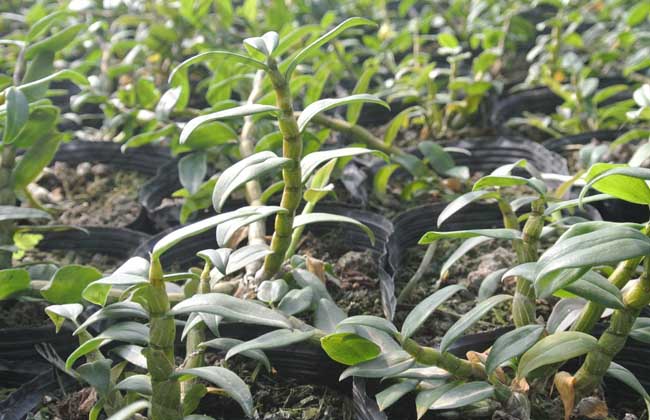
Dendrobium, also known as Wanzhangxu, Diaolan, Linlan, Jinsheng, Jinchaihua and so on, is a precious medicinal plant with the effects of benefiting the stomach and promoting fluid production, nourishing yin and clearing heat. It is mostly used for conditions such as yin damage with depleted fluids, dry mouth and excessive thirst, poor appetite and dry retching, post-illness deficiency heat, and blurred vision. With the depletion of wild resources, it is now mostly cultivated artificially. Let us take a look below at whether growing Dendrobium in 2016 is profitable!
Is growing Dendrobium profitable?
Because Dendrobium has a slow growth cycle, harsh growing conditions, and an extremely low reproduction rate, in recent years, affected by market demand, people have dug it up in unlimited large quantities, and Dendrobium officinale is on the verge of extinction, causing the price of Dendrobium officinale to keep soaring. The price of fresh product rose from 600 yuan per kg in 2010 to 1500 yuan per kg in 2012, more than doubling. Its first-grade dried product Fengdou broke through 20,000 yuan per kg in 2013. With continuous breakthroughs in agricultural technology, the application of tissue culture technology and artificial cultivation technology has brought rapid development to the Dendrobium officinale industry. The existing national planting area has exceeded 2000 hectares, with cultivation in Zhejiang, Yunnan, Guangdong, Guangxi, Anhui, Hunan, Fujian, Jiangsu, and Sichuan, and an output value exceeding 3 billion yuan, making it one of the Chinese medicinal materials with the largest production and sales volume and the fastest development in our country.
Market prospects for Dendrobium
At present, the total annual market demand for Dendrobium is 8000 to 10000 tons, and demand is increasing by 10 to 15% each year. However, artificial cultivation has just started, and supply is seriously insufficient. It is expected that within 10 years the output of Dendrobium will still be difficult to meet market demand. At present, the price of premium pure Dendrobium is around 100,000 yuan per kg. The price of first-grade Dendrobium is 20,000 to 30,000 yuan per kg, and there is a price but no goods. For growing Dendrobium, the state also strongly supports it. The State Science and Technology Commission has listed the artificial cultivation and research and development project of Dendrobium as a national-level Spark Program plan. For individuals and enterprises artificially cultivating and researching Dendrobium, the State Science and Technology Commission has clearly stated that it will approve the project and provide funding support from the government.
Risks of growing Dendrobium
1. Technical difficulty is very great: although after more than 10 years of research and exploration, artificial cultivation technology for Dendrobium is basically mature. However, it is still very difficult for ordinary people to master skilled cultivation techniques in a short period. At present, cultivation techniques vary greatly from place to place, and differences in product quality and benefits are also great. Cultivation failures also occur from time to time.
2. Large investment and high risk: calculated according to an actual effective planting area of 400 sq m per mu under intensive greenhouse cultivation, each mu needs 30,000 to 50,000 clusters of seedlings. Calculated at the current 2.5 yuan per cluster, the seedling investment requires more than 80,000 yuan. Adding the cost of facilities such as greenhouses, as well as 2 years of labor and management fees, the investment per mu exceeds 100,000 yuan. Once cultivation fails, the loss is heavy, and such examples have also appeared many times.
3. Long cultivation cycle: from tissue culture of seedlings to acclimatization of bottle seedlings takes about 15 months. In Dehong and other places in Yunnan where temperatures are relatively high, it takes 15 to 18 months for preliminary harvest. In some areas with lower temperatures, the harvest period requires 18 to 30 months.
4. Quality is difficult to guarantee: our country currently has as many as 76 varieties of Dendrobium. Dendrobium alone also includes several seedling types of different quality, such as hybrid species, origin species, soft-stem species, and hard-stem species, which are difficult even for ordinary professionals to distinguish. In addition, factors such as substrate selection, planting mode, fertilization, and pest and disease control all affect the quality of Dendrobium. If the technology is not mastered well, the quality of the cultivated product is poor, and pesticide residues, heavy metals, and other substances exceed standards, making it generally very difficult to sell.
5. Follow the principle of genuine origin: although all are Dendrobium, quality differs greatly because of different cultivation places. At the current initial stage of the industry, consumers do not yet attach much importance to place of origin. With the expansion of the market, the principle of genuine origin will be taken seriously, and Dendrobium artificially cultivated in greenhouses in some places unsuitable for cultivation will lose the market because of quality and other reasons.
6. Market fluctuations are too great: due to the participation of enterprises in Zhejiang, Guangdong, and other places, large one-time planting areas, plus the influence of greenhouse cultivation on quality, genuine origin, and various other factors, the Dendrobium market is unstable, and later benefits are difficult to predict.