A detailed guide to the prevention and control of Gastrodia tuber rot
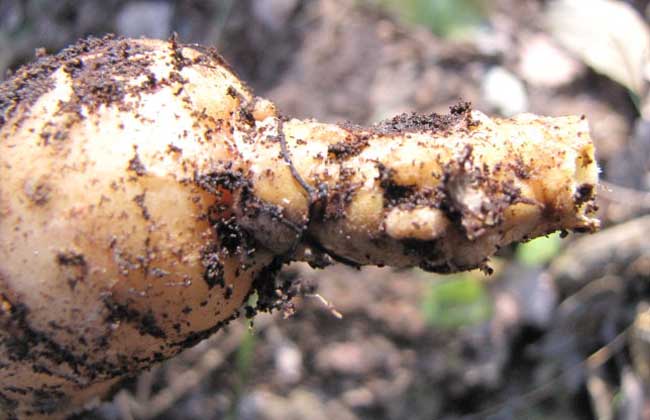
Gastrodia tuber rot, also known as Gastrodia soft rot or rotten nest disease, is one of the reasons for low and unstable yields in Gastrodia cultivation. In affected tubers, the skin turns yellow and withered, the central tissue rots, and a white, watery, thick fluid with a foul odor seeps from the cut surface of the tuber. In rotten nests and inside the tubers, the rhizomorphs of Armillaria mellea grow densely. Let us take a look below at the prevention and control methods for Gastrodia tuber rot.
Symptoms of Gastrodia tuber rot
In tubers affected by Gastrodia tuber rot, the skin becomes yellow and withered, the central tissue rots, and the interior of the tuber turns into a foul-smelling, thin slurry. Some upper-layer Gastrodia tubers rot and shrivel, while others have only part of the upper portion rotting or the cortical layer necrotic, whereas lower-layer Gastrodia tubers are either unaffected or affected.
Causes of Gastrodia tuber rot
1. Improper soil selection: soft rot and rotten nests are mostly seen in hard gravelly soil and dead yellow mud soil with poor moisture retention and aeration. Armillaria mellea grows and develops poorly in such sites, and Gastrodia wilts, rots and dies because it cannot obtain nutrients from Armillaria mellea.
2. High temperature and high humidity environment: under such climatic conditions, miscellaneous fungi grow readily. Grayish-white miscellaneous fungal hyphae quickly appear on the Armillaria mellea wood, and gradually spread into the humus in the nest, with yellowish-white, rapeseed-like sclerotia forming among the hyphae. Once infected by pathogenic fungi, Gastrodia begins to rot from a local spot and the rot spreads.
3. Excessive rain and poor drainage: under waterlogged conditions, the growth of Gastrodia is inhibited and its lytic function is significantly weakened. However, because Armillaria mellea has strong stress resistance, it can still grow normally. Armillaria mellea breaks through the dissolved layer of Gastrodia and rapidly multiplies inside the tuber, "eroding it back." Its characteristic feature is that the underside of the rotting tuber skin is filled with Armillaria mellea rhizomorphs, and the Armillaria mellea rhizomorphs on the fungal wood in the rotten nest are dense. This rotten nest phenomenon mostly occurs during the rainy season.
4. Mistakes in cultivation techniques: this situation is mostly caused by insufficient fungal wood, too large a seeding rate, and insufficient humus filler in the nest. Because Gastrodia cannot obtain adequate nutrient supply from Armillaria mellea, its growth is slow and weak, which gradually leads to soft rot.
Prevention and control of Gastrodia tuber rot
1. Choose sandy loam with good granular structure, strong water permeability and rich humus content, and require forest land on a 15-25° slope, with a soil pH of 5.8-6 and humidity of 40%. In high mountain areas, choose sunny slopes; in middle and low mountain areas, choose semi-sunny slopes; in low hills, choose understory cultivation.
2. The cultivation season is generally mainly arranged in winter (October-November). Usually, old fungal wood plus new fungal wood is used to supplement the nutrition of the Armillaria mellea fungal wood and control excessive growth of Armillaria mellea. During cultivation, open the fungal bed cultivated in March-April of that year, take out 5 well-developed pieces of fungal wood and add 4 new pieces to plant another nest, then add 4 new pieces to the original fungal bed to plant one nest (that is, the "take five, add four method"). Generally, 500-750 grams of seed are planted per 10 pieces of fungal wood. The Gastrodia seed is placed close between the fungal wood pieces, and more fungal branches are added among the new wood. Besides laying a layer of oak leaves at the bottom of the nest, each layer planted is also filled with an appropriate amount of oak leaf humus soil. After planting, cover with leaves and then cover with 10-15 cm of soil.
3. Gastrodia management is simple: no hoeing weeds and no fertilizing. The main tasks are preventing drought, preventing waterlogging, preventing cold and preserving soil moisture. In low mountain areas, to prevent drought, several corn plants can be planted beside the nest as drought indicator plants. When the corn leaves curl, spray an appropriate amount of water to prevent drought. In the rainy season, open ditches on the upper slope of the cultivation area for drainage. In high mountain areas, add leaves or straw curtains in the cold winter season to prevent freezing. In addition, prevent trampling by people and livestock and contamination by pesticides.
4. Strictly select fungal wood and fungal beds. When planting Gastrodia, strictly select the fungal wood and fungal beds. If there is fungal wood infected by miscellaneous fungi, it is better to discard it than use it. Pay attention to cold protection measures at ordinary times. For spring Gastrodia, take cold protection measures during overwintering to ensure safe overwintering. If safe overwintering cannot be achieved, harvest should be carried out before overwintering.