Is growing Gastrodia profitable? A planting benefit and profit analysis
Gastrodia, also known as chijian, duyaozhi, limu, heliicao, shencao, guiduyou, mupu, mingtianma, dingfengcao, bailongpi and more, is a perennial herbaceous plant of the genus Gastrodia in the orchid family (Orchidaceae). Its rhizome is used as medicine to treat dizziness, numbness of the limbs, infantile convulsions and other conditions, and combined with Qiongzhen lingzhi (a type of reishi) it treats headache and insomnia. Let us take a look below at whether growing Gastrodia makes money!
Market forecast for Gastrodia cultivation
1. Gastrodia is a precious Chinese medicinal herb and a specialty of China. Gastrodia stewed with chicken tonifies weakness; regularly eating Gastrodia porridge, or stir-frying, boiling or stewing fresh Gastrodia like Chinese yam or potato, can strengthen the body's antibodies and immune function, prevent visual disturbances, eye inflammation, dry skin and loss of mucous membrane secretion capacity, and can resist certain respiratory and digestive infections, and treat and reduce the harm of dizziness, vertigo, arthritis, rheumatism, kidney disease and other ailments.
2. Gastrodia can also protect the body's youthful vitality, prolong life, and prevent premature aging, with a particularly notable effect on treating headaches. In recent years, the number of manufacturers developing Gastrodia foods, Gastrodia drinks, Gastrodia health products, Gastrodia medicinal cuisine products and Gastrodia medicines at home and abroad has been increasing day by day, requiring large quantities of raw material.
Summary: Most countries in the world do not produce Gastrodia and can only import it from China, which brings huge business opportunities to Gastrodia cultivation. It is expected that there will be no worry about sales for the next 10 years, while prices will rise steadily with some fluctuation.
Suitable regions for Gastrodia cultivation
1. Gastrodia has no roots and no green leaves, cannot carry out photosynthesis to produce nutrients, and instead lives symbiotically with Armillaria mellea (honey fungus), relying on Armillaria mellea to provide nutrients for its growth. It does not need sunlight to grow, and from planting to harvest requires no fertilizer, no weeding and no pesticide spraying; it only needs suitable manual regulation and management of temperature (temperature below 10 cm of ground surface of 15-28°C) and humidity (50-65%) to grow normally. Therefore it does not compete with crops for land, fertilizer or nutrients, and is the "lazy man's golden industry" with the highest return rate among planting projects.
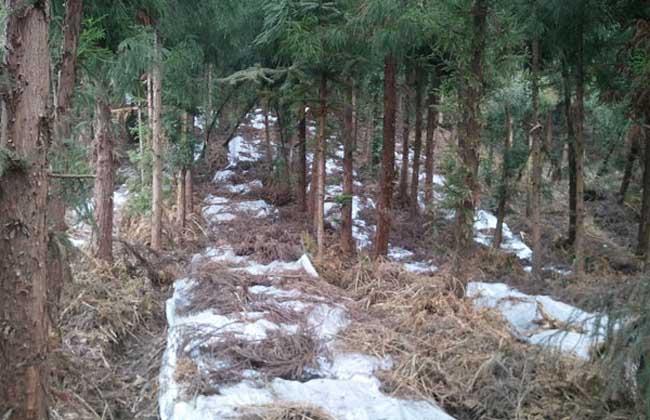
2. Gastrodia can be cultivated artificially whether in mountainous areas, plains, villages or cities, indoors or outdoors, in fields, on balconies, in corridors, in cave dwellings, in tunnels, in air-raid shelters and in barren hills and forest land, and can also be grown in factory-style, modern, standardized and industrialized ways. For raw materials, choose tree species that do not contain aromatic oils, such as those of the Fagaceae, Betulaceae, Rosaceae and Fabaceae families, for example Cyclobalanopsis, oak, white birch, water alder, cherry tree, silk tree, chestnut tree, pagoda tree, poplar, elm, willow, various fruit trees and so on; their trunks, branches and leaves can all be used to grow Gastrodia. Fresh trunks (referred to as fresh wood sticks) and fresh branches are sawn into wood segments and branch segments respectively, and together with leaves are planted simultaneously with Armillaria mellea spawn, Gastrodia spawn and river sand (or sandy soil).
3. In the natural season, winter planting runs from November to January of the following year, with a growing period of 9-11 months before harvest; spring planting runs from February to May, with a growing period of 6-8 months before harvest. 1 sq m can produce about 10 kg of fresh Gastrodia; based on the 2010 purchase price: fresh Gastrodia by size at a lowest price of 30 yuan/kg from the range of 30-40 yuan/kg, that is worth 300 yuan. The small Gastrodia harvested can be used as Gastrodia spawn for continued planting. One introduction of spawn can allow cyclical planting for 2-3 years.
Economic benefits of Gastrodia cultivation
1. To plant 1 sq m requires 70 yuan of Gastrodia spawn and Armillaria mellea spawn, about 10 yuan for 33 kg of fresh wood sticks (including 30 kg of thick wood sticks about 4-8 cm in diameter and 3 kg of thin branches about 2-3 cm in diameter), 10 yuan for 0.25 cubic meters of clean medium-fine river sand (sandy soil can also be used instead of river sand; if planted outdoors, this cost can be omitted), and about 10 yuan for labor and other costs, for a total investment of about 150 yuan. The yield of Gastrodia per 1 sq m is generally 10 kg; based on a purchase price of fresh Gastrodia at the lowest price of 30 yuan/kg from the range of 30-40 yuan/kg, the output value is 300 yuan.
2. If fresh Gastrodia is made into dried product (drying ratio 4-4.5:1), the current lowest market price of dried Gastrodia is 160 yuan/kg, and the output value can reach more than 300 yuan. Subtracting the cost of 80 yuan and labor of 80 yuan, the net income per 1 sq m is more than 150 yuan. Then growing Gastrodia on 1 mu (667 sq m) of land, excluding drainage ditches and walking paths, gives an actual planting area of 500 sq m and a net income of more than 75,000 yuan; this is the income from commercial Gastrodia calculated at conservative yield.
3. If the prices of commercial Gastrodia and Gastrodia spawn are calculated together, the income will be more than 1 times higher. This is because of the 10 kg of fresh Gastrodia produced per 1 sq m, commercial fresh Gastrodia accounts for 70%, about 7 kg, calculated at the lowest market price of 30 yuan/kg, 30 yuan × 7 = 210 yuan; small Gastrodia, that is, first-generation Gastrodia spawn, accounts for 30%, about 3 kg, calculated at the lowest market price of 80 yuan/kg, 80 yuan × 3 = 240 yuan; 210 yuan + 240 yuan = 450 yuan; 450 yuan - 150 yuan = 300 yuan, so the net income is 300 yuan. This is the rough cost estimate for the first year.
4. The characteristic of Gastrodia cultivation is that the first year has higher costs, because everything has to be bought, so the investment is relatively higher. The maximization of its benefits appears starting from the second year. In the second year of continued production, Gastrodia spawn does not need to be bought, Armillaria mellea uses old fungal wood as a substitute, half of the wood sticks can be saved (they can also be cultivated oneself), and the sand used for planting can continue to be used. In this way, the cost in the second year is only the cost of fresh wood sticks plus labor and other costs. Thus the cost is greatly reduced, and the benefit can increase by more than 10 times. The 3 kg of first-generation Gastrodia spawn harvested per 1 sq m can be expanded to plant 5-6 sq m.