When is the most suitable time to plant honeysuckle?
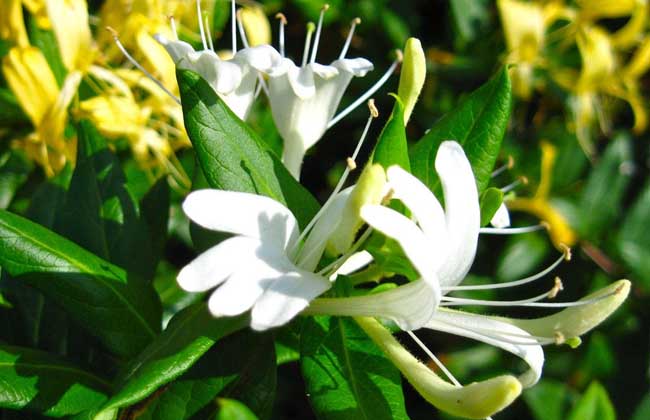
Honeysuckle is a commonly used traditional Chinese medicine with a long history. Its creeping growth ability is stronger than its climbing growth ability, making it suitable for ground cover cultivation under forests, at forest edges, on the north side of buildings, and other places. It can also be used as a low green wall, and its twining ability can be used to create flower corridors, flower trellises, flower fences, flower pillars, and to twine around rockery stones. Let us take a look below at when to plant honeysuckle!
Growing conditions for honeysuckle
Honeysuckle grows on mountain slopes in scrub or sparse forests, in piles of rubble, by roadsides at the foot of mountains, and beside village fences, at altitudes up to 1500 m. It is highly adaptable, sun-loving, shade-tolerant, strongly cold-resistant, and also tolerant of drought and waterlogging. It is not demanding about soil, but grows best in moist, fertile, deep sandy loam. It sends out shoots twice a year, in spring and summer. Its root system is dense and well developed, with strong sprouting ability, and its stems and vines can take root as soon as they touch the ground. It likes sunlight and a mild, moist environment, has strong vitality, wide adaptability, and is cold-resistant and drought-resistant; in shaded places it grows poorly.
When do you plant honeysuckle?
1. Seed propagation: Honeysuckle seed propagation is usually sown in April. Soak the seeds in warm water at 35-40°C for 24 hours, take them out and mix with 2-3 times their volume of wet sand to promote germination, and sow when about 30% have cracked open. On the seedbed, open furrows at a row spacing of 21-22 cm and sow, covering with 1 cm of soil, spraying water once every 2 days; seedlings emerge in just over 10 days. Transplant after autumn or in the spring of the second year, using about 15 kg of seed per 1 hectare.
2. Cutting propagation: Honeysuckle cutting propagation is generally carried out during the rainy season. In rainy weather in summer and autumn, select robust 1-2 year old branches free of pests and diseases, cut them into 30-35 cm lengths, remove the lower leaves to make cuttings, and use them immediately after cutting. On the chosen land, dig holes at a row spacing of 1.6 m and a plant spacing of 1.5 m, with holes 16-18 cm deep, place 5-6 cuttings in each hole, buried in the soil in a scattered, slanted-upright arrangement, with about 7-10 cm exposed above ground, then fill in soil and firm it.
Honeysuckle cultivation techniques
1. Timely pruning: Pruning is carried out from after leaf fall in autumn to before budding in spring. Generally, vigorous branches are pruned lightly and weak branches heavily, and every branch is pruned. When pruning, pay attention to ensuring good ventilation and light transmission after new branches grow. Thin and weak branches, dead and old branches, and basal shoots are all cut off. For plots with poor fertilizer and water conditions, pruning should be heavier; for aging plants, cut off old branches to promote new branches. Young plants should be pruned lightly, mainly to develop plant shape. Plants grown on mountain and ridge plots generally keep 4-5 main trunk branches, while plain plots should keep 1-2 main trunk branches. The tops of the main trunks should be cut off to make them thicker and upright.
2. Reasonable shaping: Shaping is carried out together with pruning. In principle, it is based on fertilizer and water management, promoting the whole plant, making full use of space, increasing the amount of branches and leaves, making the plant shape more reasonable, and clearly increasing flowers and yield. After pruning, the flowering time is relatively concentrated, which facilitates harvesting and processing. Generally, after pruning the branches can be made upright, and removing thin and weak branches and basal shoots is beneficial to the formation of new flowers. After picking flowers, prune again, then apply a quick-acting nitrogen fertilizer and water once to promote early development of the next flush of flowers. In this way, 4 harvests of flowers can be obtained in a year, with an average yield of 150-200 kg of dried flowers per mu.
3. Earthing up and weeding: Honeysuckle cultivation requires earthing up and weeding 3-4 times a year. The first time is when new leaves appear, the second before the second flowering period, and the last before frost in late autumn and early winter. The purpose of earthing up is to prevent the flower roots from being exposed above ground, and it is recommended to carry it out together with fertilization. Weeding should start from the outer perimeter of the plant, first far and then near, and be careful not to damage the root system.
4. Reasonable topdressing: In the first 1-2 years after planting honeysuckle, when the plant is in its stage of developmental shaping, apply more fertilizers such as human and livestock manure, plant ash, urea, and potassium sulfate. After 2-3 years of planting, apply more fertilizers such as livestock mixed manure, barnyard manure, cake fertilizer, and superphosphate at the beginning of spring each year. After the first flush of flowers is harvested, an appropriate amount of nitrogen, phosphorus, and potassium compound fertilizer should be applied to provide sufficient nutrients for the next flush of flowers. Each year after sprouting in early spring and when the first batch of flowers has been harvested, open ring trenches and apply human feces and urine, chemical fertilizers, etc. by watering, with 250 grams of each fertilizer applied.
5. Harvesting and processing: The best time to harvest honeysuckle is in the early morning and forenoon. At this time, the harvested flower buds do not easily open, and have sufficient nutrients, a strong fragrance, and good color. Harvesting in the afternoon should be finished before the sun sets, because the opening of honeysuckle is restricted by light, and after the sun sets the mature flower buds will open, affecting quality. Do not include young buds or leaves. After picking, place them in wicker or bamboo baskets. When gathering them together, do not pile them into a large heap; spread them out instead, and do not leave them for longer than 4 hours.