Detailed Explanation of the Key Techniques for Cultivating Honeysuckle Bonsai
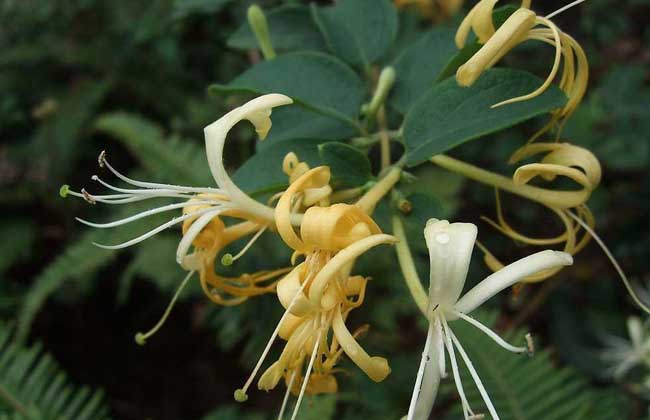
Honeysuckle (Japanese honeysuckle, Lonicera japonica) is a perennial semi-evergreen twining shrub of the genus Lonicera in the family Caprifoliaceae. Its flowering period is from May to October each year. It gets its name because the flowers are white when they first open and then turn golden yellow. It is naturally distributed in most parts of China, in flat fertile land, mountainous areas, roadsides, embankments and other places. Besides being grown in the ground, it is also a rare and valuable material for flower-viewing and trunk-viewing bonsai. Let us take a look at the cultivation techniques for honeysuckle bonsai!
Growth Habits of Honeysuckle
Honeysuckle has strong adaptability. It likes sunlight and tolerates shade. It is highly cold-resistant and also tolerates drought and waterlogging. It is not strict about soil requirements, but grows best in moist, fertile, deep sandy loam. It sends out new shoots twice each year, in spring and summer. Its root system is dense and well developed, with strong sprouting ability, and its stems and vines can take root as soon as they touch the ground. It likes sunlight and a mild, moist environment, has strong vitality, wide adaptability, is cold-resistant and drought-resistant, and grows poorly in shaded places. It grows in mountain thickets or open forests, piles of rocks, roadsides at the foot of mountains, and beside village fences, at altitudes of up to 1500 m.
Selection of Honeysuckle for Pot Cultivation
In nature, not too many honeysuckles are suitable for making bonsai. Try to choose tree stumps with well-developed roots, thick and sturdy trunks, vigorous and antique-looking form with curved variations, short and compact tree shape, thick and short dense internodes, and natural tapering transitions. To cultivate honeysuckle bonsai, you can also plant small honeysuckle seedlings with short internodes that flower easily in places with deep, loose and fertile soil and rapid growth for directional training. When the ideal thickness is reached, they can be potted for cultivation. In this way, you can usually view the flowers and pick the flowers, and at the same time obtain a relatively ideal honeysuckle stump, achieving multiple goals at once.
Cultivation and Management of Honeysuckle
1. Bonsai planting: Honeysuckle bonsai can be planted in all four seasons, but late autumn and early winter is the best time for planting. In order to make the honeysuckle bonsai grow well, you can plant already rooted honeysuckle cuttings in late autumn or early winter in an ornamental pot suitably sized to the stump, then cultivate them with prepared fertile humus loam, cover the surface with green moss, and water immediately to help them survive.
2. Pruning and shaping: Honeysuckle bonsai can be pruned and shaped from winter until the following year before bud break. According to the needs of the bonsai design, generally keep 3 to 5 main branches, leave 2 to 3 buds on each branch, and cut off all other branches and vines. This is the key to ensuring rapid shaping. In addition, after each flowering, be sure to combine fertilisation with timely pruning and shaping, so as to achieve the ornamental effect of multiple flowerings.
3. Bud removal and pinching: For honeysuckle bonsai, promptly remove the vigorous-growing, twining, tree-form-disrupting water sprout buds that would grow in the future. During the growth process, especially the water sprout buds, must be firmly controlled. Remove the thin and weak branch buds that will not be able to flower later, so as to avoid affecting ventilation and light penetration. Keep only the buds of ordinary growth branches that can flower normally later. Generally, after the branches form, cut them at about 20 cm. Most branches can bear flowers, and bear many flowers. For individual long branches that affect the tree shape, you can first pinch off the growing tips to ensure a compact tree shape with ventilation and light penetration, and no twining branches at all.
4. Fertilisers and water management: Honeysuckle bonsai can develop and grow normally only under conditions of sufficient fertiliser and water, but it must not be allowed to grow unchecked. During this period, according to its growth condition, flexibly grasp and promptly withhold water, control the tree shape, increase flower quantity, prevent excessive vegetative growth, promote the ageing and maturation of stems and vines, shorten internodes, and dwarf the plant shape. Generally, in addition to applying decomposed cake fertiliser once a week, also spray the leaves with a 0.2% potassium dihydrogen phosphate solution 2 to 3 times. Before flower bud formation, apply less or no nitrogen fertiliser, and apply more phosphorus and potassium fertiliser. After the branches stop growing, during the bud gestation period, apply an appropriate amount of nitrogen fertiliser to promote larger and more colourful flowers.
5. Pest and disease control: Honeysuckle bonsai basically has no pests or diseases during cultivation. A small number of plants develop brown spot disease and powdery mildew. Frequently pick up and remove dead branches and fallen leaves, apply more phosphorus and potassium fertiliser, and improve the disease resistance of the plants. In the early stage of disease, spray with 500-times dilution of 65% zineb wettable powder or spray with half-strength Bordeaux mixture for control. Pests include inchworms and aphids that eat tender leaves, and coffee tiger longhorn beetles that bore into and eat branches and vines. Commonly use 0.1% fenitrothion or 800 to 1000-times dilution of 95% crystal trichlorfon for spraying and killing. If there are not many pots, it is best to catch and kill them manually, which is simple and easy, economical and practical, and pollution-free.