Detailed Explanation of Pine Pollen Collection Techniques and Methods
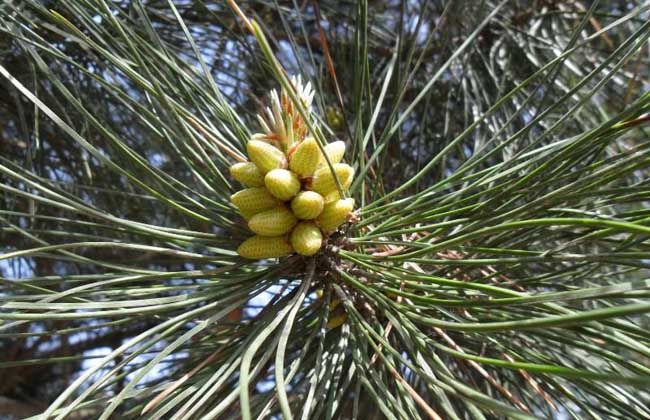
Pine pollen is the male reproductive cell (i.e., sperm cell) of plants in the genus Pinus of the family Pinaceae, such as masson pine (Pinus massoniana) and Chinese pine (Pinus tabuliformis), commonly called pollen. Mature pollen is dispersed by wind and airflow to complete pollination and fertilization. It not only contains the genetic information of life, but also contains all the nutrients needed for human life and longevity. Let us now take a look at pine pollen collection techniques!
Pine Pollen Collection Time
In China, the flowering period of masson pine and Chinese pine is delayed from south to north: Yunnan around March, western Henan in mid-April, and the northeast around June. Within the same region, the flowering period is also delayed as altitude increases. For example, in Songxian, Luanchuan and other places in western Henan, mid-mountain areas above 1000 m in altitude flower 7-10 days later than low-mountain areas at around 500 m in altitude. Moreover, at the same location, the flowering period in different years may differ by about 10 days due to factors such as the amount of precipitation and temperature levels. In a given region, the pine pollen collection time generally lasts only 10-15 days. Therefore, one must observe diligently and pay close attention to the growth of male cone spikes in order to determine the suitable collection period for pine pollen. When the color of the small flower grains on most spikes changes from green to yellow, picking should begin.
Selection of Pine Pollen Spikes
1. Mature spikes are slightly yellow, the flower grains are slightly loose, and when the grains are lightly rolled by hand there is basically no sap, and yellow pollen can be shaken out. This kind of spike is most suitable for picking, with a pollen yield of about 8-9%.
2. Immature spikes are greenish in color; the flower grains feel hard when rolled by hand and release sap, and after drying in the sun they yield no pollen. They are also not easy to dry and tend to become moldy.
3. Overmature spikes are yellowish-white, and the flower grains are loose; when picked, the pollen scatters profusely, and the pollen content is very low.
4. Spikes that have already withered are old yellow or dark brown, and most of the pollen has already dispersed and fallen away, so they have no collection value.
Pine Pollen Preliminary Processing Techniques
1. Drying site: Pine pollen is a raw material for medicines and health foods. The threshing and processing site for the spikes should be a clean, sunny, dry and level concrete surface, brick surface, etc. The roof of a rural single-story house may also be used, with a layer of plastic film spread on top. The spike processing site can simply be outdoors; generally 1 sq m of space can dry 15-20 kg of spikes.
2. Drying method: The spikes brought back should immediately be spread evenly on the plastic film to a thickness of 10-20 cm; if too thick, they easily become sour and moldy. Under conditions of sufficient sunlight and natural ventilation for moisture removal, after about 3 days the pine pollen will fall onto the plastic film.
3. Rough screening: The pollen that has fallen from drying is manually screened with a 60-80 mesh sieve. The sieve dimensions are 90×60×10 cm, and the sieve bottom is fastened as a double layer, with ordinary plastic window screen mesh below and 60-80 mesh stainless steel sieve mesh above. A large plastic bag with its lower end tied shut is fitted under the sieve, and two people shake the sieve so that the pollen falls into the plastic bag. A cotton cloth is placed over the sieve to prevent the light pine pollen from drifting away in the wind. Where conditions permit, a mechanical vibrating sieve can be used, which can significantly improve efficiency.
4. Pollen dehumidification: The moisture content of roughly screened pine pollen is generally 15-25%, making it highly prone to molding and souring, so it needs timely dehumidification. For small-scale processing, spread the coarse pollen from the plastic bag out evenly again to dry, to a thickness of about 5 cm, taking care to stir it promptly and strictly prevent strong winds from blowing it away.
5. Fine screening: When the moisture content of the pine pollen meets the requirement, pass it through a fine sieve of the specified mesh to remove impurities. Generally, producing first-grade pine pollen requires passing through a 200-mesh sieve, and producing second-grade pine pollen requires passing through a 160-mesh fine sieve. The fine screening site should be chosen indoors in a relatively enclosed and clean area. For small quantities, manual screening is used; for large-scale production, a vibrating screening machine can be selected for screening.
6. Scientific storage: Put the qualified pine pollen after fine screening into food-grade non-toxic polyethylene plastic bags. The bag dimensions are 40×100 cm; after doubling the bags, each bag can hold 12-15 kg of pine pollen. Let it stand for more than half an hour, squeeze out the air in the bag, then tie the bag opening tightly, and store it temporarily indoors in a cool, dry place pending sale. If it is to be stored for a long time, a constant-temperature mechanical cold storage at 1-5 degrees C should be used; after 3 years of storage, it can still maintain its appearance, color and biological activity.