What are the propagation methods for monk fruit? Learn them all in one article
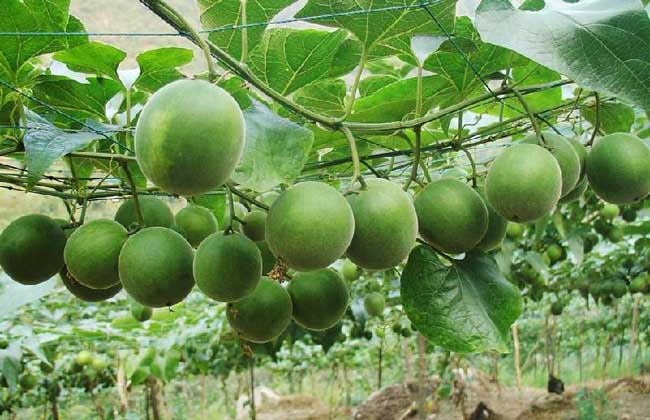
Monk fruit (Siraitia grosvenorii) is a perennial vine of the Cucurbitaceae family, known as the "immortal fruit." It blooms in summer and bears fruit in autumn. In China, it is mainly produced in Longjiang Township, Yongfu County, Guilin City, Guangxi Zhuang Autonomous Region, as well as in Longsheng and Baishou towns. Its propagation methods mainly include vine layering, grafting and seed propagation, with vine layering mainly used in production. Let's take a look at the propagation methods for monk fruit below!
Vine layering propagation of monk fruit
1. Layering time: Determined according to local climatic conditions, generally when the 10-day average temperature is 25-28°C, that is, from White Dew to the Autumn Equinox, which is suitable.
2. Material selection: Choose the drooping rampant vines on the trellis that have vigorous growth, are thick and strong, have long internodes, small leaves, round tips and light green color. For excellent plants that bear many fruits but have no rampant vines, layering propagation cannot be carried out that year. In the early spring of the following year, lower part of the vines to climb on the ground, prompting the vines to grow rampantly and thicken, forming good layering material. To speed up propagation, the tubers planted that year can be kept from going up the trellis, allowing them to climb on the ground, and pinching off the tips in time to promote the growth of side vines and cultivate layering material.
3. Layering methods
① Layering in place: Layering in place means digging a pit near the layering material to carry out layering. According to the amount of layering material, determine the width of the pit. Generally, for one vine or 3-4 vines, dig a pit 25 cm long, 10-20 cm wide and 10 cm deep on the bed, guide the vines into the pit, place the tips of the vines at 2/3 of the pit, with each vine 3-4 cm apart, then gently cover with fine soil 3-4 cm above the bed surface, and cover with rice straw, pour water, keep the soil moist, and promote the growth of new roots and the enlargement of tubers.
② Air layering: Air layering, also called off-soil layering, uses moss as the culture medium. Take a piece of plastic film 20 cm long and 25 cm wide, spread moss 3 cm thick on it, place the tip of the selected layering material at 2/3 of the moss, then roll and wrap the vine into a tube shape, tie both ends with rope, and place it in a cool place on the trellis, avoiding direct sunlight. After 50-60 days, around the Start of Winter, cut it off from the base of the tuber, and take the wrapped tuber back indoors for storage over winter for later use.
Seed propagation of monk fruit
1. Seed collection: In the mature season of monk fruit, select plants that are robust, have good yield performance and are free of pests and diseases from excellent varieties as mother plants for seed collection. Choose fruits that are plump and have the characteristics of the variety as seeds, and harvest when the fruit stalk turns withered yellow and the fruit surface turns yellow.
① Fruit storage of seeds: The monk fruit used as seed should retain the fruit stalk and keep the skin undamaged. After harvesting, first soak in a 500-fold diluted Topsin solution for 10 minutes to disinfect, eliminate pathogens on the fruit surface, then hang in a ventilated place to dry. This method is beneficial to the after-ripening of seeds, and the seed germination rate can reach as high as 70-80%.
② Bag storage of seeds: For the harvested fruits, first remove the fruit skin, put them into a linen bag, wash them clean in clean water, select the seeds, dry them indoors, and then store them in bags for later use. However, the germination rate of seeds preserved by this method is lower than that of fruit storage.
2. Germination promotion and disinfection: Monk fruit seeds are germinated in early spring when the 10-day average temperature is stably above 15°C. The seed shell is hard, and if the seed shell is not removed before germination, it is difficult for water to be absorbed, and germination is very slow and uneven. For this reason, when promoting germination, use a single-edge blade to lightly cut a slit at the side suture of the seed, pry open the seed shell and take out the seed kernel, and select plump seed kernels for germination. Before germination, the seed kernels should be disinfected by soaking in a 500-fold diluted Topsin solution for 8-10 minutes, then washed clean with cold boiled water or distilled water to prepare for germination.
3. Seedbed preparation: For the monk fruit germination bed, use a bamboo or wooden container filled with fine sand to a depth of 8-10 cm. Place the seed kernels on the sand surface at a spacing of 2×3 cm, then cover with fine sand 0.5 cm, keep the germination bed moist, and cover with plastic film, keeping the germination bed at 25-28°C. After 5-6 days, they can sprout and germinate.
4. Sowing and transplanting: Monk fruit seeds germinate very unevenly. In order to cultivate strong seedlings, the seedlings that sprout first should be transplanted into the seedbed first for strengthened management. The seedbed can use decomposed manure soil (after disinfection) mixed with 1/3 fine sand. Make a bed 1.2 m wide in cultivated land and level the bed surface. Transplant seedlings with cotyledons open or half open into the seedbed, cultivating at a spacing of 10×12 cm. After transplanting, water to settle the roots and keep the bed soil moist. The seedlings can also be transplanted into nutrient cups made of 1:2 garbage soil and loess, for later transplanting and planting.
5. Temporary planting method: When the seedlings grow 5-6 true leaves, they can be temporarily planted. Temporary planting is mainly to identify male and female plants, so the plant density is relatively high, with a spacing of 1×1 m. Dig a pit 40×30×30 cm in length, width and depth respectively, backfill with mature soil and apply base fertilizer, plant two plants per pit, strengthen seedling management, promote early flowering, so as to facilitate identification of male and female plants. After flowering and confirming male and female plants, then carry out final planting.
6. Seedling management: Based on the characteristics of monk fruit being afraid of strong light and drought, during the seedling period, shading should be carried out in seasons with strong sunlight and frequent watering to prevent drought. Pay attention to applying diluted decomposed human urine and manure, or use 0.5% urea solution to water the roots, promoting seedling growth, and at the same time pay attention to preventing and controlling pests and diseases.
Grafting propagation of monk fruit
1. Rootstock cultivation: Select highly adaptable varieties such as Qingpiguo, Chashanguo and Hongmaoguo, and cultivate rootstocks by vine layering or seedling propagation. Rootstocks cultivated by vine layering have tubers that grow quickly and can bear fruit earlier after grafting. The method of using seedlings to propagate rootstocks has the characteristics of robust plants, well-developed root systems and a high propagation coefficient, and can be used for large-scale grafting.
2. Scion selection: On excellent varieties, select the middle part of semi-lignified vines with large leaves, short internodes, thick stems and no pests or diseases as scions. Cut off the 3-4 too-tender nodes at the top of the vine. For each shoot, take 8-10 nodes with plump buds from the middle part of the vine, cut off 2/3 of the leaves, and insert them into a bucket of water or temporarily wrap them with a moist towel for later use.
3. Grafting time: In order for grafted seedlings to flower and bear fruit in the same year and to form thick main vines before overwintering, so as to facilitate safe overwintering, grafting in the first half of the year is better. Experiments have shown that monk fruit has the highest grafting survival rate in early June when growth is most vigorous. It is advisable to choose windless, warm sunny or cloudy days. High temperature, dryness, rainy weather, or hot midday are not suitable.
4. Grafting methods: There are many grafting methods for monk fruit. Commonly used ones include splice grafting and cleft grafting, which have the advantages of high survival rate, easy splitting of the rootstock and insertion of buds, a large contact surface between rootstock and scion, and good healing of the joint, but the rootstock must have its buds removed in time.
① Splice grafting method: Use single-bud splice grafting, centered on the axillary bud, use a blade to peel off the cortex, leave 1.5 cm above and below, and cut both ends into wedge shapes. At 10-15 cm from the base of the rootstock, select an internode where the vine has a similar curvature to the scion, center on the internode, and make a longitudinal cut from top to bottom, with a cut length of 3 cm. The cross-section of the cut should be equal to the width of the scion, the cut should be smooth, shallow at both ends and slightly deeper in the middle. When inserting the scion, it is appropriate to align the cortex of the rootstock and scion. After cutting the scion and splitting the rootstock, insert promptly, align the cortex of the rootstock and scion, and the bud must not be placed sideways, so as to improve the survival rate.
② Embedding method: Use a single-bud scion. When cutting the scion, center on the bud, make a longitudinal cut on the opposite side of the bud, 3 cm long, leave 1.5 cm on each side of the front of the bud, and cut both ends into 45-degree slopes. At 10-15 cm from the base of the rootstock, select a relatively straight internode, use a blade to make one cut upward and one downward, with a cut length of 3.5 cm, and peel off the cortex 0.8 cm in the middle of the cut to expose the bud eye of the scion. Align the cut of the scion with the cut of the rootstock and embed it, and note that the cortex on both sides of the rootstock and scion must be aligned. If the scion is smaller than the rootstock, align it to one side.
③ Side grafting method: Use single-bud grafting. Make oblique cuts below the bud on both sides, with cuts 2 cm, forming a wedge shape. Above the internode of the rootstock, on the side near the bud, make a longitudinal cut from top to bottom, 2 cm long, then insert the scion into the cut of the rootstock so that the cortex fits tightly, and bind it.
④ Cleft grafting method: Use the single-bud grafting method. Cut the scion on both sides below the bud, with cuts 2 cm, so that the scion forms a wedge shape. Cut off the rootstock at 10-15 cm above the ground, split it with a blade longitudinally from the center of the cut surface, with a cut length of 2 cm, insert the scion into the cut, align the cortex of the rootstock and scion. If the scion is smaller than the rootstock, place the scion close to one side of the rootstock to align the cortex, and bind tightly.
5. Binding and unbinding: After the scion is inserted into the rootstock joint, use a chemical fiber binding tape 0.5 cm wide to wind from bottom to top, each loop pressing the previous one, up to the upper cut. When the scion bud shoot grows about 30 cm, loosen the binding tape. In order to concentrate nutrients to supply the new shoot of the scion, always pay attention to removing new buds on the rootstock.
6. Protecting vines for overwintering: To protect the grafted main vine of monk fruit for safe overwintering, in areas with frost, after harvesting monk fruit, the tender vines gradually die. Before the Start of Winter, cut the main vine at 1.5 m above the ground, apply wax to the cut to prevent drying back. Use rice straw to wrap and tie the main stem, or use nylon film bags for insulation, or bend the main vine and bury it in soil for insulation. However, the soil must be fine and broken, and the humidity should not be too high, to prevent rotting.