How to Propagate Forsythia? A Detailed Guide to Common Propagation Methods
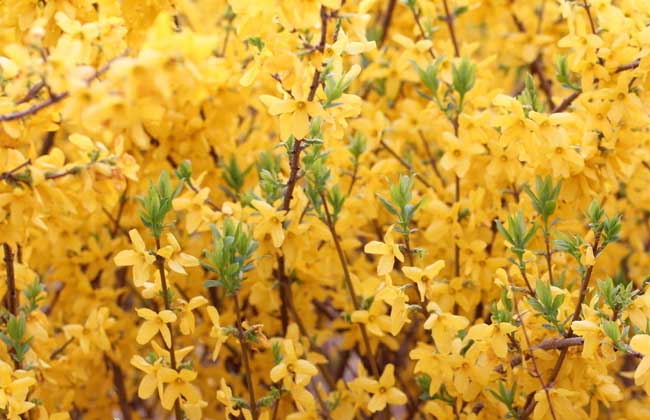
Forsythia, also known as golden bell, lianqiao, green qiao, dropping qiao, and yellow wonder herb, is a deciduous shrub of the genus Forsythia in the family Oleaceae. Its fruit can be used as medicine, and it can be propagated by seeds, cuttings, layering, division, and other methods. In production, seed and cutting propagation are the main methods. Let's take a look at the propagation methods for forsythia below!
Division Propagation
After "Frost's Descent" or before budding in spring, dig out the young shoots growing beside trees that are more than 3 years old together with soil and transplant them, or dig out the entire tree for division and transplanting. Generally, one plant can be divided into 3-5 plants for transplanting. The key to this method is to ensure that each small divided plant has some fibrous roots, so the survival rate is high and results are quick.
Layering Propagation
Layering propagation involves burying the plant's drooping branches into the soil in spring, then cutting them from the mother plant and planting them in the following spring.
Cutting Propagation
1. Cutting time: Cuttings can be taken after leaf fall in autumn or before budding in spring, but spring is preferable. In the south, cuttings are mostly taken in open fields in early spring, while in the north, cuttings are mostly taken in summer.
2. Cutting treatment: Select robust young branches 1-2 years old, cut them into cuttings 20-30 cm long. The cut at the upper end should be 0.8 cm from the first node, and each cutting must have 2-3 nodes. Then cut the lower end near a node into a flat surface. To improve the survival rate of cuttings, bundle the cuttings into groups of 30-50 and soak the base of the cuttings (1-2 cm) in 500 ppm ABT rooting powder or 500-1000 ppm indolebutyric acid solution for 10 seconds, then remove and dry them before planting.
3. Cutting method: Before inserting the cuttings, rake the seedbed fine and level it, and make a high bed 1.5 m wide. At a row spacing of 20 x 10 cm, insert them diagonally into the bed to a depth of 18-20 cm in the soil, leaving the topmost node of the branch exposed above the ground, then cover with soil and press firmly. In dry weather, water frequently to keep the soil moist, but not too wet, otherwise the part of the cutting in the soil will turn black and rot. With normal management, the cutting seedling formation rate can reach as high as 90%. With strengthened field management, the seedlings can reach more than 50 cm in height after autumn, and can be planted in holes in the following spring.
Seed Propagation
1. Seed collection: Select superior mother plants. Choose superior individual trees that grow robustly, have short and thick internodes, dense and plump flowers and fruits, no pests or diseases, and pure variety as mother trees. Pay attention to observing the flowering and fruiting periods, and grasp the appropriate seed collection time. Collection must be timely to avoid the seeds falling off on their own after maturity. Generally, mature fruits are collected from mid-to-late September to early October. Collect forsythia fruits that are fully developed, with plump seeds, and large and heavy, then spread them thinly in a ventilated and cool place, and thresh after drying in the shade. After careful selection and removal of impurities, select neat, plump seeds free of pests and diseases, and store them for seed use.
2. Seed storage: Storing forsythia seeds under different conditions has an extremely great effect on their germination rate, such as storage in a desiccator being high.
3. Sowing time: Forsythia seeds germinate easily; it should be said that the seeds are suitable for germinating at relatively high temperatures. Based on seed storage and germination conditions, combined with practical experience, cultivation time can be arranged in spring or winter. Spring sowing is in mid-to-early April, and winter sowing is carried out before the soil freezes.
4. Seed treatment: The seed coat of forsythia seeds is relatively hard. Without pretreatment, direct sowing in the nursery field requires more than 1 month before germination and emergence. Therefore, germination promotion treatment can be carried out before sowing. This method can be used in newly introduced planting areas. The specific method is to select mature and plump seeds, soak them in warm water at about 30°C for about 4 hours, remove them, mix them with 3 times their volume of wet sand, place them in a wooden box or small vat, cover the top with plastic film, and place them in a leeward and sunny place. Turn them twice a day, keep them moist regularly, and after more than 10 days, the seeds will sprout and can be sown.
5. Sowing method: After sowing, seedlings can emerge in 8-9 days, about 20 days earlier than seeds that have not undergone pretreatment. If the land is dry, first water the bed, and sow when the water has seeped down and the surface soil is slightly loose. Spring sowing is around "Qingming," and winter sowing is before the soil freezes (the seeds do not need treatment and can emerge the next year). When sowing, on the prepared bed surface, open furrows 1 cm deep at a row spacing of 20-25 cm, mix the seeds with fine sand, evenly scatter them into the furrows, cover with soil, rake level, and press lightly.
6. Post-sowing management: Seedlings can emerge in 10-15 days, with a seeding rate of about 2-3 kg per mu. The soil covering must not be too thick, generally about 1 cm, and then cover with grass to maintain moisture. After the seeds emerge, remove the grass immediately. When the seedlings are 10 cm tall, thin them to a plant spacing of 10 cm. In early April of the second year, when the seedlings are about 30 cm tall, they can be transplanted to the field.
7. Direct field sowing: Open holes at a row spacing of 2 m and a plant spacing of 1.5 m, apply compost and plant ash, mix with soil, and begin sowing from late March to early April. They can also be sown in late autumn before the soil freezes. Sow more than 10 seeds per hole, cover with soil after sowing, and press lightly. Note that sowing should be done when the soil moisture is good.